
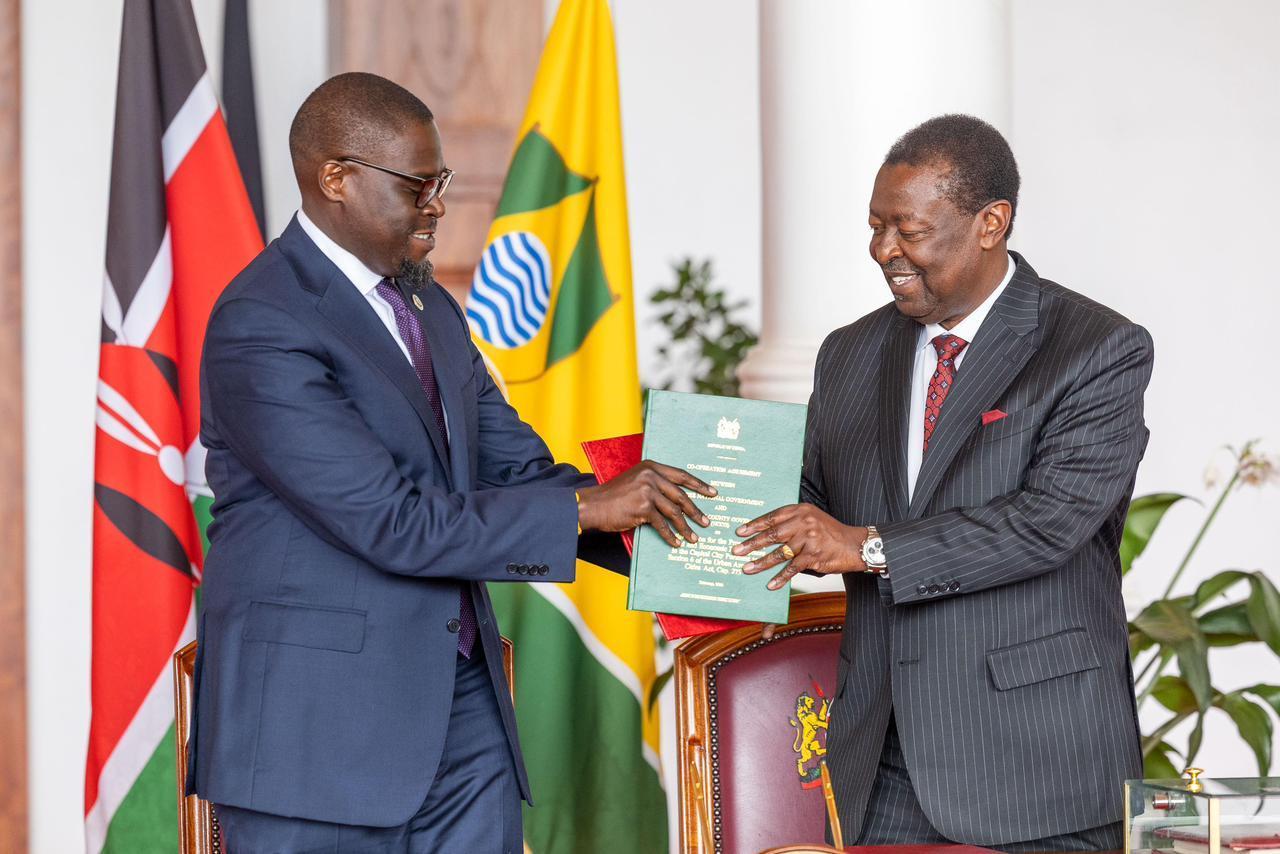
Africa-Press – Kenya. Following the cooperation agreement signed between the National Government and Nairobi City County, a clear governance framework has been established to ensure the effective implementation of development projects across the capital.
Under the new agreement, the parties have set up a two-tier governance structure comprising a Steering Committee and an Implementation Committee, designed to coordinate, supervise and deliver on the objectives of the accord.
The Steering Committee, which serves as the top oversight body, will be chaired by the Prime Cabinet Secretary Musalia Mudavadi, with Nairobi Governor Johnson Sakaja serving as Vice-Chair.
Membership includes the Attorney General, Cabinet Secretaries responsible for Interior, Treasury, Lands, Environment, Water, and Energy, as well as the County Attorney and two Nairobi County representatives nominated by the Governor.
They will, however, collaborate in undertaking their mandate.
“The Committees established under clause 5.2 shall operate in a complementary and coordinated manner to give effect to the objectives of this Agreement,” clause five of the agreement reads in part.
According to the agreement, the Steering Committee is responsible for overall oversight of all projects and programs under the pact.
It is empowered to co-opt additional members if required and will meet quarterly, with the flexibility to hold additional sessions to respond to emerging challenges.
The Principal Secretary for Devolution and the County Secretary of Nairobi will serve as joint secretaries for both committees.
Complementing this body is the Implementation Committee, tasked with the technical, operational, and administrative execution of the agreement.
Chaired by Governor Sakaja, the committee brings together Principal Secretaries responsible for national security, Treasury, Housing and Urban Development, Roads, Environment, Water and Energy, as well as the Solicitor General, representatives from the President’s office, County Executive Committee members and the County Solicitor.
The Implementation Committee is required to meet monthly or as needed and has the authority to establish project-specific or technical sub-committees to ensure the smooth delivery of projects.
Each committee will regulate its own procedures, quorum, and meeting modalities while remaining accountable to the Steering Committee.
A key feature of the agreement is its commitment to public participation.
Under clause six, both parties affirmed that all projects and programs will be subject to consultations in line with applicable laws, with the agreement itself and any subsequent amendments reflecting inputs from public engagement.
“All projects and programs undertaken under this Agreement shall be subject to public participation in accordance with applicable laws,” it states.
This ensures transparency, accountability, and inclusivity in the implementation of Nairobi’s urban development programs.
Public participation is a fundamental constitutional requirement for any public undertaking.
“Both parties acknowledge that they have not entered into this agreement in reliance wholly or partly on any statement or representation made by the other except as contained or referred to herein,” it adds.
The governance structure aligns with Article 189(2) of the Constitution, the Urban Areas and Cities Act, and the Intergovernmental Relations Act, providing a legal framework for cooperative engagement between national and county governments.
This structured approach is critical for Nairobi, whose rapid growth and strategic importance as Kenya’s capital demand coordinated planning and delivery.
By establishing clear lines of responsibility and accountability, the agreement aims to ensure that billions of shillings earmarked for urban renewal, infrastructure, water, sanitation, roads, housing, street lighting, and waste management are managed efficiently.
The agreement, signed by Prime Cabinet Secretary Musalia Mudavadi and Governor Johnson Sakaja at State House on Tuesday, establishes a structured partnership aimed at addressing the capital’s growing urban challenges and improving its efficiency as the country’s political and economic hub.
Ruto, who witnessed the signing of the deal, said the initiative recognises Nairobi’s special status as the seat of government, a regional commercial centre and host to major international institutions.
He noted that the city’s responsibilities go beyond those of an ordinary county.
“With this framework, we are strengthening collaboration between the two levels of government to ensure better service delivery and to position Nairobi as a functional, competitive and globally respected capital,” he said.
Ruto and Governor Sakaja emphasised that this governance framework is a cornerstone for transforming Nairobi into a modern, secure, and globally competitive capital.
The agreement, they say, demonstrates Kenya’s commitment to structured intergovernmental cooperation, with mechanisms in place to monitor progress, resolve challenges, and deliver tangible benefits to the city’s residents and the millions who interact with Nairobi daily.