Africa-Press – Kenya. The Law Society of Kenya 2026 elections started with a blend of early enthusiasm and significant procedural drama, as the premier bar association moved to elect its leadership for the 2026-28 biennial cycle.
While the exercise was characterised by a trickling of voters in the early morning hours starting at 6 am, a distinct shift in momentum was observed by 11 am.
At the Supreme Court polling station, the arrival of senior lawyers and prominent political figures signaled a steady flow of participants, reflecting the high stakes involved in the governance of the legal fraternity.
The ballot was comprehensive, with members casting votes for the presidency, vice presidency and council positions, including general membership and regional representatives.
Among the early voters were high-profile advocates including Nairobi Senator Edwin Sifuna, Governor Mutula Kilonzo Junior, PLP leader Martha Karua and former presidential candidate Ekuru Aukot, all of whom participated without incident.
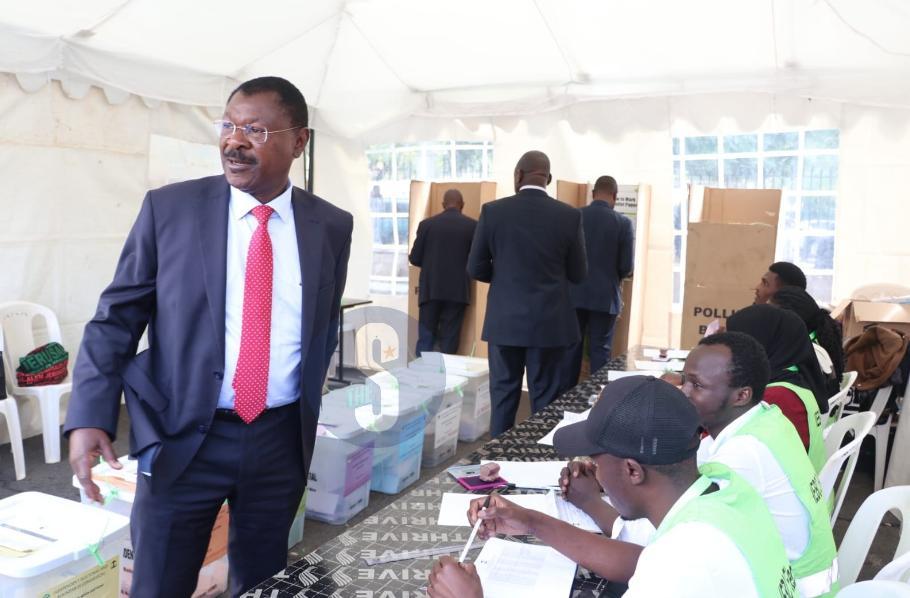
However, the same could not be said for National Assembly Speaker Moses Wetang’ula. Arriving minutes after 10am, the Speaker found himself in a peculiar predicament when he could not locate his name on the voter register.
Despite seeking assistance from officials of the Independent Electoral and Boundaries Commission, Wetang’ula was ultimately denied the opportunity to vote.
The IEBC official in charge Owiso Owiso said the Speaker’s exclusion was a matter of statutory compliance rather than an error. He said as a state officer, Wetang’ula is exempt from certain professional requirements that govern the LSK’s internal franchise.
“Wetang’ula was not on the voter register, because he did not have a PC (Practicing Certificate),” Owiso said.
“State officers do not take PCs so they can’t be on the voter roll, unless they decide to take up PCs,” he said, highlighting a technicality that separates active practitioners from those in high-ranking state roles.
Comparatively, this election appears to be following a trajectory of increased engagement. In the last LSK election held in February 2024, the turnout was recorded at approximately 47.8 per cent, with 7,521 out of 15,715 registered members casting their ballots.
The 2024 poll saw Faith Odhiambo rise to the presidency with 3,113 votes, amidst a competitive field of five candidates. The 2026 exercise is being watched closely to see if it will surpass those figures, particularly as the society navigates complex relations with the state.
While the Supreme Court remained largely peaceful, there were minor logistical frustrations. Vice presidential candidate Teresia Wavinya said some voters were turned away at the gates and told they were at the wrong entrance, leading to a loss of momentum as some individuals left without voting.
In a brief discussion on the sidelines, Aukot and Odhiambo emphasised the broader democratic implications of the day, with both advocating for a peaceful transfer of power as the most significant outcome of the process.
Despite reports of canvassing at the Milimani Law Courts station, IEBC officials remained on-site to address disputes. The general consensus among the membership was that the election remained well-organised. The focus now shifts to the tallying centres as the legal fraternity waits to see who will steer the society through its next chapter.