What You Need to Know
Financial experts at the Kenya International Investment Conference 2026 stressed the importance of integrated financing ecosystems to accelerate economic growth in Kenya. They highlighted the need for better coordination and deployment of capital to bridge the infrastructure gap and attract investment, moving away from fragmented approaches.
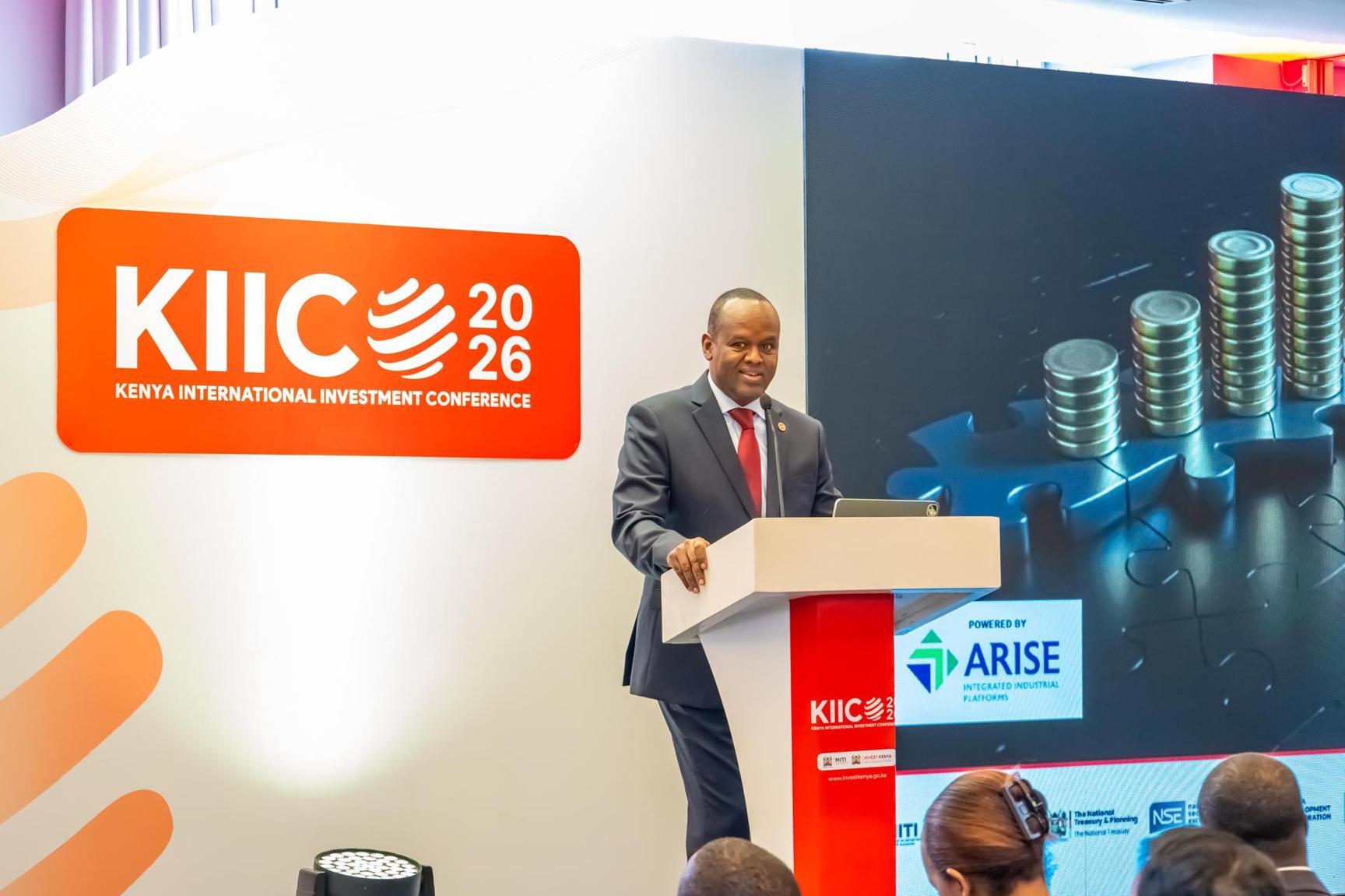
Africa-Press – Kenya. Absa Bank Kenya CEO and MD Abdi Mohamed speaking during the Kenya International Investment Conference
Kenya’s ability to accelerate economic development and attract tangible investment hinges on how effectively the country can coordinate, structure, and deploy capital.
These are views of top financial leaders and experts in the country after the just-concluded Kenya International Investment Conference (KIICO) 2026.
For instance, Absa Bank Kenya boss, Abdi Mohamed, while speaking at a side event dubbed “Financing Ecosystem”, said that the country must shift away from fragmented financing approaches and embrace more integrated, ecosystem-driven models to successfully bridge the infrastructure gap.
According to him, Kenya stands at a pivotal moment where the ambition to accelerate industrialisation, deepen inclusion, and build resilience in an increasingly complex global environment is clear.
“The question before us is not whether capital exists to support this ambition, but how effectively we can mobilise and deploy it,’’ Abdi Mohamed.
He maintained that the primary challenge is no longer the availability of funds but the mechanisms through which the public and private sectors mobilise that capital.
Reinforcing this need for a strategic pivot, the Permanent Secretary for the National Treasury, Chris Kiptoo, highlighted the fiscal urgency of these reforms, noting that the country currently spends 40 per cent of its ordinary revenue on debt service.
Kiptoo said that the government is determined to reverse this trend.
“We are implementing structural reforms across both revenue and expenditure to mobilise capital more effectively,’’ he said.
“This shift is supported by President William Ruto’s recent signing of the National Infrastructure Bill, which introduces a new framework designed to reduce reliance on public debt in favour of a sustainable, investment-led approach.”
Exports say that this shift requires a departure from traditional commercial banking in order to meet the nation’s vast development needs.
“While capital exists across government, development finance institutions, and the private sector, large-scale project funding remains constrained by inconsistent structuring and operational silos.”
The discussions highlighted a need to look more deliberately at domestic capital sources such as pension funds, institutional investors, and other long-term pools that represent sustainable opportunities for the country.
“By focusing on execution across the entire ecosystem, Kenya can move beyond intent to achieve delivery at scale.”
They agree that the path forward requires significant clarity in policy frameworks, the strengthening of project preparation, and the creation of clear risk-sharing mechanisms to attract a broader range of investors.
“When public-private partnerships are well structured, they align public priorities with private capital to ensure that projects are positioned for successful execution.”
They are of the view that if the country succeeds in these efforts, the impact will extend far beyond infrastructure to shape the overall competitiveness of the economy, deepen capital markets, and accelerate truly inclusive growth.
They have called for coordination between the government, financial institutions, and development partners to unlock the long-term capital flows essential for Kenya’s future.
The Kenya International Investment Conference (KIICO) 2026 brought together 500 global investors, policymakers, and industry leaders, collectively representing trillions of US dollars in capital.
Kenya has been striving to enhance its economic landscape, particularly through initiatives aimed at attracting foreign investment and improving infrastructure. The Kenya International Investment Conference serves as a platform for stakeholders to discuss strategies that can facilitate sustainable economic growth. Recent reforms, including the National Infrastructure Bill, aim to reduce reliance on public debt and promote investment-led development, reflecting a shift in the country’s financial strategy.