
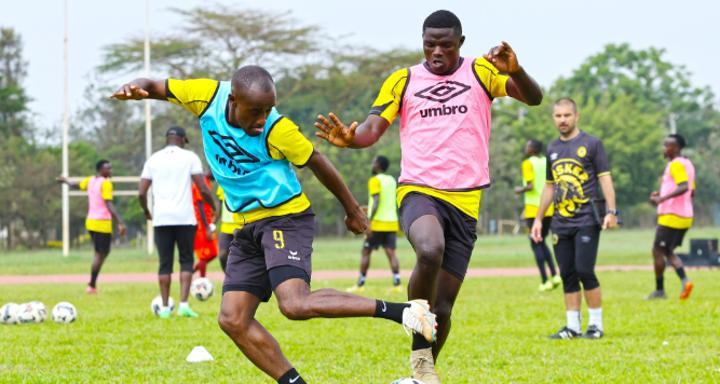
Africa-Press – Kenya. Twelve-time Kenyan champions Tusker FC are stirring once more, rising from a spell of uncertainty into a phase of renewed belief. Under new head coach Julien Mette, the brewers are grinding their way back into relevance, piecing together form with patience and intent, as seasoned striker Erick Kapaito leads a campaign defined by reinvention and quiet reconstruction at Ruaraka.
Now anchored in the top 10, Tusker are no longer chasing the fading mirage of a title charge. Instead, they are pursuing something more enduring — identity, rhythm, and redemption — a layered process Mette insists is still unfolding.
“We are building something that must last beyond emotion,” Mette said. “It is not about short bursts. It is about structure, discipline, and belief under pressure.”
Since arriving in February to replace Charles Okere, Mette has methodically reshaped Tusker’s footballing language — moving the team away from hurried directness toward composed possession, from reactive instinct to deliberate structure.
The early returns are beginning to surface, with three wins in their last four matches across all competitions offering a glimpse of a side slowly rediscovering its balance.
“We are not there yet,” Mette admitted. “But we are no longer where we were. That is important.”
If Mette is the architect sketching a new blueprint, then Kapaito has emerged as his most intricate and revealing design. Once a ruthless number nine, the former Golden Boot winner has been reimagined into a fluid hybrid — drifting between lines, knitting play together, and functioning as both creator and finisher in a more expansive attacking role.
“It is different, yes,” Kapaito said. “But football changes, and I must change with it. I am learning to enjoy it.”
The transformation has not diminished his influence; it has deepened it. With 11 goals and 6 assists in all competitions, Kapaito remains Tusker’s most decisive attacking outlet — even when operating away from the traditional striking zone.
“I am not only thinking about scoring now,” he said. “I am thinking about how the team moves, how we break lines, how we control games.”
In the 2–1 victory over Kariobangi Sharks, his movement between midfield and attack consistently unsettled defensive structures, creating corridors of space and stretching the opposition in ways that numbers alone cannot capture.
“I feel responsibility in every phase of play,” he said. “Even when I drop deep, I am still dangerous. That is my new identity.”
Yet even amid this resurgence, Mette has refused to dilute his demands, insisting that progress must translate into sustained consistency rather than isolated flashes of brilliance.
“We have won games, yes,” Mette said. “But consistency is still missing. A team is not built on moments. It is built on repetition.”
Tusker’s record — 10 wins, 4 draws, and 9 defeats, coupled with a goal difference of -3 — reflects a side still navigating its transition. While recent form suggests recovery, the margins remain fragile, and the standards, in Mette’s view, remain uncompromising.
“There is no comfort in mid-table,” he warned. “Either you grow, or you remain stuck. We are choosing growth.”
His introduction of a strict merit-based system has further sharpened the internal environment, creating competition that extends beyond matchday selection into every training session.
“No one is guaranteed a place,” Mette said. “If you train well, you play. If you do not, you wait. That is football.”
One of Tusker’s understated strengths has been their resilience away from home — six wins in nine matches before their February dip — a statistic Mette believes speaks more to mentality than tactical design.
“We are learning how to suffer away from home,” Mette said. “That is where teams are made.”
Even so, recurring defensive lapses and moments of lost concentration have continued to undermine their progress, particularly in tightly contested fixtures.
“We cannot switch off,” he said. “One moment of loss of focus changes everything.” For Kapaito, leadership has evolved into something more measured, more intentional, and less dependent on outward expression.
“I speak less now but think more,” he said. “Sometimes leadership is not shouting. It is positioning, movement, timing.”
He recognises the weight of expectation that comes with wearing Tusker colours but chooses to convert it into fuel rather than pressure. “When you play for Tusker, pressure is normal,” Kapaito said. “It is not something to fear. It is something to use.”
With the FKF Cup now emerging as a realistic avenue for silverware, Kapaito sees opportunity within the shifting priorities of the season. “In the league we are rebuilding,” he said. “But in the cup, anything is possible. We must believe in every competition.”
With the title race effectively beyond reach, Mette has reframed the campaign as one of construction rather than immediate conquest, focusing on long-term gains over short-term illusions.
“We are not fighting for the league anymore,” he said. “We are fighting for identity, for standards, for next season.” Still, he points to subtle but meaningful improvements within the squad, even as inconsistency lingers.
“I see improvement in understanding, in positioning, in mentality,” Mette said. “But we must convert that into results every week.”
Tusker’s next major examination arrives on March 19, 2026, against league leaders Gor Mahia — a fixture that will test both their tactical growth and psychological resilience.
“It is a good test,” Mette said. “The best teams show you where you are.” Kapaito, too, embraces the magnitude of the challenge.
“These are the games you want,” he said. “Against the best, you measure yourself.”