What You Need to Know
Energy Cabinet Secretary Opiyo Wandayi testified before Parliament regarding the recent fuel importation issues, asserting that no substandard fuel reached consumers. He explained the circumstances surrounding a consignment that exceeded quality parameters and the subsequent waiver granted by the Kenya Bureau of Standards. Wandayi emphasized ongoing investigations and a commitment to improving the
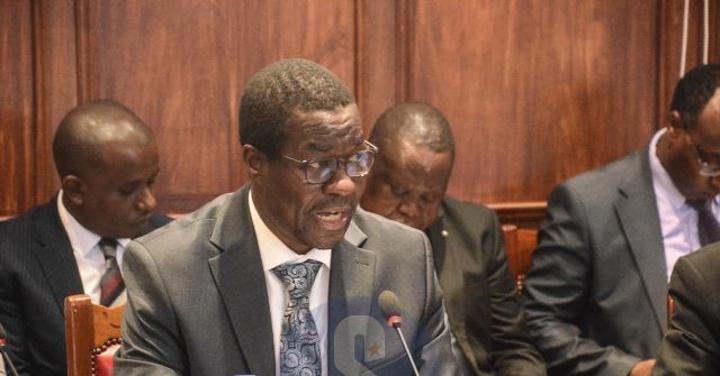
Africa-Press – Kenya. Energy Cabinet Secretary Opiyo Wandayi on Monday appeared before Members of Parliament to answer questions on the fuel importation fiasco that has dogged his ministry.
The CS broke his silence, terming the issue a contained breach rather than a collapse of the importation system framework.
In a submission to the National Assembly Energy Committee, chaired by Nakuru Town East MP David Gikaria, Wandayi acknowledged that a Premium Motor Spirit (PMS) consignment aboard MT Elka Apollon, scheduled for delivery between March 30 and April 1, 2026, was allowed into the country despite quality concerns.
The quality parameters—including oxygenates, manganese, sulphur and benzene—exceeded the limits set under KS EAS 158:2025 and were reportedly waived.
Wandayi confirmed that the State Department for Petroleum sought a waiver from the Kenya Bureau of Standards (KEBS) for the parameters through letters dated March 26 and March 27, 2026. The waiver was subsequently granted by the Ministry of Trade and Industrialisation on March 28, 2026.
“Concerning the consignment in question, certain parameters were off the specifications; therefore, a waiver was sought from KBS by the State Department of Petroleum on March 26 and March 27, which was duly granted by the Ministry of Trade on March 28. No test results were altered,” Wandayi told MPs.
He attached the waiver letter as evidence, alongside load port reports and internal scrutiny documents from the Kenya Pipeline Company (KPC).
Facing sharp questions on why imports were allowed outside the Government-to-Government (G-to-G) arrangement, Wandayi said no imports are permitted outside the Petroleum Act, 2019, and the Petroleum (Importation) Regulations, 2023 (Legal Notice No. 3 of 2023).
The legal instruments explicitly provide for two channels: the G-to-G arrangement or the Open Tendering System (OTS).
“There is no existing parallel importation framework other than as prescribed by law,” he said.
The CS also revealed that the Vessel Alignment Committee (VAC) noted on March 18, 2026, that a scheduled vessel had loaded in Jebel Ali but could not sail through the Strait of Hormuz, raising concerns about a potential supply gap.
It emerged that a multi-agency technical brief recommending contingency cargo was presented to the Principal Secretary, State Department for Petroleum, for approval.
When pressed on where exactly the supply chain failed, Wandayi directed MPs to KPC’s internal procedures, stating that the pipeline company received the load port report on March 27 and scrutinised it for compliance.
He added that KPC prepared a report on the same.
“The State Department then sought a waiver based on that report,” he explained.
MPs were told that KPC conducted due diligence through a review of the load port report, pre-discharge testing, and post-discharge testing by the KPC laboratory.
Nevertheless, the CS conceded that quality assurance processes were tested to their limits.
“The Ministry and its agencies are continually reviewing their processes to optimise them and ensure compliance with the law.”
The CS declined to name culpable officials, indicating that the matter is under active investigation by the Directorate of Criminal Investigations (DCI).
“The matter is under investigation by the Director of Criminal Investigations (DCI),” was Wandayi’s response to the David Gikaria-led committee.
However, he allayed fears that the fuel was in circulation.
“The importer has been directed to withdraw all invoices and issue credit notes to Oil Marketing Companies (OMCs), which have been instructed not to take the consignment,” he said.
“The substandard fuel is to be removed from Kenya entirely, with the importer confirming compliance,” he added.
The CS explained that the consignment will not be included in any petroleum pump price computations.
“No substandard fuel reached consumers,” Wandayi asserted.
Looking ahead, the CS told MPs that a comprehensive internal review of petroleum products management systems has been initiated.
The review aims to reinforce transparency and eliminate discretion in quality certification.
He reaffirmed the Ministry’s commitment to “maintaining the integrity, stability, transparency, and accountability of the petroleum supply chain under the G-to-G framework.”
Wandayi had earlier told the MPs that an alternate supply had been sought after the Vessel Management Committee held a meeting on March 18 and noted that a Premium Motor Spirit (PMS)/super petrol vessel scheduled to deliver between March 30 and April 1 had loaded in Jebel Ali port in Dubai. However, it could not sail through the Strait of Hormuz due to the ongoing Iran war, and thus the committee noted the PMS stock was low, with the next vessel expected to deliver between April 3 to April 5.
“A brief on supply position was prepared by a multi-agency technical team that recommended consideration for contingency cargo to shore up the stocks. The brief was presented to the PS, State Department of Energy, for consideration and approval,” the CS said.
Tomorrow, the committee will hear from the chairperson of the Energy and Petroleum Regulatory Authority (EPRA), Acting MD of Kenya Pipeline, Executive Director of One Petroleum Ltd and Managing Director of Oryx Ltd as the Committee probe continues.
The fuel importation framework in Kenya has faced scrutiny due to quality control issues, particularly concerning the standards set by the Kenya Bureau of Standards. The Petroleum Act and related regulations govern the importation process, aiming to ensure compliance and safety in fuel supply. Recent events have highlighted the challenges within this system, prompting calls for greater transparency and accountability in the management of petroleum products. The ongoing investigation by the Directorate of Criminal Investigations underscores the seriousness of these concerns and the need for reform in the sector.