
What You Need to Know
Interior Cabinet Secretary Kipchumba Murkomen has identified irresponsible leaders as the primary threat to national security in Kenya. He emphasized that the issue is not merely a policing problem but a broader leadership and societal challenge. Murkomen called for a change in approach to tackle insecurity, highlighting the need for political tolerance and community harmony.
Africa-Press – Kenya. Interior Cabinet Secretary Kipchumba Murkomen has blamed irresponsible leaders for insecurity incidents scarring parts of the country, saying the situation is not a policing issue but a leadership and societal problem.
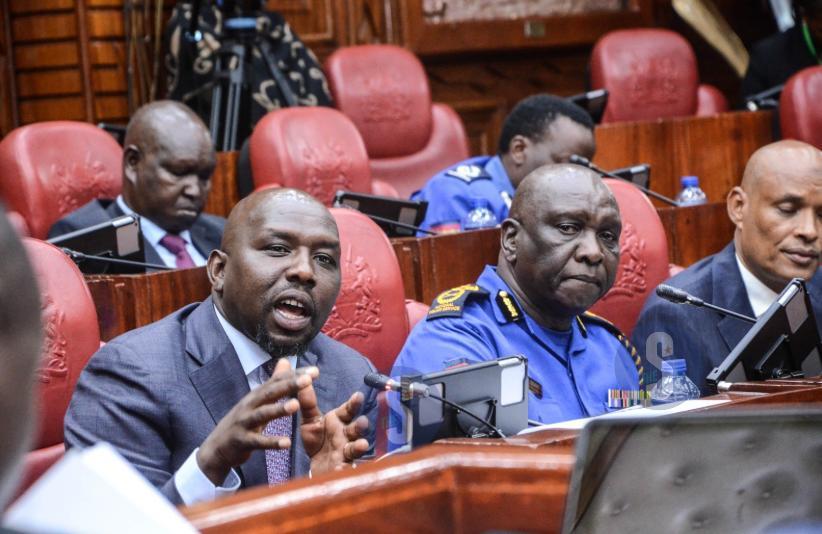
Appearing before the National Assembly Departmental Committee on Administration and Internal Security at County Hall, Nairobi, Murkomen blamed irresponsible leaders for inflaming tensions in their elective areas for political expediency.
“I have said, and I want to repeat, that irresponsible leaders are the greatest threat to national security. Everybody is crying about guns. There was a time they were monopolised by a few leaders; now they are owned by more leaders, and they are fighting with more leaders, so the whole place is chaotic,” he said.
Murkomen said he had seized the moment to address the issue before the very leaders he said bore the greatest responsibility for the prevailing state of lawlessness in some regions.
Murkomen called for a paradigm shift in how the country tackles insecurity, saying that whereas the government deploys security agencies across the country to keep the peace, “no amount of guns, bullets, and teargas can resolve this problem.”
The CS said officers deployed to counties mostly focus on administrative work and general duties, leaving little room for them to concentrate on the resource-intensive task of countering criminal elements.
“So, the first point of call when it comes to the safety of the people is a society that has a consensus about living together in harmony — a dignified political discourse that focuses on issues,” he said.
Murkomen said his home county, Elgeyo Marakwet, is a role model, noting that incidents of goonism — an emerging security threat of national concern in other regions — are virtually absent.
He attributed the county’s commendable track record to a high level of political tolerance among elected and aspiring leaders who compete on the basis of issues, rather than flexing political muscles through violence.
“It’s the only county where you can give a lift to your opponent. You are going to a baraza, and you can even ask your opponent for Sh5,000 for harambee because they are in office. People laugh after the campaigns and they go home.”
In other counties, he said, political opponents cannot even attend the same church service.
“You go to some church services and the sermon cannot even be preached. Some characters who are drunk back there are shouting, ‘two-term this one, one-term the other one.'”
Murkomen said the government was scaling up security operations to combat political gangs through short- and long-term interventions.
In recent weeks, he said, security agencies have arrested hundreds of individuals linked to criminal gangs and recovered crude weapons and communication devices, underscoring the growing sophistication of the crime.
Enforcement alone, however, is not sufficient without complementary social, economic, and governance interventions. We are, therefore, strengthening the legal and policy framework governing organised crime, including provisions that enhance penalties and facilitate the seizure of assets derived from criminal activities,” he said.
“We are also prioritising economic empowerment initiatives to create opportunities for young people, thereby reducing the incentives for joining gangs. As the election period approaches, I urge all political leaders to compete on ideas and agenda, and desist from using gangs in their campaigns,” he added.
Murkomen was accompanied by Inspector General of Police Douglas Kanja, Director of the DCI Mohamed Amin, and other senior ministry officials.
The top security chiefs had been summoned to respond to questions on why the country was increasingly witnessing deteriorating security, including rising political violence and banditry.
Kenya has faced various security challenges, particularly related to political violence and banditry, often exacerbated by irresponsible leadership. The government has historically struggled to maintain law and order, especially during election periods when tensions rise. Recent calls for a shift in strategy emphasize the importance of community engagement and political discourse in fostering a safer environment. Murkomen’s remarks reflect a growing recognition of the need for leaders to prioritize societal well-being over political gain.