
Africa-Press – Kenya. The eleventh edition of Mara day will be commemorated on Thursday even as the threats facing the basin intensify.
Government officials from Kenya and Tanzania are expected to attend the commemoration at Enapuyapui swamp in the Mau Complex, Nakuru County.
Unlike in the past when Mara Day has majorly focused on awareness creation, this year’s commemoration seeks to explore the public-private sector partnership for the management of the River Mara basin.
Besides being the backbone of the Mara-Serengeti tourism spectacle, the River Mara currently sustains the livelihoods of over 1.1 million people while contributing between 10-15 per cent of the Gross Domestic Product of Kenya and Tanzania.
The basin is, however, under threat from numerous human activities, including unsustainable agriculture, tree-felling, abstraction of water, pollution and encroachment by human settlements, among others.
World Wide Fund for Nature Kenya senior sub-land scape coordinator for greater Mara Kevin Gichangi said the threats to the ecosystem still intensify.
“There is pollution from nearby towns such as Bomet and Mulot. The other challenge is over-abstraction which is worst in February and March,” he said.
Gichangi said there is a need for closer collaboration between the water users association of both Tanzania and Kenya over the sustainable use of the basin.
He warned that without sustainable use of the basin, Maasai Mara and Serengeti ecosystems will collapse.
Gichangi said the two ecosystems almost collapsed in 2009 and 2017 due to the threats facing the Mara basin.
Mara has in the recent past been threatened by drought as water levels in the Mara River and its tributaries are dropping.
The impacts of the threats have been felt far and wide.
In the Maasai Mara, for instance, business opportunities have dwindled due to the declining number of tourists visiting the gem.
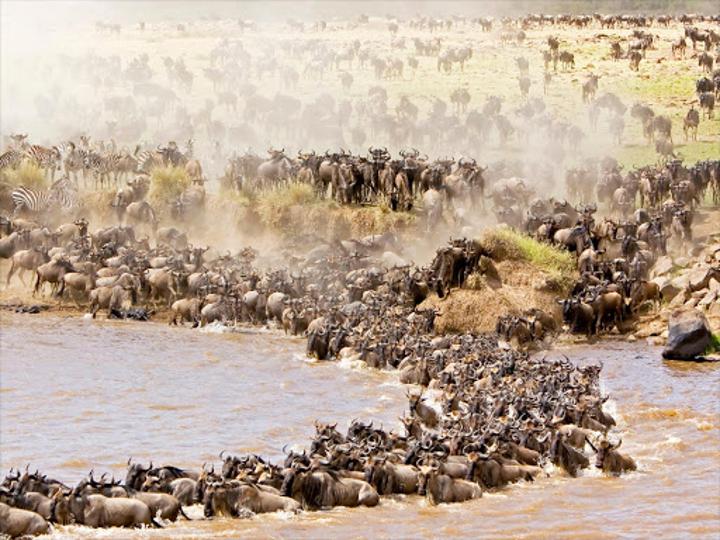
Studies have shown that the number of wildebeest migrating from Tanzania to Maasai Mara and back has reduced due to the threats.
Around July or August every year, tourists throng the Maasai Mara Game Reserve in Narok county in their numbers to witness the great wildebeest migration.
More than 1.5 million wildebeests make a daring, perilous journey from Serengeti in Tanzania across the Mara River into the Masai Mara National Reserve in Kenya.
On the trip, they are joined by thousands of zebras, elands, and gazelles.
Predators among them lions and crocodiles wait on the wings to make a kill.
The wildebeest migration is deemed the biggest animal show on earth.
In 2006, the phenomenon was named the 7th Wonder of the New World in a poll of experts conducted by ABC Television’s Good Morning America.
The feat is also one of Unesco’s Wonders of the World.
But from roughly 1.3 million wildebeests crossing annually from the Serengeti Park in Tanzania to the Maasai Mara in the 1970s, that number dropped to 157,000 in 2016.
This is according to Joseph Ogutu, a senior statistician at the University of Hohenheim, Germany, who analysed trends in East Africa’s five remaining migratory wildebeest populations in 2019.
Ogutu and his colleagues used aerial survey monitoring data collected over almost 60 years (from 1957 to 2016) in Kenya and Tanzania.
“We found that four migrations have virtually collapsed,” Ogutu says.
The remaining Serengeti-Maasai Mara route is now under threat and fewer animals are crossing yearly.
The dispersal areas and migratory corridors of key wildlife species are being lost due to high human population densities, increasing urbanisation, and expanding agriculture and fences.
The Mara Day commemoration that began in 2012 is an annual activity aimed at raising awareness about River Mara, a transboundary resource of immense socio-economic and biodiversity significance for both Kenya and Tanzania.
This year’s event will however be themed, ‘Towards a Sustainable Mara River Ecosystem’, acknowledging the work of various parties to protect the threatened system.
The 11th Mara day celebrations edition is aimed at shifting from awareness to ownership by the private sector and civil society actors and creating a need for a forum of state and non-state actors to drive forward the Mara ecosystem management.
River Mara has its main source at Enapuyapui swamp in the Mau Complex around Molo in Nakuru County close to where the event will take place.
Conservation experts believe that having both the public and private sectors will provide the requisite financial and policy interventions that will be critical in securing and conserving the basin for generations to come.
The Mara Day celebrations that rotate between Kenya and Tanzania seek to find long-lasting solutions to some of these threats.
The previous six editions were held in Narok and Bomet counties.
The event will aim to put into operation Article 7(a) of the EAC Treaty focusing on promoting people-centred EAC regional integration.
Some of the organizations supporting the sustainable management of the basin include the World Wide Fund for Nature-Kenya (WWF-Kenya), a locally registered non-governmental conservation organization; an affiliate of WWF International.
WWF has been working in Kenya since 1962 alongside the government, civil society, private sector organizations and local communities to contribute toward providing an enabling environment for the achievement of sustainable natural resource management.
Others supporting the management of the basin include USAID, UNEP and Maasai Mara Wildlife Conservancies.
For More News And Analysis About Kenya Follow Africa-Press