
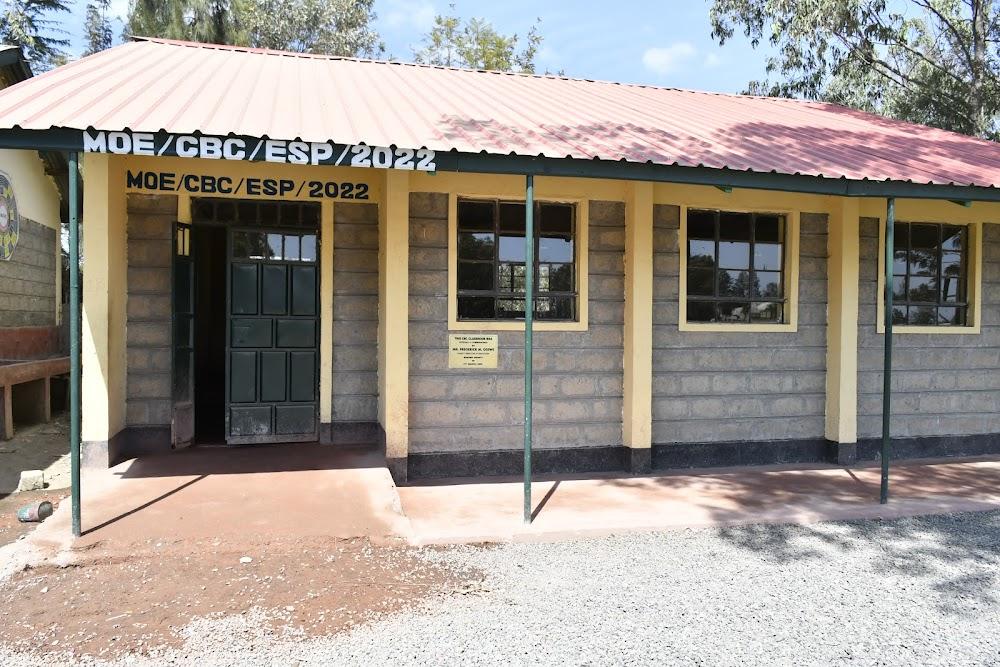
Africa-Press – Kenya. Achieving a 100 per cent transition from primary schools to secondary schools proved to be a headache following the limited facilities. Even as Grade 6 learners are retained in primary school, there’s no clear infrastructure policy for the school children.
The government has only promised to construct an extra classroom and laboratory for each of the 24,000 schools. But how sustainable is this, in an environment where one stream requires around 40-45 students?
According to the teachers, if the government constructs one classroom for each school with a population of almost 500 learners, then it means a school will still require more classes.
This year, public secondary schools also grappled with the infrastructure challenge. Several school heads disclosed to the Star they have used her alternative methods to cope with congestion.
A principal in Bomet county said the school admitted almost 560 students, so the school is building an extra dormitory for 300 students. “With our board of management, we came up with a temporary dormitory. We used iron sheets outside and timber inside. It accommodates more than 200 students,” he said.
The routine was changed with classes beginning at 7.30 am and not 8 am so that students can learn in shifts. “The dining hall was meant for 400 students but the school has 1,600 students,” he added.
The teacher is afraid, however, the congestion is risky and could be dangerous in case of a stampede. Another school in Nairobi county is struggling with a population of 1,700 students after enrolling 600 Form 1 students.
Students sleep in classrooms at night and use the same rooms for studies during the day. “In this school, we use a cafeteria in the dining room. They are served in three shifts and then go outside to eat because there is no space,” a teacher told the Star.
A girls’ school in Vihiga county admitted almost 450 Form 1 students, up from almost 335 last year. The school had to build an extra dormitory to accommodate the extra number of pupils.
The school also had to increase the number of streams from six to eight, in Form 1. Elsewhere, a school with 10 streams had to put up two more classrooms and a 200-bed dormitory for Form One students, enrolling almost 700 learners.
Dagoretti High School, for instance, has 10 streams for Form One students. “If we have to accommodate them, we will use our hall, we have two halls. One has a basement, ground floor and first floor,” principal Lawrence Nyakweba said.
But in case junior secondary learners decide to become paying boarders, Nyakweba has a temporary solution. The school’s board of management has employed 28 Board of Management teachers to deal with the teacher shortage.
The move has proved costly. “We have to remunerate them from the boarding section. We spend almost Sh600,000 per month from boarding, it’s a big challenge,” he said.
For More News And Analysis About Kenya Follow Africa-Press