By
Tridivesh Singh Maini
Africa-Press – Lesotho. Several important agreements were signed during the India visit of Russian President Vladimir Putin (December 4-5, 2025). Apart from the bilateral dimension of the visit — where several agreements were signed — both sides sought to strengthen their partnership under the umbrella of the UN and other multilateral platforms including G20, Shanghai Cooperation Organisation (SCO) and BRICS. Putin and Indian Prime Minister, Narendra Modi held talks on a wide range of issues during the 23rd India-Russia Annual Summit held at New Delhi.
A joint statement issued after the summit, while referring to BRICS+, stated that both sides:
“.. further committed themselves to promote cooperation in the expanded BRICS under the three pillars of political and security, economic and financial, cultural, and people-to-people cooperation. They reaffirmed their commitment to the BRICS spirit of mutual respect and understanding, sovereign equality, solidarity, democracy, openness, inclusiveness, collaboration, and consensus. Russia pledged its full support for India’s upcoming BRICS Chairmanship in 2026.”
BRICS Common currency and trade in local currencies
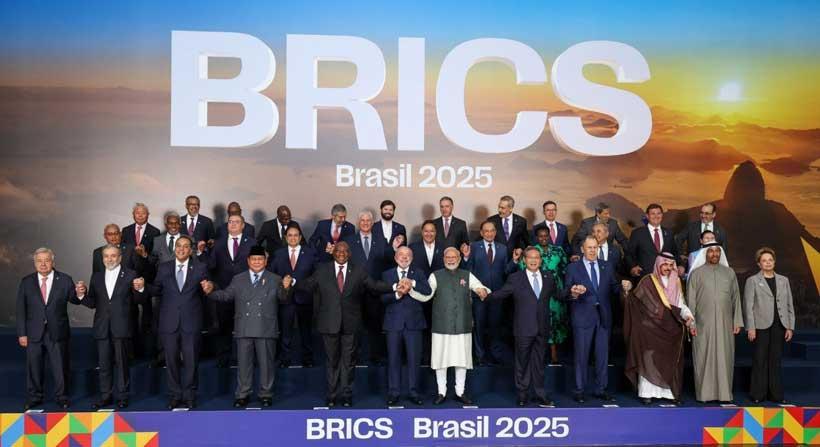
One of the aspects that was discussed during Putin’s visit was the issue of a common BRICS currency and trade in local currencies between BRICS members. Intra-BRICS trade has grown in recent years with the entry of new members—Saudi Arabia, UAE, Egypt, Ethiopia, and Iran in 2024 and Indonesia in 2025. If one were to look at intra-BRICS trade in local currencies, this too has witnessed a significant rise. 90% of bilateral trade between Russia and China is in local currencies, while a significant percentage of trade between India and Russia—estimated at well over 90%—is in local currencies. BRICS member states have been pushing a common payment platform for giving a push to trade. This issue was high on the agenda at the 2024 BRICS Summit held at Kazan, Russia, as well as the 2025 BRICS Summit held at Rio de Janeiro (Brazil). While speaking at the 2024 BRICS Summit, Putin had said:
“The dollar is being used as a weapon. We really see that this is so. I think that this is a big mistake by those who do this.”
While trade in local currencies is essential to circumvent sanctions and several countries are seeking to diversify economic relations, the idea of a common currency has been rejected by most BRICS members, including Russia. During his India visit, Putin while highlighting the need for increasing bilateral trade — including in local currencies — said that the organisation needed to be cautious as far as the idea of a common BRICS currency was concerned. In a media interview the Russian President said:
“There is no need for haste. And if there is no hurry, then you will avoid many grave mistakes.”
He underscored the need to learn lessons from the Eurozone, saying that countries cannot be forced to follow a “common system” if structures are not aligned.
India which will be chairing the BRICS Presidency, in 2026, has taken a nuanced position. While pushing for trade in local currencies and pitching for other BRICS countries to adopt the Unified Payment Interface (UPI), it has categorically distanced itself on more than one occasion from the idea of a common BRICS currency. Apart from the economic factors for the same, there is a clear geopolitical reason – India is sceptical about sharing a currency with China.
BRICS, De-dollarisation, sanctions and the US Dollar
It is important to understand that a changing geopolitical situation, especially economic sanctions, has propelled several countries to trade in local currencies, but this does not mean that all of them are doing it with the objective of undermining the US dollar. Those who believe that the US Dollar will be threatened by trade in local currencies – including the US President Donald Trump – need to adopt a more nuanced approach vis-à-vis the growing trade in local currencies between developing countries – especially members of BRICS. Recently, American investor and the author of ‘Rich Dad Poor Dad’ Robert Kiyosaki while commenting on the announcement of a Gold currency by BRICS in a post on X highlighted the need for investors to move away from the US Dollar and explore alternatives such as cryptocurrencies and precious metals. In his post, he wrote, “…Bye Bye US Dollar…”
In conclusion, the idea of a BRICS common currency is unfeasible, while trade in non-dollar currencies is likely to grow due to sanctions imposed upon Russia. Countries are looking to reduce their dependence upon the US Dollar, but this phenomenon is extremely complex and cannot be viewed from simplistic binaries as has been mentioned earlier.
moderndiplomacy