
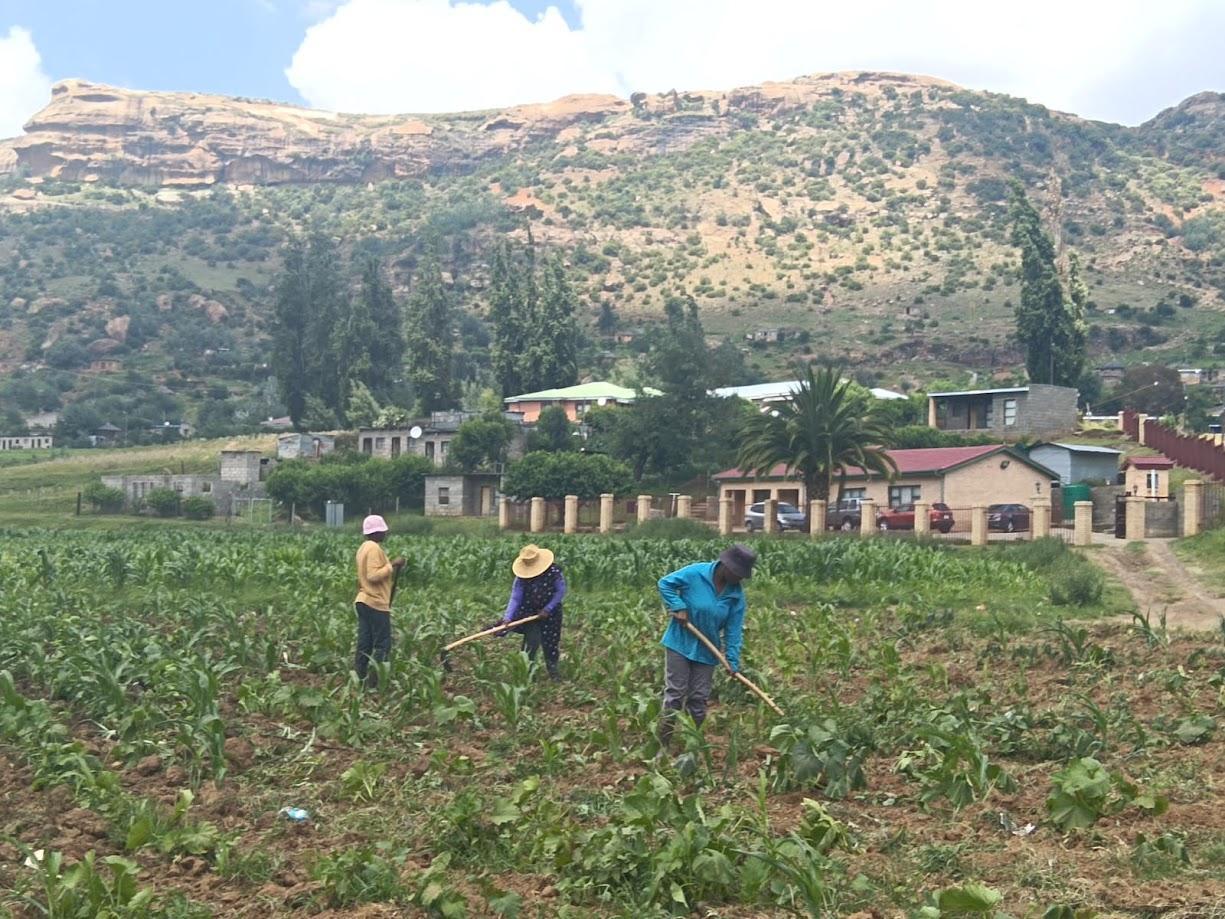
Maseru, Jan. 28 — In the past, villagers used to come together and work on one field during the field weeding season until all the fields belonging to the villagers were done.
The practice is called ‘Letsema’ in Sesotho and it was done without pay. All that the owner had to do was to provide food.
With the evolution in customs and the impact of the ailing economy, the practice no longer exists among several communities. In order to have your field weeded, one has to do it themselves with assistance from family members or ask for help from other community members for a fee.
Regularisation of payment of labourers for weeding can come a long way towards promotion of decent work and economic growth for all as well as poverty reduction in line with Sustainable Development Goal (SDG) 8 which calls for promotion of decent work as well as inclusive and sustained economic growth, full and productive employment and decent work for all.
This is also in line with SDG 1 and SDG 2 which call for an end to poverty and hunger respectively.
These are the views raised by some men and women employed on a part time basis for weed control in the fields where they are paid daily in most cases.
While payment in several sectors including domestic and construction, to mention a few, are regulated and there is a scale on how much a worker must get each day or per hour, this is not the same with weeding. Workers get paid M50.00 or M60.00 per day based on the discretion of the employer and working hours are from 5 a.m to 11 a.m.
This pay is not enough for the workers, especially women as they bear the daily burden of ensuring that there is food at home and the needs of children are met. The current economic situation in which a loaf of bread costs more than it used to, two years ago, coupled with the prevailing weather conditions which are characterised by extreme heat, heavy rains and severe thunderstorms, make those who rely on pay from this job for a living suffer the most.
The cost of living has drastically risen and statistics show that in 2023, the price of a loaf of bread was M13.00 and currently it is M16.00. A litre of domestic paraffin now costs M13.10 and these are some of the basics for a typical low-class household.
At times, the hopes of the workers to have bread on the table at the end of the day are shattered by rainfall.
They do not get paid because they did not work per agreed hours with the employer. At times the pay is delayed and they only get it after some days when it has accumulated, while daily needs are waiting to be met. This may result in some buying food on credit or borrowing money from others which in some cases goes with interest, just to feed their families.
Speaking in an interview with the Lesotho News Agency (LENA), Ms.’Manyeoe Semoisi of Ha Kholoko, Roma stated that earning M50.00 per day on a 5 a.m to 10 a.m shift is not sufficient. She suggested that workers should at least get paid M100.00 per day.
She indicated that she has to work for at least three to four days so that she can buy a 12.5 kilograms of maize meal together with other few basic needs that will last for several days, instead of using the daily pay as it only gets her few kilograms of maize meal as 1kg of maize meal costs between M10 and M13.00 in the rural areas.
Ms. Semoisi stated that regularisation of the pay could help improve the lives for those who are unable to get permanent jobs, although it will be for a short period as weeding is seasonal.
She said with regularisation of the payment, employers will be forced to comply, adding that the pay will be standard countrywide. He further added that workers will be fully informed of the payment they deserve and will be able to demand their right and pay they are entitled to.
She pointed out that this type of work is most helpful for women as they take care of their families. She said in most cases, men direct their money towards personal use without considering the needs of their family members including children.
Another worker Mr. Letsema Seitlheko told the Agency that when he first started the work, an agreement between the owner of the field and the workers was that pay will come weekly.
He pointed out that when the time to pay the workers comes, the employer at times tells them that he will not be able to pay them because he does not have enough money and has to pay other workers who were on a shift prior to theirs.
“It is unfair for the owner of the field to pay us when it is convenient for him. We work with women here and they have to face hungry children each day. We experience unnecessary stress and incur costs as we have plans for that money which we have earned,” he lamented.
He pointed out that if the payment is regulated, they will be able to approach the authorities when their rights are being violated in terms of the payment.
Also speaking in an interview, Mr. Lerato Rabolinyane whose wife works in one of the fields in their village, stated that while his wife goes for the piece job, he takes care of their livestock.
He pointed out that the livestock helps them make a living as they get cow milk, which they use at home and sell to other community members. He added that they also earn money by selling wool after sheep shearing. He emphasised that the money his wife earns from the weeding job is equally important as it is used for daily needs of the family.
He indicated that as both parents have the responsibility to provide for their children, it is more efficient for his wife to take the piece job as it takes few of her morning hours.
“When she comes back from the fields, she is able to do house chores and prepare for the children when they come back from school and me when I get home from the veld,” he said.
In another interview, Mrs. ‘Mamonyooe Polane who owns a field at Kolonyama stated that regularisation of pay for weed control workers will not be helpful. She pointed out that the Department of Labour often set low payments.
“It is true that we do not know what they base themselves on when they set the payments. We are often told about the economy. It would be best if field owners exercise their discretion when paying the workers”.
She pointed out that her workers get M50.00 daily for a shift starting at 6:00 a.m and coming to an end at 10:00 a.m with an hour’s break. She added that the workers sometimes work until 9:00 a.m without a break, then knock off, especially during the extremely hot days.
She pointed out that when it is rainy, work has to stop, adding that during hot and sunny days, workers are expected to wear protective clothing.
She said while the economy is weighing heavy on everyone, at least an increase of the pay to M80.00 would be meaningful adding that it will make an impact for the workers.
She said workers need supervision for consistency. She pointed out that they sometimes delay work to ensure that they work more days to increase their earnings.
Mrs. Polane pointed out that the majority of workers in weed control are often women, adding that out of seven workers, only two will be men. She pointed out that men in the rural areas do not take seriously the fact that men are providers. She said they leave the responsibility to women.
When asked if there is a possibility that payment of weeding labours can be regularised Labour Commissioner from the Ministry of Labour and Employment, Mrs. ‘Mamohale Matsoso stated that they are currently reviewing and strengthening the inspectorate with the aim to ensure that the agricultural sector is also covered as it currently deals with the private sector.
The statement from the Labour Commissioner provides hope for the workers that their plea might be heard.
According to Legal Notice No. 27 of 2024 issued by the Government of Lesotho for the financial year 2025/2026, a factory worker has to be paid M2,724-M3,041, construction worker M3,226- M5,664 while a domestic worker has to be paid M872.00
“Regularisation of payment for workers is a fundamental aspect of wage protection aimed at ensuring workers receive their remuneration on time, in full and in legal tender.
Non-payment or delayed payment of wages is identified as a major issue that can lead to debt bondage, poverty and forced labour,” says the International Labour Organisation (ILO).
The organisation describes work as part of everyone’s daily life, adding that it is crucial to a person’s dignity, well-being and development as human beings.
The ILO has developed international labour standards intended to ensure that all individuals have access to decent and productive work in conditions of freedom, equity, security and dignity.
According to Protection of Wages Convention, 1949 (NO.95), ‘wages must be paid regularly and in legal tender’ while Protection of Wages Recommendation, 1949 (No.85) states that ‘wages should be paid at intervals no less often than once a month (or fortnightly) for manual workers’.
The ILO recommends frequency, direct payment, transparency, final settlement and no coercion as key principles for regularised payment. They encourage governments, as they bear the responsibility to ensure regular payment, to ascertain effective labour inspections, sanctions, compensation and collective bargaining.
Ends/SM/tl