
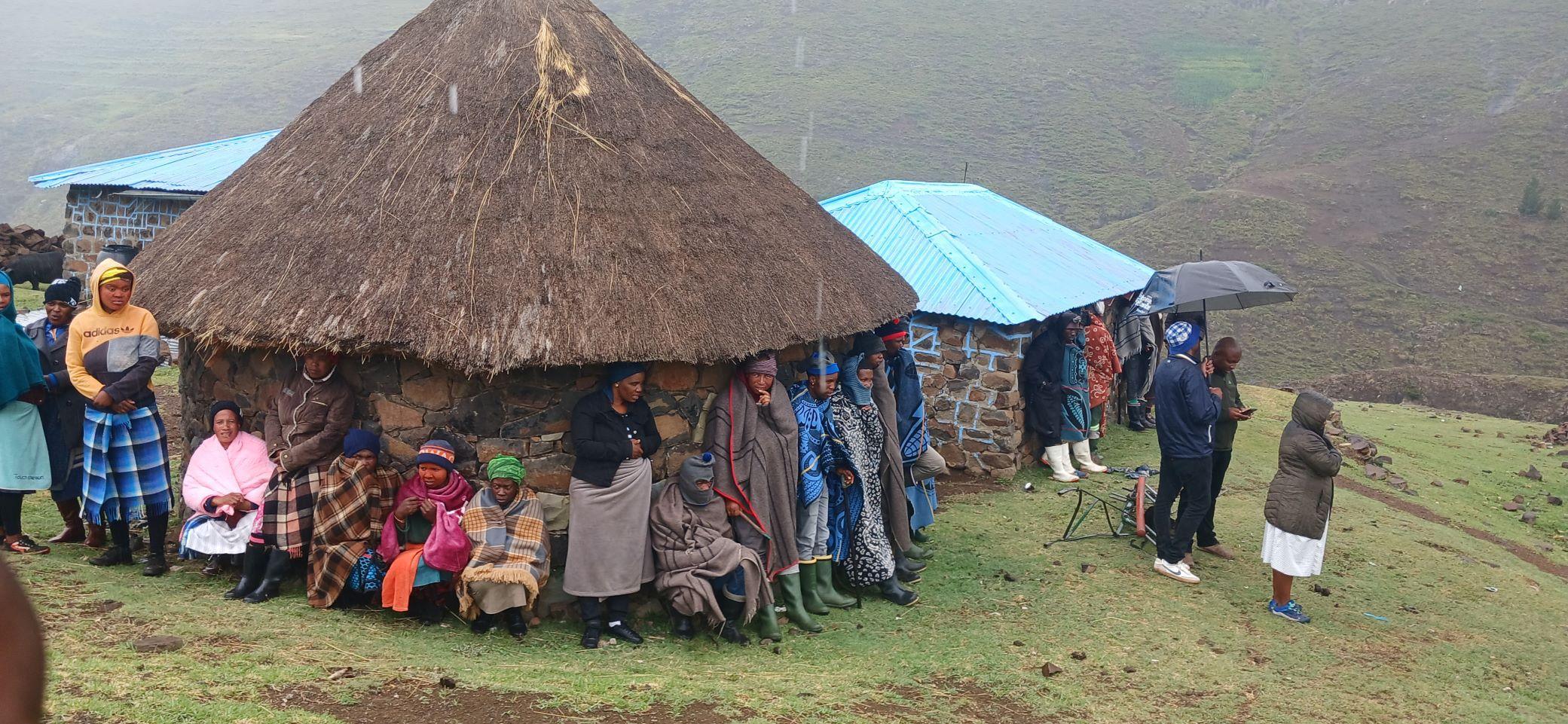
Qacha’snek – Despite persistent heavy rains, members of the Qacha’sNek Census Committee on Tuesday visited Ha Rasekoele and surrounding villages to sensitise communities about the upcoming Population and Housing Census scheduled for April 2026.
Addressing villagers, District Bureau of Statistics (BoS) Statistician, Mr. Sekila Folojeng, said the main objective of the census is to collect comprehensive, accurate and up-to-date information on the demographic and socio-economic status of the people of Lesotho.
He explained that the census goes beyond merely counting people.
“This information serves as the foundation for evidence-based decision-making across all sectors and levels of government. It supports national planning, policy formulation, equitable resource allocation, development of public services and prioritisation of development initiatives,” he said.
Mr. Folojeng noted that census data provides detailed insights into population structure, including age, sex, employment, education, migration, disability, fertility and mortality. It also gathers information on living conditions such as housing quality, access to water and sanitation, electricity, household assets, agriculture and livestock ownership.
He said such data ensures that no group is left behind and enables the government to design effective strategies in health, education, housing, transport and employment.
The statistician added that census findings support both urban and rural development by revealing migration trends and patterns of urbanisation, which are essential for planning infrastructure such as roads, schools, hospitals and housing projects. The data also helps identify underserved areas to improve access to essential services.
Furthermore, he said census information serves as a foundation for household surveys, academic research and monitoring progress towards national and international development frameworks, including the National Strategic Development Plan (NSDP), the Regional Indicative Strategic Development Plan (RISDP), Agenda 2063 and the Sustainable Development Goals (SDGs).
Mr. Folojeng highlighted that census data also strengthens private sector development.
“Businesses use census data to identify market opportunities, assess labour availability, determine suitable locations for expansion and tailor services according to community needs. It is a vital tool for economic forecasting and strategic planning,” he said.
He clarified that the 2026 census will be conducted through face-to-face interviews using tablets. Enumeration will cover all households, institutions such as hotels, military barracks and boarding schools, as well as cattle posts.
“Strict confidentiality will be maintained,” he assured, adding that once completed, results will be published on the BoS website and made available through publications at the BoS library.
Mr. Folojeng said Lesotho’s history of population counts dates back to 1875, while the modern decennial census programme began in 1936. Since independence in 1966, the country has successfully conducted six national population and housing censuses in 1966, 1976, 1986, 1996, 2006 and 2016.
He noted that the exercise is conducted under the legal mandate of the Statistics Act, which assigns responsibility to the BoS.
He further announced that about 4,500 diploma-holder enumerators and 1,500 supervisors will soon be recruited nationwide to facilitate the exercise.
In an interview with the Agency, Khubetsoana Chief Molahlehi Tholoana welcomed the initiative, saying early community sensitisation helps address concerns, reduce hesitancy and enable residents to make informed decisions.
He also commended the job opportunities that will be created through the census, noting that many Basotho are currently facing economic hardships.
Thaba-Koto resident, ’Makhotsofalang Makhama, expressed her willingness to cooperate during the exercise but raised concern that the employment opportunities may appear to favour only educated individuals.
With preparations underway, the 2026 Population and Housing Census marks a significant step towards informed planning and inclusive development in Lesotho.
Ends/MM/BM