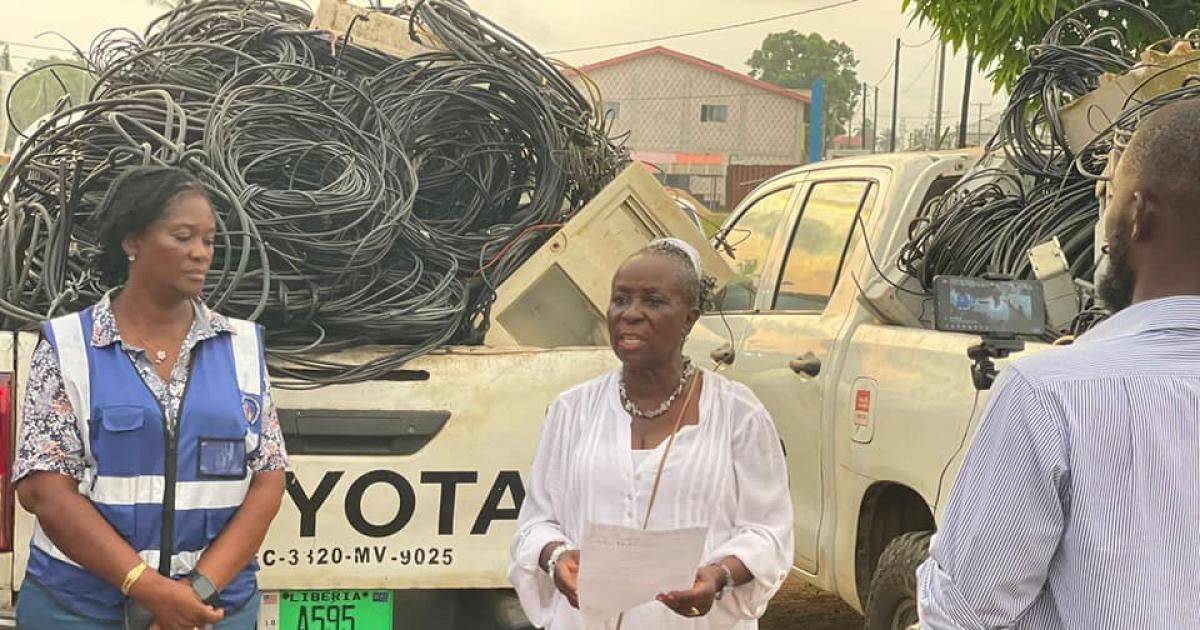
Africa-Press – Liberia. When Mary Broh was given the task to change the fortune of the struggling Liberia Electricity Corporation, she knew the challenge was both tedious and crushing.
The national grid operation has not just failed in making electricity accessible to most homes but has been increasingly losing millions to power theft – becoming a burden on genuine taxpayers who had lost all confidence.
But Broh, who is the Director General for Liberia’s General Services Agency, has always been the workhorse, cleaning the mess where others failed, had a difficult job this time around in saving the public enterprise from collapse, considering it a “complete failure” of corporate control.
“Before Broh was given the task, our fight against power theft was a complete failure of lack of corporate controls,” says a ranking official of the LEC, who asked for anonymity to discuss internal issues. “The system was compromised and the trouble compounded by faulty oversight.”
“She came and changed everything. The LEC has for years had a challenge in making a profit and reducing power theft and we never believed that we would have achieved what we have in a space of a few months. We were looking at years, but Broh showed that LEC has a bright financial future if the right policy is pursued.
Broh’s success came down to a strategy that is not pursued by many public officials in today’s Liberia. Instead of jailing people for power theft since it is a crime, she decided to waive the punishment and replace it with a fine and an opportunity to get legally connected.
What followed was an influx of people willing to pay the fine and get legally connected. And since they would not get prosecuted or jailed, they saw the fine — which was high for some depending on the individual involved — as an option to atone for their sins of power theft and move forward.
Broh’s idea, which some top brass at the LEC had initially opposed, has landed the national grid operation a whopping US$1.35 million in revenue from issuing fines and reconnections.
“We are now at US$1.35 million,” Adolphus Scott, LEC Senior Communications Manager disclosed. “That’s the good part of it — that we have gone beyond the one million benchmarks just under the anti-power theft task force.”
The issue of power theft, however, is a global problem as billions of dollars are lost every year, wherein electricity is distributed to customers but is never paid for. In 2018 alone, LEC reported that it was losing about 60% of the electricity generated annually and that monetary value then, was an annual loss of about US$ 35 million.
At the launch of the anti-power theft task force, according to LEC’s Acting Chief Executive Officer, Monie Captan, the national grid operator was losing nearly 50% of its production, or electricity, amounting to over US$48 million annually to power theft.
Captan, who is also LEC’s Board Chair, made this revelation in 2022 when announcing the setup of the taskforce, which has not failed to live up to its effort.
Liberia is trying to rebuild its power sector, destroyed during a civil war that lasted from 1989 to 2003. The Mount Coffee hydroelectric plant, destroyed during the war and subsequently rebuilt with donor aid, generates a lot of electricity, but commercial losses (theft and unpaid bills) have been a thorn in the company’s flesh while robbing the public utility of much-needed cash to expand.
The situation means that up to now less than 30% of Liberians have access to affordable electricity, one of the lowest access rates in the world.
But the Broh taskforce is helping LEC raise the money needed to expand using “salami slicing” tactics, which is the practice of using a series of small actions to achieve a much larger result that would be difficult to accomplish with a single large action.
The fulcrum of the success lies in encouraging residents who had been engaged in power theft to confess and connected to the national grid while paying a nominal fine,
The approach by Broh in dealing with power theft has turned the tide for LEC since those involved in the act were willing to settle scores legally outside of litigation.
The bargain was that individuals involved in power theft had to pay US$22 for a meter to get reconnected, purchase US$30 worth of current, and a fine of US$50. The fine was for households, but for small businesses, the amount increased to US$70 and US$500 for large enterprises.
However, if Broh had pursued LEC’s normal failed strategy of prosecution since power theft is a crime, it would have cost them thousands and an eternity in court proceedings just to have someone convicted for power theft which is a second-degree felony punishable by jail terms ranging from two years to seven years and fines ranging from US$400 to US$1,000 for individuals.
And for industrial and commercial entities and syndicates, the fine is US$10,000 or double the gain from the commission of the crime, coupled with seizure and forfeiture of assets associated with the offense if found guilty.
But the drawback here is that LEC has to expend thousands of dollars on anti-theft measures only to see theft numbers temporarily dip before climbing back up again.
The problem is, the measure relied primarily on LEC workers spending hours poring over metering data to uncover irregular patterns since customers stealing electricity used more and more sophisticated ways to go around regularly metered use.
And considering the volume of illegal connections in the country, LEC does not have the employers’ numbers to carry on such a task, making prosecution of power theft an unrealistic prospect.
But Broh, who perceived this ahead, decided to make the fight against power theft a people-driving war, one void of litigation but an amicable procedure to atone for mistakes. The strategy, while it indeed temporarily suspends the power theft law, it, however, provides LEC a clear pathway to finding a lasting solution to the issue.
“Mary Broh is a deep thinker but at first, her ideal was somehow questioned. It has since proved critics wrong in many different arenas. It is going to serve as a guide to navigate the widespread issues of power theft and help put the institution on a stable financial path,” a LEC ranking official who asked for anonymity said.
“The effectiveness of the Broh taskforce is helping us to win customer interest while making people understand that electricity cannot be for free. And they seem to be getting this, all thanks to Broh. “
The work of the Broh task force, which has been appreciated by the public including those involved in power theft, has caught the attention of President George Weah, who in his final State of the Nation Address on January 30, hailed the Broh team, while recommitting his government’s full support.
For More News And Analysis About Liberia Follow Africa-Press