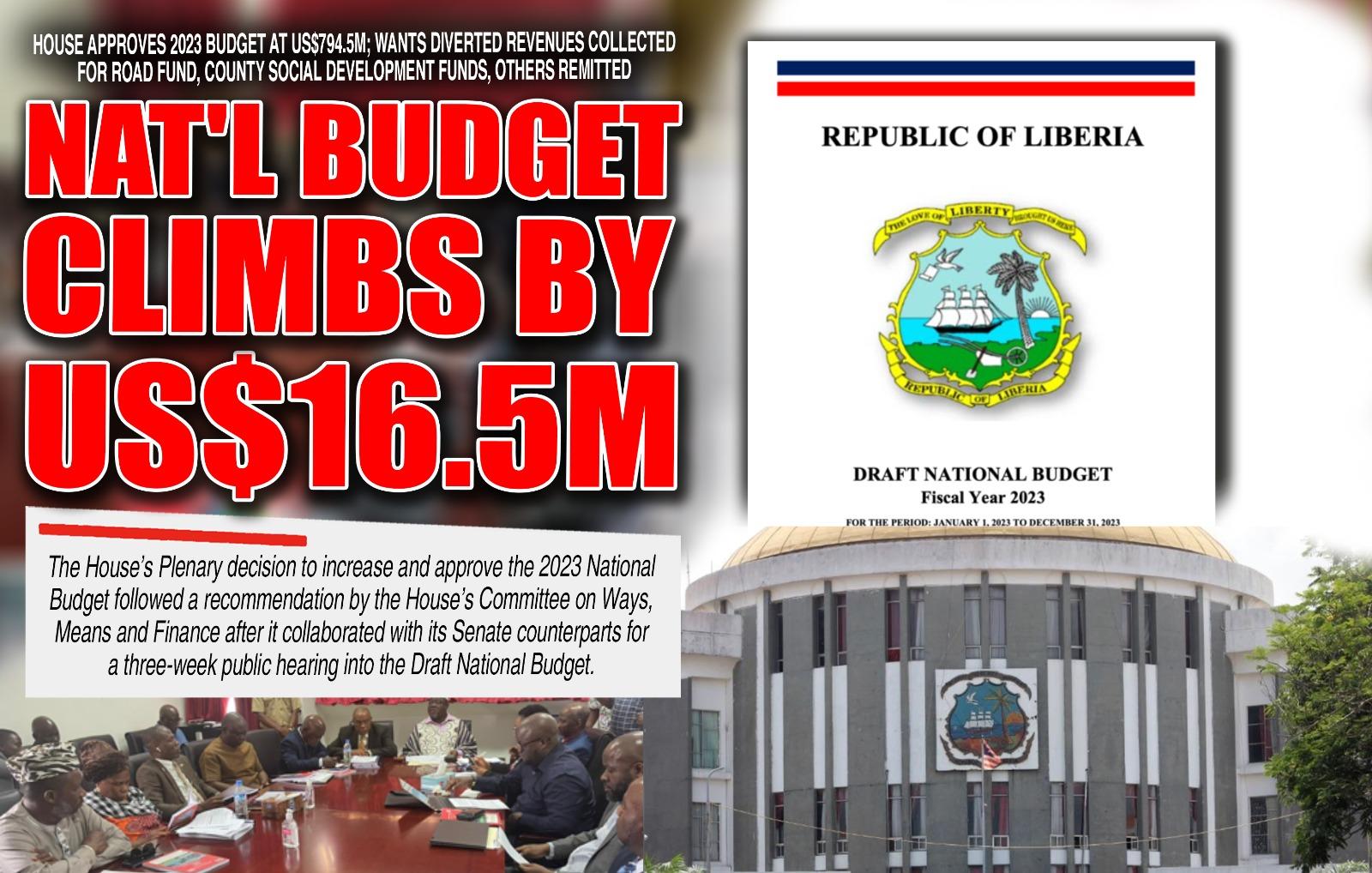
Africa-Press – Liberia. The House of Representatives on Tuesday voted to approve Fiscal Year 2023 draft national budget in the tune of US$794,532,682, an excess of US$16.5 to the version submitted by the Executive.
Plenary’s decision followed a recommendation by the House’s Committee on Ways, Means and Finance after it collaborated with its Senate counterparts for a three-week public hearing into the draft national budget.
The committee said the figure was derived following hearings which were characterized by rigorous budget debates. In these debates, the committee reported that ministries and agencies were given the opportunity to defend their draft proposals.
In cases where there were doubts and insufficient information, the committee said it divided itself into sub-committees to ensure that the hearing intently look at the programs in details, so as to ensure value for money.
Major revenue generating agencies that were grilled were State Owned Enterprises (SOE’s) including the Liberia Telecommunication Authority, Liberia Maritime Authority, National Port Authority, Liberia Petroleum Refining Company, and other revenue generating ministries, agencies and commissions.
The Breakdown
Of the amount ofUS$794,532,682, the largest chunk- US$295,620,939 goes to compensation of employees: US$118,656,601.83, subsidy:US$4,946,554; grants: US$95,984,314, Social Benefits: US$16,524,851, Non-financial assets: US$176,226,409; Domestic Liabilities: US$30,112,551 and Foreign Liabilities: US$56,460,362.
The Recommendations
The Committee’s recommendations, as adopted by plenarycalled for all revenues collected from the Road Fund to be remitted to the Road Fund Authority by the Ministry of Finance and Development Planning as collected, while 5% of said fund shall be for the administration of the Road Fund Authority.
It called for the direct transfer to the affected counties’ escrowed accounts all social development funds including the Land Rental Fees and a revenue sharing of 50%-50% between the Central Government and the counties (Cities, Township, Borough) for all excess budgetary revenue collected from real property taxes.
This comes after affected counties including Nimba, Bong and Grand Bassa complained that portion of their counties’ social development funds are being upheld by the central government.
Plenary also adopted the committee’s recommendation that called for budgetary appropriation of the Liberia Revenue Authority (LRA) to be paid immediately upon collection of revenue by the budgetary ratio of 5% of revenue collection until budgetary ceiling is realized in accordance with the Act of creating the LRA.
This clause will be welcome by the LRA after it made a passionate appeal to the Legislature for more support during the budget hearing.
Speaking during the LRA appearance, Deputy Commissioner General for Technical Services, Gabriel Montgomery said: domestic revenue mobilization is the lifeblood of the country’s development.
As donor support is drying up, he added that the government will continue to increase its reliance on the LRA to meet even more ambitious targets.
“As we are given ever bigger targets and pushing ourselves to meet them, the need for adequate financing of the revenue authority and other revenue generating initiatives need to be prioritized. This is a part of the conversation, Mr. Chairman that we will like for you and your team to critically consider,” he added.
The LRA, he noted, is currently in need of funding for a number of administrative interventions, stating, “our current fleet of cars and motor bikes is in need of revitalization; nearly all of our TBO’s and CBO’s need renovation and upgrade at those facilities. These critical interventions are needed to ensure that the LRA continue its progress of mobilizing more revenue for the provision of public goods.”
The House also mandated all spending and revenue generating entities to submit quarterly reports to the Legislature through a specified procedure and reporting template to be regulated by the Legislative Budget office (LBO).
This is in line with the decision adopted by the Joint Budget Committee, demanding all spending entities including line ministries and agencies to submit their performance reports for the past fiscal year as they defend their budget for FY2023.
The 54th Legislature has come under staunch criticism for their “failure” to thoroughly scrutinize the national budgets that have been submitted by the Executive in the past.
Last year, a number of legislators from the opposition bloc claimed that the budget was hastily passed without a proper scrutiny as spending entities did not submit their performance reports as required by Section 36 of the PFM Law.
The law, among other things, states that “It is a general responsibility under this Act for all government officials handling public financial transactions to ensure that financial information is reported in a timely, comprehensive, and accurate manner, in the manner prescribed in this Act, under its regulations, and in instructions issued by the Minister.”
For More News And Analysis About Liberia Follow Africa-Press