CLAUDIUS T. GREENE JR.
Africa-Press – Liberia. Saye Town, a community that is just a stone’s throw from the Monrovia City Hall, has been in the throes of squalid under development for more than two decades.
For a community that has played host to several prominent businesses, as well as Liberia’s Environmental Protection Agency and several major international non-governmental organizations (NGOs), it is not far-fetched for anyone to wonder why the community has been in such a state for so long.
One of the major pain points in the community is the sewage and sanitation problem. The Monrovia sewage line in the community is ruptured at two sections — one at the corner of 2nd Street and Russell Avenue (commonly known as ‘Jallah Town Road’), and the other on 3rd Street.
Beyond the obvious aesthetic and pollutive nuisance, the situation is a hazard both to public health and the safety of pedestrians and motorists. Further across Russell Avenue, the community extends to the bank of the Mesurado River, where many residents — for lack of adequate toilets — use the water source as a latrine.
Speaking of public health, there is apparently not a single health center found in Saye Town, which has an estimated residential population of 5,000.
“Saye Town really needs help,” Jahbulleh Cicero Dempster, the community’s newly elected chairman, told the Daily Observer in an interview last week. “We are calling on the Government and International Partners, NGOs, Liberians in the diaspora, and Liberians that are here in Liberia to please help us with whatever help they can render so we can carry on development.”
Dempster believes that local development is necessary for national development and that, if the government could work to provide each of the communities in Monrovia with a plot of land and some funding, they could carry out local development projects like constructing clinics, schools, community centers, libraries, and other facilities.
A fixture in the community, Dempster served as Co-chairman of Saye Town for seven consecutive years (2003-2010). Agitated by the slow pace of development in Liberia as a whole, Dempster says he used his own money to build a community center (hall) with offices for the people in his neighborhood.
Dempster is also the Executive Director of Concerned Residents (CR), formerly known as People United for Progress (PUP), a socio-economic advocacy group he established in 1991. Dempster is also known for his numerous articles published in Daily Observer, aimed at helping to change the mindsets of his fellow compatriots.
He said he embarked on the community center project in January 2020, using the land in a public alley. According to him, the project is close to 80 percent complete and spaces in the center are already being put to good use.
“The center and the spaces are offered free of charge because it was built for the benefit of the community dwellers,” Dempster says.
“The government does not provide any funding for community development projects.” He said that he was lucky to be able to build the community center, which provides a space for people to gather and conduct business.
“The community center is a valuable resource for the community,” he said. “It is a place where people can come together to discuss issues and plan for the future.”
He also said that it is a place where people can get help with things like job search and develop financial literacy.
Dempster said that Saye Town does not receive a budgetary allocation from the government, which has left the community in a state of disrepair. He said that there are no good educational facilities, health centers, good roads, toilets, libraries, or hand pumps in the town.
According to him, numerous overtures have been made by elders of the community to have the Liberia Water and Sewer Corporation (LWSC) come and fix the sewage line ruptures, but to no avail.
As community chairman, he plans to add his voice to that of his fellow residents to ensure that the sewage and other problems are finally resolved.
Community organizations in Liberia are not always what they seem to be. There is much ado about electing leaders to steer the affairs of the community. For clarity, these are not state-sanctioned elections, but independent democratic processes organized by the communities in their own right.
With good fortune, community elections can be peaceful. Otherwise, some communities are fraught with disputes over election results that could end up in court. Dempster is fortunate to have sailed through on the confidence of his fellow community members. His election on June 25 saw him achieve more than double the number of votes his closest opponent received.
His team of newly elected officers, includes landlord E. Barclay, Co-chairman for Administration, and Sekou P. Bayoh, Youth Chairman.
However, after the election dust settles and leaders are sworn in, the work must begin, and, without financial and resources, many community leaders are not sure where to start. Letters of appeal for support to individuals, businesses, and state actors are the main go-to strategy, but the responses are less than encouraging.
“The majority of the towns have nothing — no offices, nothing — to even begin with,” Dempster says. “How can the community leaders be effective without these individuals in the office and without any sort of facility?”
Town without ‘Township’ benefits
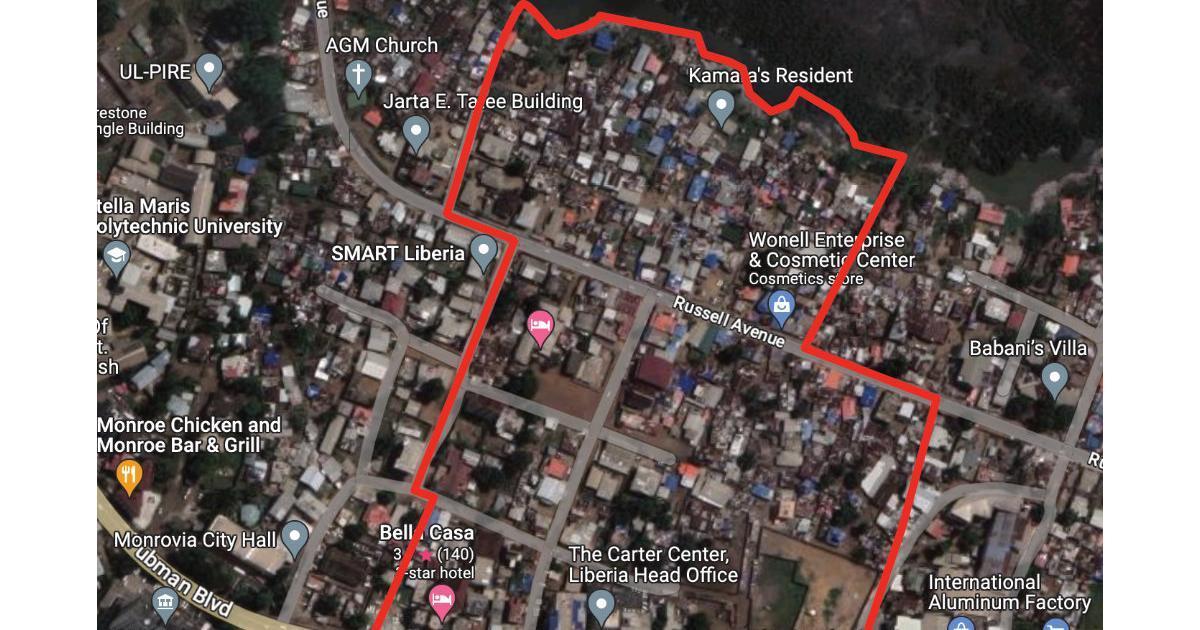
Bound on the south by Tubman Boulevard at Bella Casa Hotel (located between 2nd and 3rd streets) and proceeding down the boulevard to 5th Street, the town’s area proceeds northward, across Russell Avenue (commonly known as ‘Jallah Town Road’), all the way to the bank of the Mesurado River.
Saye Town begets its name from one “Old Man Saye”, a prominent individual who migrated from Nima County — probably during the early 20th Century, sources say — and settled in the Plunkor (otherwise referred to as Sinkor) area of Monrovia City.
The area then became known in terms of its most prominent resident — Saye. There is no evidence yet to suggest that the town got any statutory mandate via a legislative charter.
So, for all intents and purposes, the leadership of Saye Town is more or less a Community-Based Organization (CBO).
However, given its population size of about 5,000, Saye Town meets the first of nine key criteria — population size — to be classified as a bonafide Township, according to the Local Government Act of 2018, Section 2.16c.
Other criteria are that the community should have: a waste disposal system; educational services (primary and junior-high schools); health clinics; sports and recreational facilities; a cemetery; transportation infrastructure; transportation services and communication infrastructure; and business services, including motels, restaurants, and shops.
Essentially, Saye Town meets all but two of the nine criteria, given the absence of a health clinic and a cemetery. But besides the infrastructure, all the other criteria are driven by private sector activities.
According to Dempster, the absence of a public or privately-owned health facility forces many residents of the township to self-medicate through the multiplicity of pharmacies in the area.
The nearest health center is the Few Diagnostic Medical Clinic, a private clinic just beyond the boundaries of Saye Town. But Dempster says most of Saye Town’s residents prefer health care centers that are further away because few diagnostics is costly.
Most would have to make an early morning trek to the JFK Medical Center, a government-owned hospital.
According to the Local Government Act 10-year implementation plan, developed under the auspices of the Ministry of Internal Affairs, one of the principles guiding the implementation of the Act involves the empowerment of local authorities to establish partnerships with non-state actors, including the private sector, non-governmental organizations (NGOs), development partners and community-based organizations such as the Saye Town community organization.
Although Dempster acknowledges that he has heard of the Local Government Act, he admits that he does not know how it benefits his community, if at all. Like many other community leaders, his first reaction to underdevelopment in his community was to call out the central government “for lack of support”.
Liberian leaders, he explains, always turned their backs on the people who chose them to run the country. “We are like the dump truck that is constructing the Executive Mansion and cannot pass in front of the executive residence,” he said.
A source at the Ministry of Internal Affairs told the Daily Observer that the Local Government Act of 2018 “does not reference roles of Community-Based Organizations”, nor does it require local authorities to consult with CBOs. There is also no mention of the protection of the rights of CBOs.
“Community development is necessary for national development,” Dempster said. “Similar to a poor foundation, it will collapse no matter how many stories you put on top of it. As a result, there can be no progress because the community residents in Liberia are left on their own. So, we’re pleading with the government.”
Dempster also said that the government should pay more attention to and provide more assistance to urban communities, especially where the implementation of the Local Government Act is concerned.
“If those communities that are right under the nose of the central government are not covered under the local government act, then what can we expect from the rural communities?”
Source: Liberian Observer
For More News And Analysis About Liberia Follow Africa-Press