PATRICK S. TOKPAH
Africa-Press – Liberia. Norious Nahn, a 61-year-old widow, has for decades lived in a soaking, crumbling house, exposed to the unforgiving elements that seemed to mirror its very existence.
“My children and I have been living in a tiny, indecent thatch house for decades,” says Nahn, a resident of a poverty-stricken village in Bong County.
“During the rainy season, we hardly sleep as the house leaks, forcing us to stand throughout the night. We have no choice but to make do with what we have.”
Nahn, who survives on subsistence farming, has resigned herself to the fact that owning a house beyond her makeshift, broken structure that provided little protection against the elements, was an unattainable dream since her financial condition would not permit it.
Her experience is not strange, as it is exactly what many people in Nahn Village, Bong County are conformed with.
They have for generations long grappled with the deep-rooted issue of inadequate housing with dreams of a safe and dignified life that seemed impossibly distant.
But that hopelessness soon became a distant reality when President George Weah set out to tackle one of the most pressing issues facing the country — the issue of adequate housing for thousands of rural Liberians.
Under this initiative, the government aimed to provide decent and affordable housing to those who had lived in destitution for far too long.
And when the few houses began to take shape in Nahn village, hope cascaded through Nahn village like a revitalizing river,
“I never thought I’d see the day when I could live in a house with proper walls and a roof that doesn’t leak,” Nahn reflects, as her eyes shimmering with emotion. “As a farmer, my children and I struggle for survival not to talk about building a self-contained two-bedroom house.
“What this project has done for me and countless Nahn villages people is the confidence to dream again. For years, we have lived in a tiny, crumbling shack that offered no protection from the elements but now our lives have changed forever,” she says.
Nahn’s joy is shared by Paul Binda, a 51-year-old father of six, who says the project has fostered a newfound sense of pride and instilled a sense of ownership.
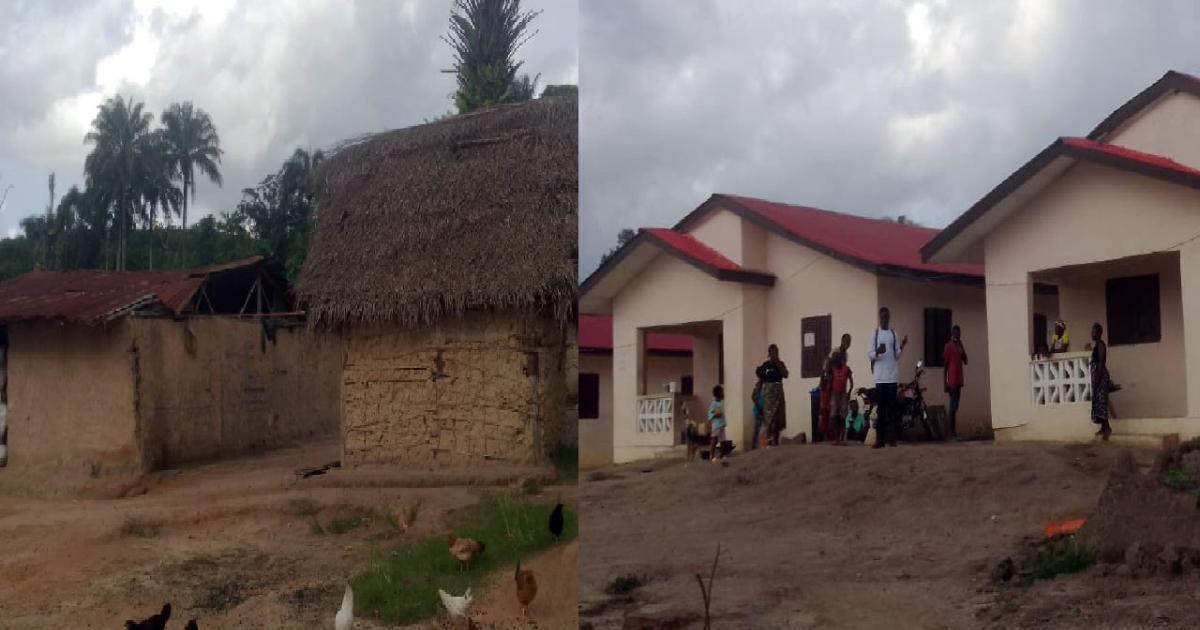
Binda, whose once crumbling mud house is now replaced by a sturdy concrete structure, noted that the President’s project provided comfortable homes to those who had been denied the chance to escape the clutches of living in makeshift structures.
“For the first time in my life, I have a place where I feel safe, comfortable, and proud to call my own,” Binda says as his eyes light up with joy as he describes the significance of owning a proper home.
“It’s not just a house; it symbolizes hope and progress for me and my family. I could hardly believe it when I first stepped inside. The floors were solid, the walls were strong, and we had our own toilet and shower. It is a dream come true,” he shares with a heartfelt smile.
“For years, we lived in fear of rain and wind, praying our fragile home wouldn’t collapse around us. Now, thanks to President Weah’s vision, we have a place we can truly call home — a place of safety and comfort.”
And as Binda sits on his porch, admiring the new horizon of possibilities that stretches before him, he cannot help but feel a deep sense of gratitude to Weah and all those who made this dream a reality.
Surrounding him are ten concrete two-bedroom housing units, which now stand as a symbol of newfound stability and prosperity in Nahn village, which is not far from the road leading to Lofa County.
Tears of joy flowed freely as he and other project beneficiaries narrated the pain of living in a fragile home where heavy rains would turn dirt floors into mud pits, and gusty storms threaten to tear their fragile dwellings apart.
However, The tides shifted when Weah rolled out his visionary pro-poor housing project for Nahn village, designed to provide quality living spaces to those below the poverty line.
From muddy patches to solid foundations, the village was metamorphosed with ten housing units, with Martha Kermue, who is the chair lady of Nahn village, wasting no time in embracing the newfound hope that had arrived at the village doorstep.
As Kermue walked through her new home, gratitude radiated from every corner: a spacious living room, bedrooms, and a fully functional kitchen now greeted her and her family.
“My family and I are eternally grateful to President Weah. We were trapped in a cycle of despair, but now we have a place to call home. It’s brought us stability, hope, and the desire to believe that anything is possible.
“Before the intervention, the muddy floors and crumbling houses had served as constant reminders of our struggle to survive,” Kermue claimed. “But with secure and comfortable dwellings, we can now focus on other areas of their lives that had previously taken a backseat.”
Looking out of her front window, Kermue could see her neighbors are experiencing the same sense of pride and relief as they, too, moved into their new homes.
Source: Liberian Observer
For More News And Analysis About Liberia Follow Africa-Press