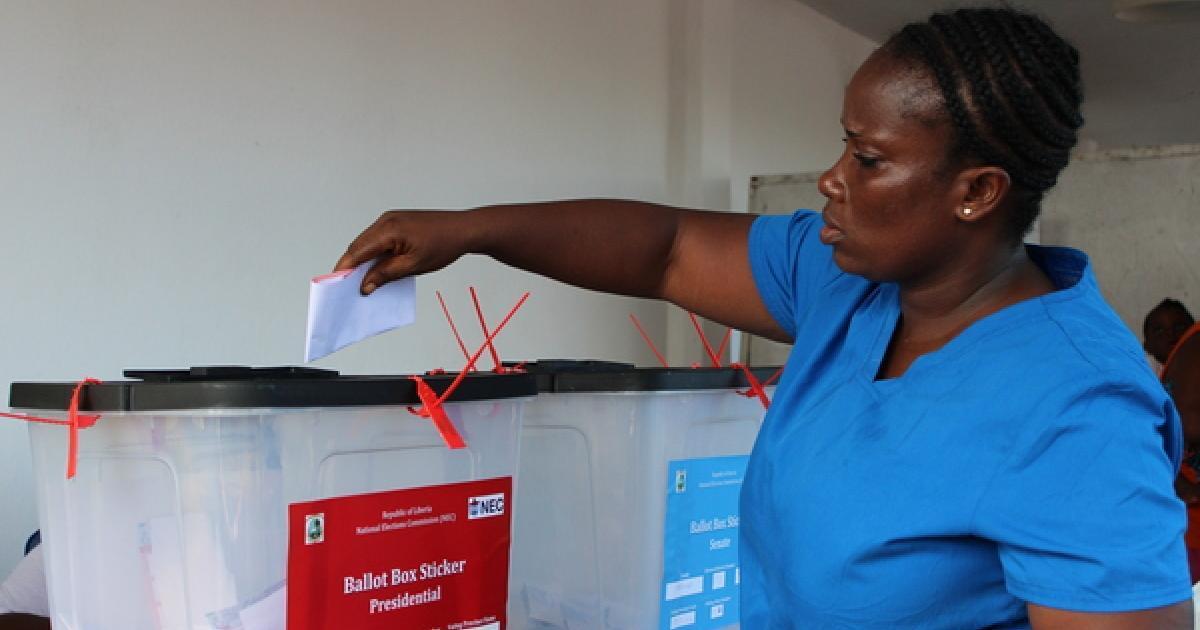
Africa-Press – Liberia. While the October 10 presidential and legislative elections witnessed a huge turnout, the overshadowing issue has been the unexpectedly high number of invalid votes that the National Elections Commission (NEC) has been announcing since the closure of polls.
The NEC has reported that out of the total 1,947,780 votes cast (99.93% of the total), a staggering 114,597 were invalidated, accounting for 5.8% of the total, while 1,833,189 votes were deemed valid (94.1%).
“This is too huge, and I did not expect that,” Abdullah Kiatamba, a revered Liberian political Analyst, said on a local radio in Monrovia on Thursday. “This shows that the NEC did a poor job in educating the people on how to vote.”
Kiatamba could not fathom what might have led to such a huge number of invalid votes but refused to buy into the conspiracy theory, also held by the NEC, that the voters might have been angry with the politicians and decided to vent their anger by taking swipes at each of them on the ballot.
“I cannot wrap my head around while the number is so huge, but I think the NEC and the major political parties need to do better when it comes to voter education as we go to the runoff,” he said.
Remarkably, the invalid votes, at nearly 6%, outstrip all other candidates in the presidential race, except the two top performers, who acquired nearly 90 percent of the valid votes.
According to NEC’s results, President George Weah of the Coalition for Democratic Change is leading with 803,675 votes (43.84%), closely followed by former Vice President Joseph Boakai with 796,313 votes (43.44%). No other candidates have surpassed 3 percent. Edward Appleton of the Grassroot Democratic Movement (GDM) secured a surprising third place with 40,255 votes (2.2%), followed by Lusinee F. Kamara of the All Liberia Coalition Party (ALCOP) with 35,977 votes (1.06%). Alexander Cummings of the Collaborating Political Parties (CPP) occupies the fourth position with 29,611 votes, and Cllr. Tiawan Gongloe of the Liberian People Party (LPP) holds the fifth spot with 26,225 votes (1.43%).
Like Kiatamba, the high number of invalid votes has also drawn the attention of the media, political parties, and international observers. Many ordinary Liberians are surprised at the staggering figures. Some believed that the NEC might have been involved in sinister acts against certain candidates and decided to destroy their votes.
“This cannot be true. The number of invalid votes is too huge,” Esther Williams said on a local radio station. “Liberians have been voting for four consecutive presidential elections now and no one can tell me that we don’t know how to vote. The real story about those invalid votes will come to light one day.”
Janjay Edwards concurred with Williams, “I want to agree that the votes were manipulated, and the invalid votes are just one way of suppressing the candidates that the NEC did not favor. Liberians are too smart to still be wasting votes. I cannot believe this.”
While some are swimming into conspiracy theories, others believe that the problem might have come from the design of the ballot papers and the issue of inking voters’ fingers before casting their votes, as was done at some places, creating a probability of the ink spilling over.
Some observe that the ballot papers were unusually long, posing a risk of ink bleeding through the paper when voters marked their choices and folded them, potentially invalidating their votes.
Additionally, some areas experienced difficulties with the ballot boards on which voters lay the ballots to have it marked, causing some voters to hold the papers in their hands while marking them, which raised concerns about the possibility of more invalid votes.
Journalists reported that at precincts across the country, voters struggled to mark their papers and urged the NEC to address the situation by fixing the damaged boards.
Another contentious issue was the poor visibility at polling centers, with some polling stations inadequately lit during the early morning and afternoon hours. This required voters to use their phones or flashlights to mark their ballots behind the voting screens, raising concerns about incorrectly marked ballots.
When asked if the huge amount of invalid votes could be attributed to limited civic education efforts, NEC Chairperson Davidetta Brown-Lansanah could not agree or deny, but noted that several community-based organizations (CBOs) were contracted across the country to conduct civic education that lasted for three months.
She, however, claimed that some voters deliberately cast invalid votes because of their dislike for certain candidates. “The commission did not fail to raise awareness. Many things are obtained with respect to Liberians being able to mark the ballots correctly,” Lansannah disclosed.
“You will recall that during the biometric voter registration and during the campaign, oftentimes we had Liberians punching holes in the eyes and ears of candidates they did not favor. They even brought down posters. Perhaps this was also transferred to the ballots.”
The high percentage of invalid votes in Liberia’s post-war elections and referendums has been an ongoing concern. In the 2020 national referendum, over 60 percent of the total votes were invalid. In the 2017 presidential and legislative elections, around five percent of the votes in the first round of the presidential elections were invalid.
While the high number of invalid votes cannot be altered, calls have been made for the NEC to conduct comprehensive civic voter education in future elections to prevent such recurrences. Additionally, the NEC should ensure that ballot papers are user-friendly, and voting locations are adequately equipped for a smooth voting experience.
Meanwhile, the NEC’s Board of Commissioners has promised to launch an investigation into the recurring issue of high numbers of invalid votes in post-war elections.
For More News And Analysis About Liberia Follow Africa-Press