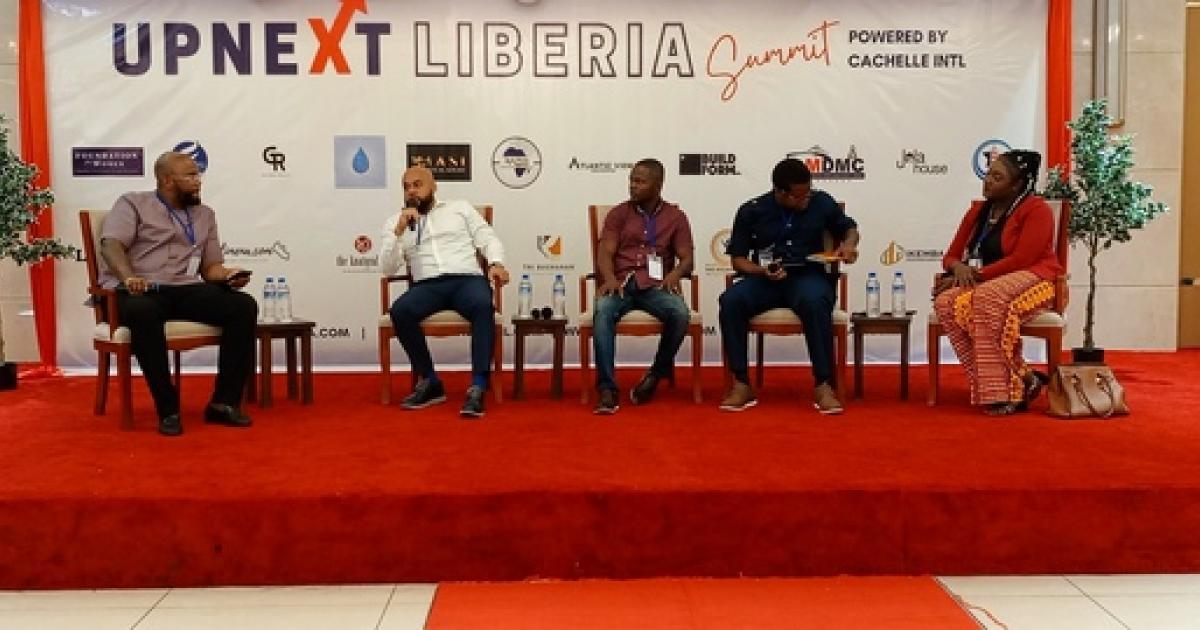
Africa-Press – Liberia. Up Next Liberia, in collaboration with CACHELLE Int’l, on December 14, held a one-day summit on sparking growth in Liberia through business, innovation, and cultural discussion.
Held at the EJS Ministerial Complex in Congo Town, the event brought together emerging leaders to create a bridge and establish a fresh vision for growth, with the goal of fostering a transformative future for Liberia.
Rev. Sarah Beysolow Nyanti, who delivered the keynote address, stated that, as a mother of four children and four grandchildren, it warms her heart to see the summit happen in Liberia because the young people of Liberia have decided to take responsibility for nation-building.
“And I talk about nation-building all the time because it is my job, in terms of the work I have been doing over the years,” she said. “People said she was a UN diplomat and so forth. She had been working on development. And I say that’s the ministry of nation-building. I have been given the opportunity to serve, utilizing the platform of the United Nations to do that, but this nation is building none the less. And so, for me, this is all part of that.”
She noted that the word “nation” does not refer to a country. “People use it synonymously, and it is not synonymous,” she said, explaining that the word “nation” refers to the people and how they build their human infrastructure to ensure that the country is prosperous.
She expressed gratitude to Up Next Liberia for the opportunity to speak at such an important event.
“First of all,” she said, “it is just a beautiful caption. What’s next? We are up, we are standing, we are up right, and we are asking what’s next. What next for you as an individual, what next for us as communities, and this, for me, is critical. The key things for agriculture, business, technology, and culture are fundamental because they speak to the heart of the key to the transformation of this beautiful country and for this nation.”
According to her, when people speak about culture, they automatically think from the perspective of dance and the perspective of the things that have been known throughout time.
However, Rev. Nyanti spoke on culture from the perspective of social norms, noting that social norms are responsible for where Liberia is today. And social norms are the things that normally happen in Liberian society.
She highlighted that social norms have normative expectations and empirical expectations. “In any community and in any society, there are things you expect others to do,” she said. “Empirical expectation: I expect them to do that. I expect that the people in government will be corrupt; I expect that men will cheat. But there are expectations we have, and they are called empirical expectations. Things you expect to happen in society. Then you have normative expectations, and those are the things you do because other people are doing them.
She also emphasized that there are things that happen in the minds of people that should not happen, but they do it because other people are doing it, and they think that other people will think that they are stupid if they do not do the same thing that they are doing.
However, she said that in order for Liberians to transform Liberia, they have to break free of the shackles of normative expectation, break free of imperative expectation, and confront culture.
“There is no way Liberia will transform agri-technology, agribusiness and so forth if we don’t confront culture,” she said, “Not everything that is cultural is required for us to move forward. But we must confront culture; we must confront the culture that says that a woman should be silent until the man has spoken. We must confront culture. We must confront that community that says that the woman must plant and harvest and the man should sit there and collect the money. And the man has many wives because he wants his farm to be big. We must confront culture if we expect Liberia to change.
Hearty K. Manneh, one of the participants, expressed her heartfelt appreciation to Up Next Liberia for the opportunity given her to go and hear new things and enhance her ideas.
“For the agriculture panel,” she said, “one thing that really touched me was when one of the panelists spoke about technology in agriculture. And I also enjoyed when she said it helped make their work easier and helped them on a daily basis in their agriculture businesses. That’s what technology is about.”
For More News And Analysis About Liberia Follow Africa-Press