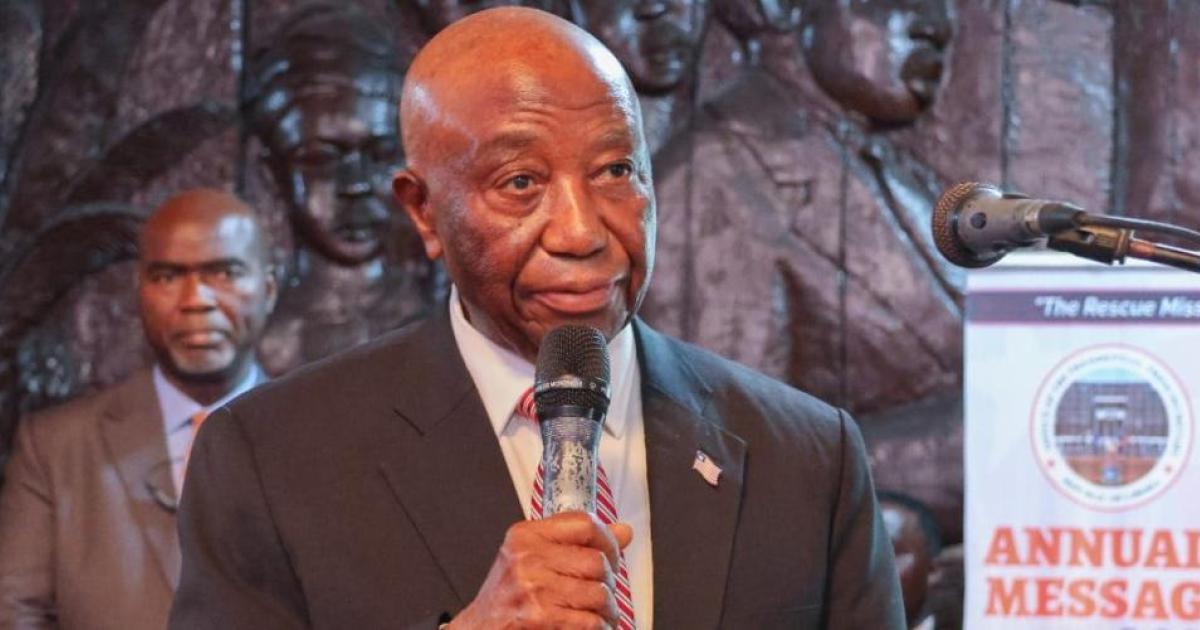
Africa-Press – Liberia. President Joseph N. Boakai has reported a discrepancy between former Liberian President George Manneh Weah’s statement and that of the Central Bank of Liberia concerning the country’s international reserves. During his address to the joint Legislature on the state of the country on January 29, President Boakai stated that the figures provided by Weah were inconsistent with the CBL’s balance sheet.
According to President Boakai, the CBL reported a balance of US$20.5 million on January 19, 2024, an amount significantly lower than the US$40 million claimed by former President Weah, making the case for regular audits across all branches of the government, not just the Executive, to ensure transparency and accountability.
“The net international reserves position reported at the end of December 2023 was US$220 million. The report of US$40 million as the GoL’s consolidated account balance as at January 19, 2024 is not supported by the fact. The balance reported by the CBL as of the same date was US$20.5 million, highly encumbered, NOT US$40 million,” the President said. “To this end, we re-emphasize our earlier commitment to audit and ensure that regular audits will be a culture across all branches of government, not only the Executive.”
On the state of the economy, Boakai said that the country experienced slow growth between 2022 and 2023, from 4.8 percent to 4.6 percent.
“The rate of growth averaged about 1.5 percent, compared with 3.1 percent between 2012 and 2017 due in part to an underperforming economy and the existing geo-political global environment,” he said, adding that the economy faced challenges during the past six years in terms of growth, job creation, and poverty reduction.
“Inflation during the period 2023 rose to 10.1 percent at the end of December, from 7.6 percent in 2022. Revenue collection as reported for 2023 stood at US$710.23 million while expenditure totaled US$796.32 million; hence, a large budget deficit of over US$80 million,” he intoned.
The President further noted that his administration intends to change the state of the economy by thinking “outside the box”, doing away with reliance on primary commodity export to focusing on value addition with the private sector as the engine to drive the economy.
President Boakai also announced the reintroduction of the Liberianization policy which would help to empower Liberian businesses and promote growth and jobs creation. “In our quest to expand the economy, we will leverage Information Communication Technology (ICT) in creating jobs, especially for our youth,” he said.
The President also disclosed that his administration will build the capacities to 10,000 young people in various digital skills in the first half of 2024. President Boakai asserted that the Liberian middle-class goal must be a reality in the next 6 years.
President Boakai also highlighted the country’s growing public debt, which stood at US$2.21 billion as of the end of December 2023, an increase of 8.67 percent compared to the previous year.
“This represents a sharp increase of US$1.33 billion compared to the end of December 2017 stock of US$878.17 million (representing 601.8 percent rise). Our debt burden has clearly grown astronomically. Certainly, the rescue mission was a necessity for Liberia’s transformation,” Boakai said.
He expressed concerns about the escalating debt burden and mentioned that Liberia is currently under sanction due to outstanding dues to the African Union and the African Development Bank. Additionally, a default in payment to the European Investment Bank is preventing the disbursement of over US$13 million for the Sanniquellie-Loguato road project.
“As I am speaking, Liberia is under sanction for lack of payment of dues to the African Union and the African Development Bank. Also, a default in payment of about US$650,000 to the European Investment Bank is preventing a disbursement of over US$13 million for the Sanniquellie-Loguato road.”
To address fiscal challenges, President Boakai pledged to reintroduce Fiscal Rules and a Travel Ordinance, along with other measures, to promote responsible financial management and curb waste and abuse.
“We will reintroduce the Fiscal Rules and Travel Ordinance in addition to other measures to help address waste and abuse and ensure the return of prudent fiscal management. We will ensure that the executive leads by example.” President Joseph Boakai stated.
In what could be considered his final address to the nation, President Weah said last week that regardless of the challenges his government faced, he was leaving over US$40M at the Central Bank of Liberia. But in contrast to Weah’s assertion, President Boakai stated that his administration has inherited financial constraints and will prioritize prudent fiscal management to ensure the country’s development.
War on Narcotic Substances
President Boakai is bent on waging war against the proliferation of narcotic substance abuse that is condemning many young people to their early graves, as his government is set to take the fight to another level.
With just a week in office, the President has launched an offensive against substance abuse in the country, declaring it a public health emergency–urging every Liberian to join in the fight against the menace.
In a resolute stance when he delivered his maiden SONA, Boakai rallied the populace in the nation’s fight against drug abuse, announcing that both he and his Vice President Jeremiah K. Koung will lead by example by being the first two people to undergo drug testing.
He said the drug epidemic, especially the use of “KUSH”, in Liberia is an existential threat eating away at the future of the country and its children.
“In this fight, me and my Vice President, we will be the first to take a drug test and I urge all others to follow,” Boakai asserted.
In recent years, youth in Liberia have taken to the use of synthetic marijuana/drug called “Kush.” It is popularly known to be a variant of marijuana (weed), which a lot of young people smoke nowadays to, as they say, make them feel good.
Kush looks a bit different from marijuana and, according to consumers, its reaction on them is quite different from the reaction they get after smoking marijuana.
However, President Boakai said it was time for the government to stand up and face this national security risk together.
“Given the need for immediate action to make good my pledge to the thousands of families burdened by this crisis, I am hereby declaring Drugs and Substance abuse as a Public Health Emergency,” he added.
This bold statement reflects President Boakai’s firm commitment to combating the scourge of drug abuse within Liberia.
By willingly subjecting themselves to drug testing, the President and his Vice President are not only demonstrating personal accountability but also setting a compelling standard for integrity in leadership.
President Boakai’s call for others to join them in undergoing drug testing underscores the collective responsibility of all citizens in tackling this pressing societal issue. By encouraging widespread participation, he aims to foster a culture of accountability and awareness surrounding drug abuse prevention and treatment.
This proactive initiative by President Boakai signals a renewed dedication to promoting public health and safety throughout Liberia. By leading the charge from the frontlines, he sets a powerful example for all citizens to follow in the nation’s ongoing efforts to create a drug-free society.
He further announced the establishment of a multi-sectoral steering committee comprising the following agencies, chaired and co-chaired by the Ministry of Health and the Ministry of Justice, respectively. Member agencies include the Ministry of Youth and Sports; the Ministry of Gender, Children, and Social Protection; the Liberia Drug Enforcement Agency (LDEA); and the Ministry of Finance and Development Planning.
Meanwhile, the Liberia Drug Enforcement Agency has welcomed the statement made by President Boakai calling for drug testing across the government.
The LDEA further said that the statement by President Boakai affirmed the decision of the agency as contained in the proposed amended drug law that is before the Liberian senate. In part, the LDEA recommended the need to run a drug testing process as either a policy of the government or on the basis of request as per requirements.
For More News And Analysis About Liberia Follow Africa-Press