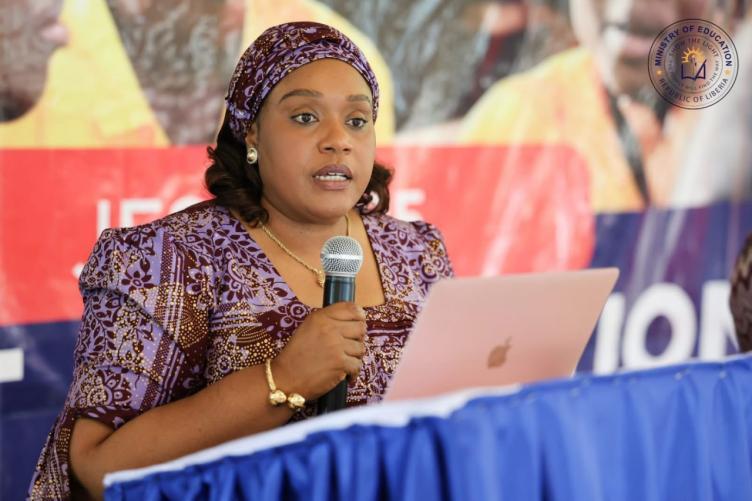
Africa-Press – Liberia. Liberia’s education sector has recorded measurable gains in access, infrastructure, and school feeding, but continues to struggle with low learning outcomes, weak accountability, and persistent inequities, Education Minister Dr. Jarso Maley Jallah has warned.
Speaking Thursday at the 2025 Joint Education Sector Review (JESR) in Buchanan, Dr. Jallah acknowledged progress made under the Education Sector Plan while cautioning that Liberia remains far from delivering quality and equitable learning for all children.
The high-level review brought together government officials, lawmakers, development partners, civil society organizations, and national and international NGOs to assess performance midway into the current education reform agenda.
Held under the theme “Halfway to the Goal: Mid-Term Review and Zoom Focus on Accelerating Foundational Learning Outcomes and Equity,” the two-day forum evaluated progress against the five-year Education Sector Plan and outlined urgent priorities to improve learning nationwide.
“Halfway to any national goal is always an uncomfortable place,” Dr. Jallah said. “It is far enough to see progress, yet close enough to confront what is not working. This review meets us at that point of truth.”
Investments and Expansion
The minister cited major investments, including the US$88.7 million EXCEL Project and the US$40 million Leaders in Teaching Project, both aimed at strengthening teacher training, upgrading teacher training institutions, and improving secondary education.
“These are not isolated investments,” she said. “They represent a deliberate move toward coherence—aligning financing, workforce development, and system strengthening around national priorities.”
In science, technology, engineering, and mathematics (STEM), Dr. Jallah said the ministry has supplied laboratory materials to 50 senior high schools, piloted “Lab-in-a-Box” kits for early grades, and expanded public secondary school infrastructure across several counties to promote hands-on learning.
She also highlighted the expansion of the national school feeding program, now reaching approximately 239,000 learners in 1,473 schools nationwide. The program is supported by US$1 million from the national budget, alongside contributions from partners including the World Food Programme (WFP), Mary’s Meals, Mercy Corps, and Save the Children.
Persistent Challenges
Despite these gains, the minister acknowledged that serious challenges remain. Completion rates—particularly at Grade Six—are still low, over-age enrollment continues to undermine classroom effectiveness, and children with disabilities remain significantly underrepresented in schools.
Enrollment in technical and vocational education and training (TVET) also lags behind national targets, while shortages of textbooks and learning materials persist, especially at the secondary level.
“For too many learners, especially girls, schooling is still shaped by whether classrooms are safe, dignified, and protective,” Dr. Jallah said, noting that insecurity, harassment, and weak supervision directly affect learning outcomes.
Declaring 2026 Liberia’s “Year of Accountability,” the minister stressed that effort alone is no longer enough.
“Accountability means policies must translate into results. Data must inform action. And progress must be visible at county, district, and school levels,” she said.
She described foundational learning as a matter of justice, warning that children who cannot read or work with numbers by age 10 are already excluded from opportunity and future economic participation.
The JESR, she added, is intended to move beyond enrollment figures to measuring what children actually know and can do.
Dr. Jallah called on development partners—including UNICEF, the World Bank, the Global Partnership for Education (GPE), and WFP—to better align financial and technical support with government systems and county-identified priorities.
“Fragmentation is no longer an option,” she said. “Alignment is essential if accountability is to have real meaning.”
Accountability, Data, and Corruption
Delivering remarks on behalf of the 55th Legislature, Representative Nya Flomo, Chair of the House Committee on Education, commended the ministry’s efforts but urged stronger enforcement of the 2011 Education Reform Act, particularly the activation of county and district school boards.
Flomo issued a stern warning on corruption, citing instances where school infrastructure remains unused due to poor planning or political interference.
“If corruption is not taken seriously, it will undermine all the efforts government and partners are making,” he cautioned.
He also called for stricter oversight of national examinations administered by WAEC, recounting reports of cheating, bribery, and compromised exam monitoring.
UNICEF Country Representative Andy Brooks praised Liberia’s system-strengthening approach but urged greater attention to the most vulnerable learners—children with disabilities, out-of-school youth, and adolescent girls.
“If you don’t talk about inequities, you don’t notice them, and you don’t change them,” Brooks said.
UNICEF reaffirmed support for President Joseph Boakai’s National Enrollment Drive, stressing that cross-ministerial coordination—across education, health, gender, youth, and social protection—is essential to identify and support marginalized learners.
Brooks also warned that expanded access must not dilute quality.
“If a class increases from 40 to 100 learners, we must ensure quality is not sacrificed,” he said.
Civil Society and Data-Driven Reform
Civil society organizations, particularly Helping Our People Excel (HOPE), spotlighted persistent gender gaps in education. Under its Educate HER Project, HOPE unveiled the Girls’ Education Scorecard 2025, a first-of-its-kind tool tracking progress across 21 indicators.
The scorecard reveals stark county-level disparities in retention, safety, learning outcomes, and access to secondary education, and is expected to strengthen data-driven policymaking for girls’ education.
Deputy Minister for Planning, Research and Development Thomas Parker clearly outlined the purpose of the Joint Education Sector Review (JESR): to assess progress against the five-year sector plan, ground policy decisions in evidence, and align resources to accelerate results. Parker described the process as participatory, county-informed, and deliberately transparent.
“This is a national moment of accountability, reflection, and collective decision-making,” he said.
The 2025 JESR revealed a sector striving to rise—buoyed by improved data systems, teacher reforms, new financing, and renewed political will—but it also exposed deep systemic weaknesses that could derail progress if not addressed with discipline and integrity.
Concluding the review, Education Minister Dr. Jarso Maley Jallah urged all stakeholders to treat the halfway mark not as a pause, but as a turning point. She called for stronger supervision, targeted support to underserved counties, improved teacher welfare and training, adequate learning materials, and safe, respectful classrooms.
“Liberia’s long-term prosperity does not rest in plans alone,” Dr. Jallah said. “It rests in daily classroom realities—and those realities must improve.”
For More News And Analysis About Liberia Follow Africa-Press