
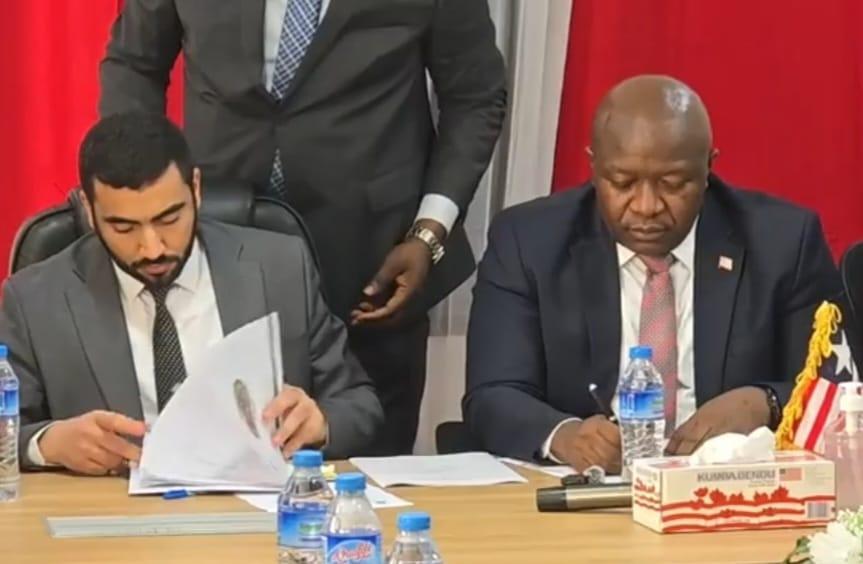
The Government of Liberia and the Arab Bank for Economic Development in Africa (BADEA) have signed a US$30 million financing agreement for the upgrading of the Salayea–Konia Road in Lofa County, alongside an additional US$700,000 grant aimed at strengthening health services along the Gbarnga–Voinjama Road Corridor, a critical artery linking northern Liberia to regional markets.
The agreement marks a significant milestone in Liberia’s post-conflict infrastructure rehabilitation agenda and underscores growing cooperation between Liberia and Arab development partners in advancing inclusive growth, regional integration, and social resilience.
Strategic Infrastructure with Regional Impact
The Salayea–Konia Road forms part of Liberia’s northern transport network connecting Lofa County to Bong and Nimba counties and onward to Guinea and Sierra Leone, facilitating cross-border trade, agricultural transport, and access to social services.
Poor road conditions have historically increased travel time, transport costs, and limited access to health care, especially during the rainy season.
According to government estimates, over 40 percent of Liberia’s road network remains unpaved, with rural areas disproportionately affected.
Lofa County, one of Liberia’s key agricultural hubs relies heavily on road access for moving rice, cassava, cocoa, and coffee to major markets.
BADEA: Deepening Long-Term Partnership
Speaking at the signing ceremony, Abdellah El Bouchiki, Operations Expert at BADEA, described the agreement as part of a broader and long-standing partnership with Liberia.
“We are pleased with this collaboration, which we cherish deeply.
This project represents not only the continuation of strategic infrastructure investments we have financed in Liberia, but also an opportunity to create economic resilience, enhance connectivity, and promote social inclusion,” Bouchiki said.
He noted that the project will build on the impact already achieved under the first phase, improving transport efficiency and amplifying economic benefits for communities along the corridor.
“This next phase marks an important step in deepening and expanding the distribution of development financing, and we look forward to strengthening this collaboration further,” he added.
Government Unlocks Stalled Financing
Liberia’s Minister of Finance and Development Planning, Augustine Kpehe Ngafuan, expressed profound appreciation to BADEA and other Arab development partners, emphasizing that the project had been stalled prior to the current administration.
“When we assumed office, this project had no movement. There were challenges, commitments were not being met, and funders were understandably withholding disbursements,” Ngafuan said.
He disclosed that the government undertook high-level engagements, including negotiations in Kuwait and follow-up meetings during the IMF and World Bank Spring Sideline Meetings in Washington, D.C., to resolve outstanding issues.
“We renegotiated frameworks, ensured Liberia met its obligations, and as a result, BADEA, the Kuwaiti Fund, the Saudi Fund, and other partners reopened their financing windows,” he explained.
Speed with Quality: Government’s New Mantra
Minister Ngafuan stressed that while speed is essential, quality will not be compromised.
“Speed and quality will define our work going forward. The only thing that should stop us is nature not bureaucracy,” he stated.
He revealed that construction activities are progressing steadily and that contractors are expected to reach Salayea within weeks, adding that the government will ensure uninterrupted financing flows.
Health Sector Receives Critical Boost
Beyond roads, the agreement includes a US$700,000 grant to support clinics along the Gbarnga–Voinjama corridor—an intervention welcomed by Minister of Health, Dr. Louise Kpoto.
“This is a significant milestone for the people of Salayea, Konia, and the entire region.
Roads and health facilities are deeply connected and when roads improve, access to health services improves, and lives are saved,” Dr. Kpoto said.
She confirmed that the grant will support the renovation and strengthening of health facilities in Salayea and Konia, improving maternal care, emergency referrals, and essential medical services.
Public Works: Expanding the Vision
Minister of Public Works, Roland Lafayette Giddings, praised BADEA for its sustained support and announced additional innovations under the project, including toll infrastructure and rest stations from Gbarnga to Voinjama.
“We are building roads, but we must also ensure sustainability.
Toll corridors will help generate revenue for maintenance, and rest stations will enhance safety and convenience,” Giddings said.
He disclosed that Liberia has already developed a national toll policy, with designs for new corridors being reviewed for rapid inclusion.
More Projects on the Horizon
Minister Ngafuan further revealed that:
The Mendicorma–Voinjama Road will be undertaken under a PAVIFORT Agreement, with mobilization already started and construction expected to intensify in February.
The Monrovia–Bo Waterside Corridor, a major trade route linking Liberia to Sierra Leone, will see visible construction activities by March, he further informed the gathering during the signing ceremony.
“We are funding priorities not for ministers, but for the people of Liberia, agriculture, education, health, trade, and commerce all benefit when roads improve,” Ngafuan emphasized.
Infrastructure as a Growth Multiplier
Development economists note that every 10 percent improvement in road connectivity can reduce transport costs by up to 20 percent, while significantly improving access to markets and social services.
Liberia’s renewed infrastructure push aligns with its ARREST Agenda for Inclusive Development, which prioritizes roads, energy, water, and human capital as key growth drivers.
As Liberia continues to rebuild after years of conflict and underinvestment, the BADEA-supported projects signal a decisive shift from stalled commitments to delivery, accountability, and regional integration laying the groundwork for sustained economic transformation in the country’s northern corridor.