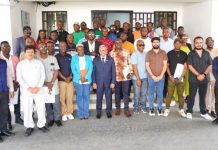
Africa-Press – Liberia. The Liberia Agriculture Commodity Regulatory Authority (LACRA) has reached a significant milestone in its ongoing efforts to modernize, regulate, and strengthen Liberia’s agricultural commodity sectors, with the successful conclusion of a two-day National Validation Workshop aimed at finalizing the National Oil Palm Policy.
Held at the Boulevard Palace in Sinkor, Monrovia, the workshop brought together senior government officials, international partners, private-sector actors, farmer representatives and technical experts, all united around a shared objective: to establish a fair, transparent, and sustainable regulatory framework for Liberia’s oil palm industry.
The new policy introduces a long-overdue “fair play” system for the oil palm sector—similar to the regulatory frameworks that have helped structure Liberia’s cocoa and coffee value chains.
For years, the absence of clear rules left smallholder farmers vulnerable to price instability, weak quality control, and limited market protection.
The National Oil Palm Policy directly addresses these gaps by setting standards that balance farmer welfare, investment confidence, and national economic interest.
“For too long, Liberia’s oil palm sector has operated without a clear, predictable regulatory framework. This policy changes that. It establishes fair rules of the game that protect farmers, guide investors, and ensure the sector contributes meaningfully to national development,” said Dan T. Saryee Sr., Acting Director General of LACRA.
Key provisions of the policy include mechanisms to promote reasonable and transparent pricing for farmers, strengthened standards for nurseries, processing, packaging, and oil quality, and clearer obligations for large-scale producers and concessionaires, including the payment of royalties to ensure the sector contributes to national revenue and economic growth.
“This policy is about keeping value in Liberia. When farmers are fairly priced, when quality is enforced, and when concessionaires meet their obligations, the entire economy benefits,” DG Saryee added.
The Chairperson of the LACRA Board of Directors described the policy as a critical reform aligned with national priorities, noting that it supports President Joseph Nyuma Boakai, Sr.’s ARREST Agenda, particularly in the areas of food security, agricultural transformation, and rural economic growth.
“The National Oil Palm Policy is a bold and necessary reform. It aligns directly with the President’s ARREST Agenda by strengthening food security, promoting responsible investment, and expanding opportunities for rural livelihoods,” the Board Chair said.
Meanwhile, as LACRA consolidates reforms at home, the Authority is also advancing Liberia’s agricultural diplomacy abroad. Acting Director General Saryee has departed Monrovia for Addis Ababa, Ethiopia, to participate in a high-level meeting of the Inter-African Coffee Organization (IACO).
Liberia was officially readmitted to IACO in late 2024 after years of absence, and this year’s meeting comes at a strategic moment for Africa’s coffee industry. Discussions will focus on repositioning African countries from being mere exporters of raw coffee to becoming competitive players that retain greater value, branding, and profits along the global supply chain.
At the summit, DG Saryee is expected to showcase Liberica coffee, Liberia’s indigenous variety, positioning it as a premium product for international buyers and specialty markets.
“At the international level, Liberia is repositioning itself. Whether it is palm oil at home or Liberia coffee abroad, our goal is the same: to move Liberia from the margins of commodity markets to a place of credibility and competitiveness,” DG Saryee said.
In a statement, LACRA described the finalization of the National Oil Palm Policy and Liberia’s renewed engagement in continental coffee governance as a major turning point for the country’s agricultural sector, signaling a new era of regulation, value addition, and international competitiveness.
For More News And Analysis About Liberia Follow Africa-Press