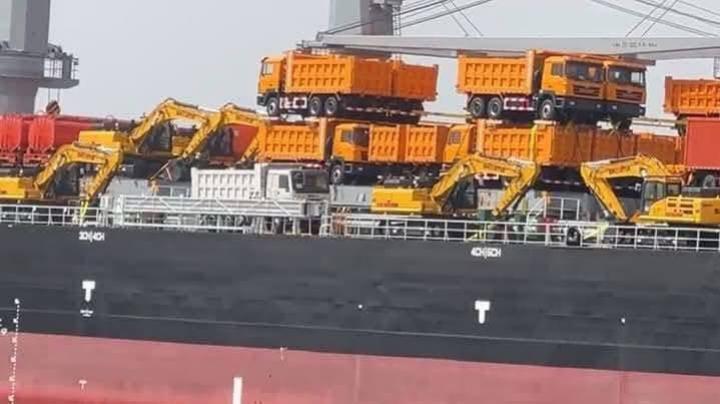
Africa-Press – Liberia. The first batch of 137 heavy-duty earthmoving machines, widely known as “yellow machines,” has arrived at the Freeport of Monrovia aboard the vessel HJ SINGAPORE, marking what the government describes as a major push to tackle Liberia’s chronic road infrastructure crisis.
The shipment includes graders, bulldozers, compactors, loaders, and other support equipment intended to accelerate road rehabilitation and construction nationwide — particularly in rural counties where deplorable road conditions have long constrained economic growth, healthcare access, and agricultural productivity.
The arrival has sparked widespread public reaction, with many Liberians praising President Joseph Nyuma Boakai, Sr., Vice President Jeremiah Kpan Koung, and the current administration for what officials say was secured under improved financial terms compared to previous arrangements.
Government sources indicate the equipment will be deployed across counties to support local authorities and public works teams in rehabilitating feeder roads, opening farm-to-market corridors, and strengthening connectivity between rural communities and urban centers.
The ‘Yellow Machine’ Political Backdrop
The new shipment arrives against the backdrop of months of political controversy surrounding heavy equipment procurement.
The debate first gained national prominence during heated exchanges involving Montserrado County District #7 Representative Emmanuel Dahn, who publicly raised concerns about transparency, cost structures, and accountability in earlier road equipment acquisition initiatives.
At the time, opposition figures and civil society organizations questioned the overall procurement cost, financing models, distribution mechanisms, operational planning, and long-term sustainability of the program.
The controversy quickly evolved into what became widely known as the “yellow machine saga,” transforming road equipment procurement into a major political flashpoint in national discourse and legislative debates.
Vice President Koung, long before ascending to national office, had consistently advocated for rural road expansion and decentralization of infrastructure development. His political base frequently argued that poor road networks remain one of the most significant barriers to economic inclusion in Liberia.
Now in government, the Boakai–Koung administration appears intent on repositioning the initiative under what officials describe as tighter oversight, improved financing terms, and enhanced accountability structures.
Procurement vs. Performance
Despite public optimism, policy analysts and development advocates caution that procurement alone does not guarantee results.
Liberia’s past experience with heavy equipment programs has often been undermined by a shortage of trained operators, weak maintenance culture, limited spare parts supply, and fragile institutional management systems.
Experts warn that without structured operator training, preventive maintenance frameworks, and decentralized oversight mechanisms, the machines could deteriorate rapidly — repeating past mistakes.
Several citizens have already called on the government to ensure transparent deployment strategies and clear county-level accountability structures.
“Our utmost interest is for the lives of our people to improve,” one Monrovia resident said. “These machines must not just be seen — they must work.”
A Governance Test
For President Boakai and Vice President Koung, the arrival of the equipment represents more than a shipment at the Freeport — it is widely viewed as a test of governance execution.
If efficiently deployed and maintained, the machines could significantly boost agricultural output, reduce transportation costs, improve emergency medical access, and stimulate rural commerce.
However, failure to manage the equipment effectively could reignite the criticisms that defined the earlier controversy.
As the first batch settles at the Freeport of Monrovia, national attention now shifts from procurement to performance.
For More News And Analysis About Liberia Follow Africa-Press