Africa-Press – Liberia. The Supreme Court of Liberia has temporarily halted proceedings in the murder trial involving taxi driver Francis Nana, raising serious constitutional concerns over whether the defendant can receive a fair trial in Montserrado County.
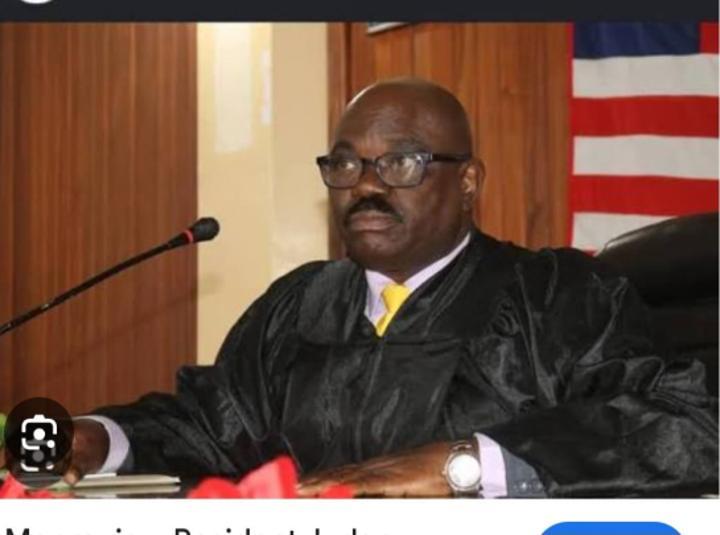
In a communication dated March 25 and issued from the Office of the Clerk at the Temple of Justice, Associate Justice Yussif D. Kaba, presiding in Chambers, ordered an immediate stay of all proceedings and summoned Criminal Court “A” Resident Judge Roosevelt Z. Willie to a conference scheduled for April 9 at 2:30 p.m.
The action follows a petition for a Writ of Certiorari filed by defense counsel, Atty. Jeremiah Samuel Dugbo I, challenging Judge Willie’s March 23 ruling denying a motion for a change of venue.
Defense Alleges “Trial by Public Spectacle”
At the center of the defense’s argument is what it describes as a “highly prejudicial and unconstitutional” public parade of the defendant by state security forces prior to trial.
According to the petition, Francis Nana was paraded through the principal streets of Monrovia under heavy police escort, with live media coverage and officers allegedly chanting, while he remained handcuffed—conduct the defense says portrayed him as guilty before trial.
The defense argues that the incident, combined with widespread media coverage and public demonstrations, has “polluted and contaminated” the minds of potential jurors in Montserrado County, making a fair and impartial trial impossible.
Citing Section 5.7.1(b) of Liberia’s Criminal Procedure Law, the defense maintains that a change of venue is warranted where an impartial trial cannot be secured. It also referenced precedents including Sawyer v. Republic (1944) and Gbenyna v. Republic (1988), which emphasize the necessity of venue change when prejudice is established.
Judge Willie Rejects Venue Change
Despite the defense’s arguments, Judge Willie ruled that media exposure alone does not justify transferring the case.
“In criminal activities such as murder, there will be media coverage. Whether jurors are from Montserrado or another county, they are expected to listen to the facts and render a verdict,” the court held.
The judge concluded that the defense failed to establish sufficient grounds and ordered the trial to proceed “forthwith.”
Defense counsel immediately excepted to the ruling and sought appellate review, a move that has now prompted the Supreme Court’s intervention.
Contradictions Emerge in Prosecution’s Case
Before the stay order, the prosecution had begun presenting its case, calling at least two witnesses whose testimonies have already drawn scrutiny over material inconsistencies.
One key witness, Police Officer Miatta Perry, testified that the taxi involved was moving at high speed but maintained the driver did not act intentionally—potentially weakening the prosecution’s claim of criminal intent.
Perry also stated that she later saw the driver at a depot, suggesting she was not directly involved in the arrest. However, another state witness contradicted this account, claiming Perry herself carried out the arrest.
The witnesses further gave conflicting timelines regarding the sequence of events, raising additional doubts about the coherence of the prosecution’s case. Legal observers say such inconsistencies could prove significant in a trial where the burden is on the state to prove guilt beyond a reasonable doubt.
Case Raises Constitutional Questions
The defense has framed the matter as a violation of fundamental rights, citing Article 21 of Liberia’s 1986 Constitution, which guarantees a fair, speedy, and impartial trial, as well as Article 11(c) on equal protection under the law.
Quoting established jurisprudence, the petition stresses that the purpose of criminal prosecution is to seek justice for both the state and the defendant—not merely to secure a conviction.
The defense also argues that certiorari is the proper legal remedy to review what it calls a “prejudicial and reversible error” by the trial court.
With the Supreme Court’s stay order now in effect, all proceedings in Criminal Court “A” remain suspended pending the outcome of the April 9 conference before Justice Kaba.
At that hearing, the Court is expected to determine whether Judge Willie erred in denying the motion for change of venue, whether the defendant’s right to a fair trial has been compromised, and whether the case should be transferred outside Montserrado County.
For now, the fate of the trial—and the integrity of the proceedings—rests with the Supreme Court’s Chambers decision.
As the case unfolds, concerns over pretrial publicity, conflicting prosecution testimony, and judicial resistance to relocation have intensified scrutiny from legal analysts and rights advocates.
For the defense, the central question remains whether Francis Nana will be judged in a court of law—or in the court of public opinion.
For More News And Analysis About Liberia Follow Africa-Press