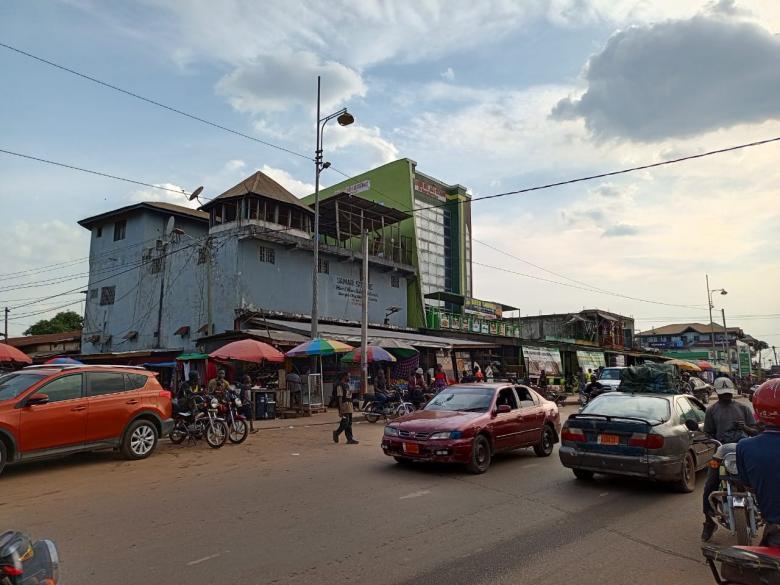
Africa-Press – Liberia. In the bustling trading hub of Ganta, a gateway city straddling Liberia’s border with Guinea and Côte d’Ivoire, local business leaders are raising a fierce cry against what they describe as predatory tactics by Indian traders.
Warning of an imminent shutdown of all commerce including their own they demand urgent government action to curb what they see as unfair foreign encroachment that’s squeezing Liberian merchants out of their livelihoods.
The heated standoff erupted during a press conference on March 25 at the Ganta Business Association’s modest headquarters amid the town’s chaotic market streets, where vendors hawk everything from imported rice to second-hand clothes under the relentless tropical Wednesday.
Massa Kamara, Head of Communications for the association and Justina Yoemie, its Vice Chairperson and owner of Justina Bar and Restaurant in Ganta, Nimba County accused Indian traders of illegally pivoting from wholesale to retail sales.
They claimed these foreigners undercut local prices, poach prime storefronts by outbidding rents and exploit customer biases driving Liberian owners toward ruin.
Ganta, long a vital commercial crossroads in Liberia’s mineral-rich Nimba County, thrives on cross-border trade that supports thousands of families.
Madam Massa Kamara, Head of Communication for Ganta Business
But the association leaders argued that lax enforcement of business permits intended to reserve retail for citizens while limiting foreigners to wholesale and manufacturing has fueled the crisis.
“Foreigners are flooding our streets, turning wholesale operations into cutthroat retail shops,” Kamara declared, her voice rising over the din of passing motorbikes.
She painted a vivid picture:
“Indian traders approaching landlords with fat stacks of cash, offering triple the rent say, $500 instead of $150 monthly to evict longtime Liberian tenants from iconic main-street shops with faded signage and bustling foot traffic.
Once installed, Kamara continued, they stock shelves with single bags of sugar, flour, juice, pricing them to match or beat locals. “In the name of double or triple pay, they’re evicting us,” she said, gesturing emphatically.
“If this continues, there will be no business left in Ganta. We’re shutting it all down ours include and theirs too. It will last as long as it takes for authorities to step in.”
Justina Yoemie amplified the outrage, her eyes flashing with determination as she urged the Government of Liberia(GoL) to reassess permits issued by the Ministry of Commerce and Industry.
“They claimed permission to do wholesale, but now they’re in retail, selling at our prices or lower,” she said. “Why? Our people favor the ‘white man’s’ goods they think a bulb from them is brighter, even at $3.50 versus our price.’.
‘‘In a few years, Liberians will be mere spectators in our own town,’’ Yoemie shared harrowing personal anecdotes to underscore the human toll.
At a recent business renewal office, she encountered a merchant who had sunk $1,500 into rent, only to be ousted when Indians dangled $3,500 before the landlord.
“These families sustained their lives through those shops,” she lamented. “Now they’re jobless, wandering the streets.”
Madam Justina Yormie, Vice Chairperson for Ganta Business Association
Another tale involved a tailor whose storefront was seized, leaving her children hungry amid Ganta’s rising cost of living, where inflation has already strained post-Ebola recovery efforts.
The association vowed not to tolerate further encroachments, threatening to block foreigners from new leases and even confront those they blame.
Store and shop owners, feeling the pressure, have hiked rents across Ganta’s main drags widening the chasm.
“This can’t happen in any country,”
Kamara insisted, calling for a mediated sit-down between Liberian traders and the Indian Community.
“Government must define their role: wholesale and manufacturing only, not retail that starves us.’‘
“As of March 25, the Ministry of Commerce and Industry officials had not responded to requests for comment.
With tensions simmering in this economic hotspot where trade volumes rival Monrovia’s markets, the standoff risks paralyzing a key driver of Liberia’s informal economy, home to over 100,000 residents reliant on its vibrancy.
For More News And Analysis About Liberia Follow Africa-Press