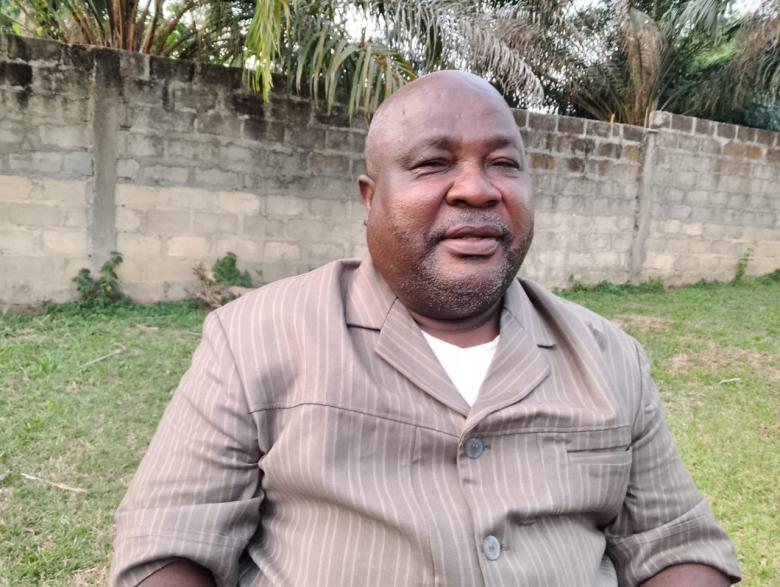
Africa-Press – Liberia. The Chairman of the opposition National Patriotic Party (NPP), George S. Mulbah, has come out strongly in support of the nomination of Cllr. Jonathan Weedor as Chairman of the National Elections Commission (NEC).
Mulbah asserted that President Joseph Boakai acted within the confines of the law and democratic norms. Mulbah described the ongoing backlash from opposition parties as politically motivated, stressing that Liberia’s democratic institutions must not be undermined by what he termed “selective interpretations” of neutrality.
Cllr. Weedor’s nomination has, however, ignited debate, with major opposition institutions raising alarm over his perceived political affiliations.
The Congress of Democratic Change (CDC), led by former President George Weah, has been at the forefront of the opposition, arguing that the credibility of the NEC is at stake.
The party insists that Cllr. Weedor’s active involvement with the Unity Party during the 2023 elections casts doubt on his ability to remain neutral in administering future electoral processes, especially given the sensitive role the NEC plays in safeguarding democratic integrity.
The CDC stated: “Entrusting the leadership of the NEC to an individual who recently demonstrated clear political alignment risks eroding the fragile trust that citizens have in our electoral system. The NEC must not only be independent in action but must also be perceived as such by all stakeholders. Cllr. Weedor’s recent engagements in partisan politics compromise that perception and place the integrity of future elections in question.”
The Alternative National Congress (ANC), headed by Alexander Cummings, has equally expressed dissatisfaction with the nomination, warning that the long-term credibility of Liberia’s democratic process could be weakened.
According to the ANC, appointing individuals with recent political ties to oversee elections could deepen mistrust among voters and political actors, particularly as the nation prepares for future electoral contests.
The ANC emphasized in its statement: “The independence of the NEC is the cornerstone of democratic governance, and any action that casts doubt on that independence must be carefully reconsidered. Appointing a figure with recent partisan visibility risks undermining public confidence and could create unnecessary tension in an already polarized political environment. Liberia deserves an electoral umpire whose neutrality is unquestionable both in fact and perception.”
Responding to these criticisms, Mulbah dismissed the arguments as lacking legal basis, pointing out that Liberia’s electoral framework does not prohibit individuals with political backgrounds from assuming leadership roles within the NEC.
He argued that such experience can, in fact, provide valuable insight into electoral dynamics, and warned against conflating political participation with institutional bias.
Mulbah also drew parallels with the appointment of former NEC Chairman Jerome Kokoya, who was selected by former President Ellen Johnson Sirleaf despite having contested a legislative seat under the Unity Party in 2011.
Kokoya, who was defeated by then-incumbent Bong County District One lawmaker Tokpah J. Mulbah of the CDC, went on to lead the NEC during a critical period in Liberia’s democratic transition. Mulbah argued that Kokoya’s tenure demonstrated that prior political involvement does not automatically translate into biased leadership.
He further reminded critics that under Kokoya’s leadership, the CDC emerged victorious in the 2017 presidential elections, defeating the Unity Party in a landmark democratic transition.
According to Mulbah, this historical example weakens the current claims being made by the CDC, as it illustrates that the electoral process can remain credible regardless of the past affiliations of NEC officials.
Mulbah also took aim at the CDC’s record, accusing the party of inconsistency. He referenced the appointment of Cllr. Teplah Reeves as Co-Chairperson of NEC in 2020, noting that Reeves had previously contested as a CDC senatorial candidate in Rivercess County in 2014.
Mulbah argued that the CDC’s acceptance of Cllr. Reeves at the time contradicts its present stance on Cllr. Weedor.
He remarked: “It is disingenuous for the CDC to now question the eligibility of individuals with political backgrounds when they themselves benefited from similar appointments in the past. Their current position reflects political convenience rather than principled leadership.”
He continued: “Liberians must not be misled by shifting standards. The issue is not whether someone once participated in politics, but whether they can uphold the law and act independently while in office. That is the standard that should guide our judgment.”
Mulbah called on the public and political actors to allow Cllr. Weedor the opportunity to serve, insisting that his performance should be the ultimate measure of his suitability for the role. He urged stakeholders to refrain from premature conclusions that could undermine confidence in national institutions.
At the same time, Mulbah criticized statements attributed to sections of the CDC suggesting the possibility of unrest if future elections are deemed unfair. He warned that such rhetoric is dangerous and has the potential to destabilize the country, especially given Liberia’s history.
He cautioned: “Reckless statements about war and conflict have no place in our democratic discourse. Liberia has come too far to be dragged back into instability by political impatience or unfounded fears.”
He added: “Those who aspire to lead must speak the language of peace and responsibility. Suggesting violence as a response to political disagreement undermines national unity and threatens the progress we have collectively achieved.”
Mulbah urged all political parties to engage constructively, emphasizing the importance of preserving peace while strengthening democratic governance.
He reiterated that the nomination of Cllr. Weedor should be assessed fairly and within the context of Liberia’s laws, rather than through the lens of political rivalry.
For More News And Analysis About Liberia Follow Africa-Press