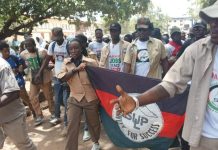
Africa-Press – Liberia. WHAT UNFOLDED ON the streets of Monrovia Tuesday should trouble every Liberian who still believes in the promise of democracy. Students—unarmed, organized, and exercising their constitutional right to assemble—were met not with engagement, but with teargas, batons, and arrests. It is a response that speaks volumes, not about the protesters, but about the state.
THE STUDENT UNIFICATION Party (SUP) and its allies did not march with weapons. They marched with a petition—one that laid bare the frustrations of a generation grappling with unemployment, economic hardship, and a deepening sense of exclusion. Their message, “Jobs and Justice,” was not radical. It was, in fact, foundational to any functioning democracy.
YET, INSTEAD OF listening, the Liberia National Police chose force.
THIS IS NOT JUST a policing failure—it is a political failure.
WHEN A GOVERNMENT responds to peaceful protest with teargas, it signals something far more dangerous than a breakdown in crowd control. It signals an intolerance for dissent. And when dissent is treated as a threat rather than a democratic necessity, the very fabric of the republic begins to fray.
THE SCENES DESCRIBED—students choking, collapsing, fleeing in panic—are not the images of a confident government. They are the images of a state on edge, one that appears increasingly uncomfortable with scrutiny and accountability.
LET US BE CLEAR: maintaining public order is a legitimate responsibility of the police. But there is a line—clearly defined by law and democratic norms—between managing crowds and suppressing voices. That line was crossed.
THE JUSTIFICATION, IF any exists, has yet to be convincingly presented. As of now, the silence from the authorities only deepens suspicion and erodes public trust.
EVEN MORE TROUBLING is the pattern. From civil servants to motorcyclists to students, protests are becoming more frequent, not less. This is not coincidence—it is consequence. It reflects a widening gap between the governed and those in power, a gap that cannot be bridged with force.
HISTORY OFFERS LIBERIA painful lessons. From the excesses of the 1980s to the unrest of the early 2000s, the suppression of dissent has never led to stability. It has only deepened grievances and, in some cases, fueled broader unrest. To ignore this history is to risk repeating it.
THE DEMANDS PRESENTED by the students may be ambitious—perhaps even unrealistic in the short term. But that is beside the point. In a democracy, citizens are not required to be “reasonable” before they are heard. They are only required to be peaceful. And by all credible accounts, they were.
WHAT THE STATE owed them was not teargas, but dialogue.
THE ARRESTS, PARTICULARLY of figures like Foday N. Massaquoi, only compound the perception of a heavy-handed response. Detention must never become a tool to intimidate or silence. If there are charges, they must be lawful, transparent, and subject to due process. Anything less undermines the rule of law the government claims to uphold.
PRESIDENT JOSEPH NYUMA Boakai’s administration now faces a defining test. It can continue down this path—where protests are met with force and criticism is treated as hostility—or it can recalibrate, recognizing that dissent is not an enemy of governance, but an essential part of it.
LIBERIA’S YOUNG PEOPLE are not asking for charity. They are demanding opportunity, accountability, and a seat at the table. These are not unreasonable demands. They are, in fact, the very essence of democratic citizenship.
TEARGAS MAY DISPERSE a crowd. It cannot disperse the conditions that brought that crowd into the streets.
AND IF THOSE conditions remain unaddressed, the next protest will not just be bigger—it will be louder, angrier, and far more difficult to contain.
THE CHOICE BEFORE the government is simple: engage or escalate.
FOR THE SAKE of Liberia’s fragile democracy, one hopes it chooses wisely.
For More News And Analysis About Liberia Follow Africa-Press