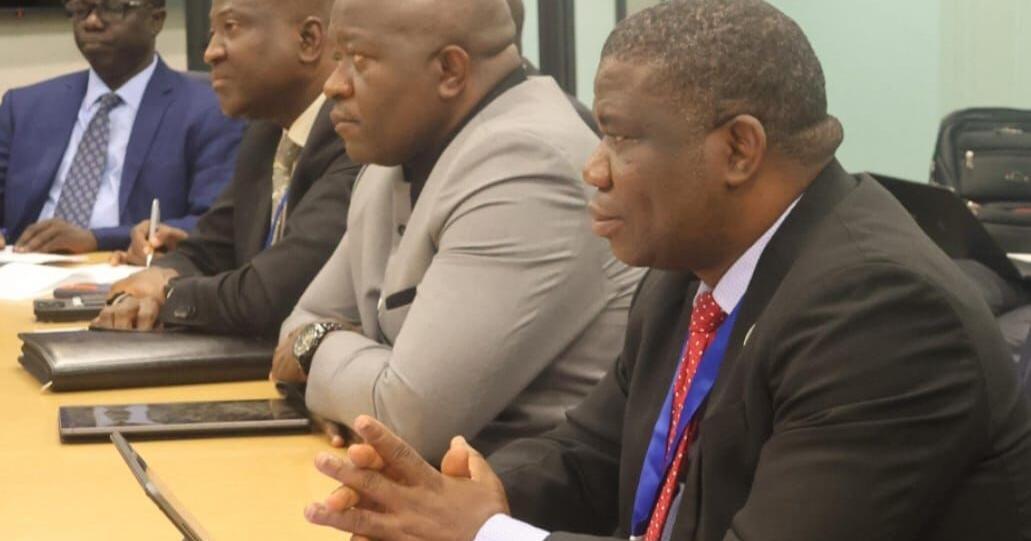
Africa-Press – Liberia. WASHINGTON, D.C. — Confronted by tightening fiscal space, rising debt obligations, and shifting patterns of global aid, Liberia’s Finance and Development Planning Minister, Augustine Kpehe Ngafuan, is urging a recalibration of how African governments finance critical sectors, warning that traditional approaches are no longer sufficient to meet growing demands.
Speaking on the sidelines of the IMF/World Bank Spring Meetings in Washington, Ngafuan framed the challenge in stark, practical terms: governments are being asked to deliver more services, expand coverage, and improve quality — all while operating within increasingly constrained budgets.
“Every day, we are asked to do more,” Ngafuan said during the launch of the “Sustainable Financing for Health: A User Guide for African Governments.” “But at the same time, we are working within increasingly tight constraints. Budgets are under pressure. Debt servicing is rising. And the external support many of our systems have relied on is evolving.”
His remarks reflect a growing concern among African policymakers that the era of predictable, large-scale donor support is shifting, leaving governments to navigate a more complex financing landscape. For Liberia, the pressure is compounded by external shocks, including the economic ripple effects of the ongoing crisis in the Middle East, which Ngafuan said continues to weigh on the domestic economy.
Against this backdrop, the finance minister is advocating for a more diversified financing strategy — one that moves beyond traditional budget allocations and embraces innovative instruments that have historically been underutilized.
“We are all familiar with traditional budget financing,” he said. “But increasingly, we are being asked to consider other approaches, whether public-private partnerships, sustainability-linked financing, or even debt-for-health swaps.”
Such mechanisms, he acknowledged, are not without complexity. For many governments, they fall outside the routine operations of public finance management. Yet Ngafuan argued that properly understood and carefully structured, they could unlock new pathways to sustain critical investments, particularly in sectors like health where funding gaps remain persistent.
Central to this shift, he noted, is bridging the long-standing disconnect between finance and sector ministries—especially health.
“As Ministry of Finance, we know where the needs are — in infrastructure, workforce, and service delivery,” Ngafuan said. “But turning those needs into financing solutions requires close engagement with our colleagues. And that is not always easy.”
The newly launched guide, developed with support from the African Legal Support Facility and the Bill & Melinda Gates Foundation, seeks to address that gap by creating a shared framework for decision-making — one that aligns technical health priorities with fiscal realities.
Ngafuan described the tool not as a silver bullet, but as a practical starting point — one that helps governments ask the right questions, structure financing discussions, and move from concept to implementation.
“This Guide will not solve all our challenges,” he said. “But it gives us something very important: a starting point.”
His intervention comes as Liberia continues to engage with the International Monetary Fund on broader economic reforms. Earlier in the week, Ngafuan held talks with IMF Liberia Mission Chief Daehaeng Kim, updating the Fund on the country’s economic outlook and policy responses to external shocks.
The IMF, in turn, praised Liberia’s economic management and signaled that the country is on course for Board consideration of its application to the Resilience and Sustainability Facility — a financing window designed to support climate-related investments over the medium term.
While that potential support could provide critical fiscal breathing room, Ngafuan’s message suggests a broader strategic pivot: Liberia is not only seeking more funding, but also rethinking how financing itself is structured and deployed.
Underlying that shift is a recognition that sustainable development — particularly in essential sectors like health — will depend less on single funding sources and more on coordination, efficiency, and disciplined innovation.
“Ultimately, sustainable health financing will not come from one solution or one actor,” Ngafuan said. “It will come from better coordination, better use of available resources, and a willingness to explore new approaches — while remaining disciplined in how we apply them.”
For Liberia, and much of Africa, that balancing act—between ambition and constraint, innovation and discipline—may well define the next phase of development policy in an increasingly uncertain global economy.
For More News And Analysis About Liberia Follow Africa-Press