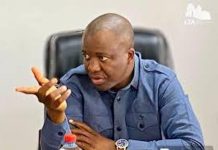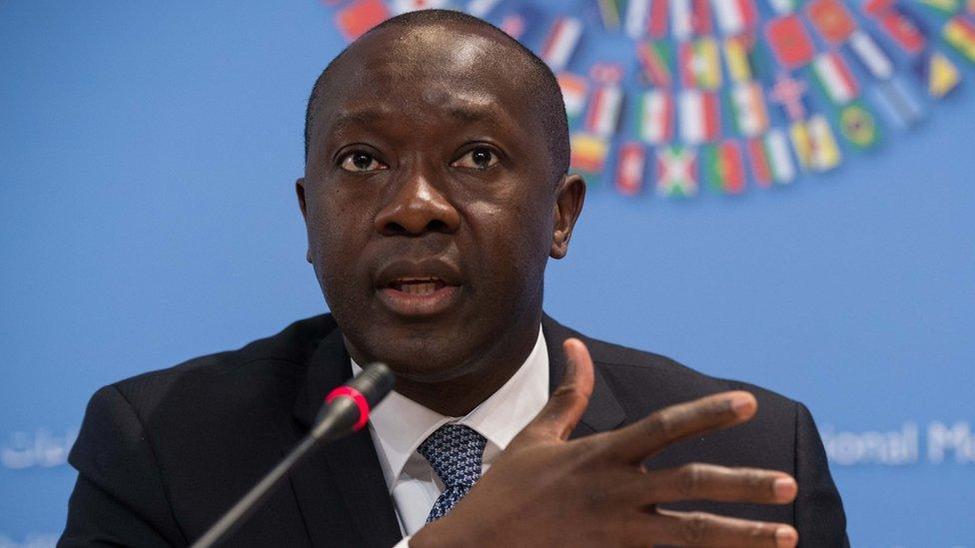
Africa-Press – Liberia. Senator Amara Konneh
Monrovia – The Chairman of the Senate Committee on Public Accounts and Audit, Senator Amara Konneh, has released an analysis on a proposal from the Central Bank of Liberia (CBL) to print new Liberian dollar bank notes, outlining consequences that would affect the Liberian economy and citizens in particular if multiple steps are not taken to sustain macroeconomic stability and reduce the high cost of living among the citizenry.
It can be recalled that the CBL, through its Executive Governor Henry Saamoi, on Tuesday, April 21 unveiled a plan by the bank to print L$79 billion dollars between 2026 to 2030 and the introduction of a 2000
Liberian dollar bank to replace mutilated local currency and improve the country’s economy.
The plan was unveiled at a public hearing organized by the Senate Joint Committee on Banking and Currency, Ways, Means, Finance and Budget and Public Accounts and Audit.
In a statement released in Monrovia on Wednesday, April 22, Senator Konneh pointed out that the CBL’s proposal reflects approximately US$19 billion beyond what the Liberian economy appears to need at this time.
He noted that Senate and the House of Representatives now face a responsibility that is both technical and moral.
He said lawmakers must now balance the operational needs of the monetary authority with the economic realities facing Liberian households.
“This balance is delicate. If we underfund the Central Bank, we risk liquidity shortages, payment system instability, and constraints on economic activity. If we authorize more currency than the economy needs, we risk fueling inflation, weakening the exchange rate, and eroding the purchasing power of ordinary Liberians.”
Silent tax on citizens
Senator Konneh asserted that Liberia’s economic history, like that of many developing nations, demonstrates that excessive monetary expansion acts as a silent tax on citizens through inflation.
He added that it (inflation) hits wage earners, market women and small businesses the hardest, as their incomes do not adjust quickly to rising prices.
He maintained that when this happens, households face higher food prices, increased transport fares, and a gradual decline in real incomes.
Senator Konneh stressed that insufficient liquidity introduces its own risks, potentially stifling growth, weakening confidence in the financial system, and disrupting payment processes.
That’s why, he noted that, even as lawmakers consider the need for physical currency, they must ensure the volume of banknotes authorize does not compromise the Central Bank’s commitment to expanding digital financial services and gradually transitioning Liberia toward a cashless economy.
“Striking the right balance is crucial to safeguarding both stability and the well-being of ordinary Liberians. For these reasons, the Senate must proceed with caution, discipline, and a focus on evidence. Based on the Senate’s own internal analysis, the justified currency needs range—which covers the replacement of worn notes, normal net injections, and a reasonable reserve cushion—is estimated at 60 billion Liberian dollars if these funds are allocated.”
Consequences
Senator Konneh stated that this gap does not automatically mean misjudgment or misconduct, but however raises important questions that must be addressed before the Legislature can responsibly approve such a large monetary expansion.
He emphasized that every additional dollar printed has consequences. He observed that it would influence inflation expectations and price stability and affect the exchange rate and the cost of imported goods. It determines whether Liberians’ real incomes increase or decrease. It shapes confidence in the Central Bank and the broader economy. It impacts the credibility of our monetary policy framework.
Senator Konneh noted that the Senate’s responsibility now is to ensure that any authorization meets the real needs of the economy, not just institutional preferences or operational convenience.
He said monetary expansion should be proportionate, justified, and aligned with long-term stability.
The Broader Economic Context
He observed that Liberia’s economy is still recovering from multiple shocks, including global commodity volatility, domestic supply constraints, and structural weaknesses in agriculture, energy, and infrastructure.
He maintained that in such an environment, monetary policy must be carefully calibrated.
He said a currency printing program of this magnitude must be evaluated not only in terms of liquidity needs, but also in terms of inflation dynamics in a highly import-dependent economy, on imports, exchange rate pressures driven by structural trade deficits, the velocity of money in a cash-dominant financial system, confidence effects on banks, businesses, and households, and the degree of fiscal and monetary coordination given revenue constraints.
Senator Konneh stated that the Senate must ensure that the Central Bank’s request does not unintentionally undermine macroeconomic stability, given that Liberians are already facing rising living costs.
The Gold Purchase Program and Reserve Adequacy
At the hearing, Senator Konneh observed that CBL Governor’s recognition that more liquidity is needed to support the gold purchase program raises key policy issues.
He noted that gold accumulation can boost reserves, enhance confidence, and diversify the country’s external buffers, but the liquidity needed to implement such a program must be clearly measured and justified.
“The Committee will require a clear breakdown of the liquidity needs for the gold purchase program, a timeline for reserve buildup, a risk management framework, and a reporting mechanism to ensure accountability. Reserve adequacy is crucial, but it must be achieved through sound policy rather than excessive monetary expansion that could destabilize prices.”
He assured that the Joint Committee will demand clear justification for each part of the request, transparent modeling of inflation and exchange rate effects, and a credible plan for reserve management and gold purchase liquidity.
Senator Konneh mentioned that the committee would also request for strong safeguards to protect citizens from unintended inflation, a monitoring framework to ensure accountability and timely updates, and a phased approach if needed to reduce macroeconomic risks.
“Our goal is simple. We want to support growth, maintain stability, and preserve the purchasing power of the Liberian people. The Senate remains committed to a responsible, data-driven outcome that enhances the Central Bank’s capacity while protecting the economic well-being of every Liberian family. This is why we may need more time before approving,” he added.
For More News And Analysis About Liberia Follow Africa-Press