Africa-Press – Liberia. Vice President Jeremiah Koung has asserted that while Liberia possesses the military capability to defend its territorial integrity, the government has deliberately chosen diplomacy over confrontation in addressing the ongoing border tensions with Guinea.
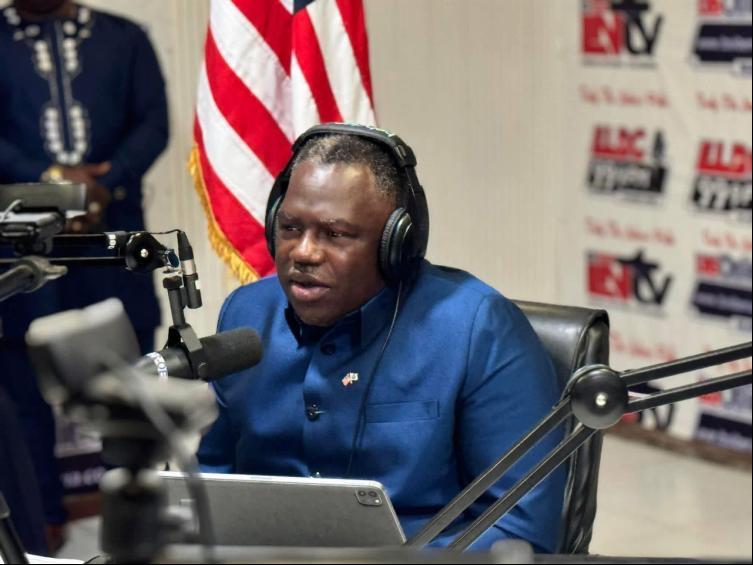
Speaking Monday on state radio ELBC, Vice President Koung pushed back against public narratives questioning Liberia’s defensive strength, emphasizing that the country’s security apparatus extends beyond the conventional army.
“I get updated every day. People say Guinea has a huge military and Liberia cannot stand, but we have fighting forces here beside the army,” he said, suggesting that Liberia maintains strategic capacities that are not always publicly disclosed.
He added, in a pointed remark, that even a small number of determined individuals could destabilize territories elsewhere, underscoring his argument that military strength is not solely about size but capability.
Despite this, Vice President Koung stressed that the administration of President Joseph Boakai remains firmly committed to peace, making clear that war is not an option under consideration.
The current border dispute between Liberia and Guinea traces its roots to longstanding ambiguities in demarcation along sections of the two countries’ shared boundary, particularly in remote and forested areas where historical agreements, colonial-era maps, and local interpretations have often conflicted.
Tensions escalated in recent weeks following reports of Guinean military presence in contested zones, sparking concern among border communities and prompting diplomatic engagement at the highest levels.
For over a month, the situation has remained delicate, with intermittent reports of troop movements, civilian displacement, and heightened anxiety among residents who depend on cross-border trade and familial ties for survival.
Local leaders have called for restraint, while national authorities have sought to prevent misinformation from inflaming the situation. The persistence of the crisis reflects both the complexity of inherited boundary issues and the challenges of maintaining clarity in regions where natural landmarks, rather than fixed infrastructure, define borders.
In response to the growing tensions, regional leaders, including President Boakai of Liberia, President Mamadi Doumbouya of Guinea, and President Julius Maada Bio of Sierra Leone, convened earlier for high-level peace talks aimed at de-escalating the situation and reinforcing commitments to regional stability.
The discussions, held under the spirit of Mano River Union cooperation, focused on dialogue, mutual respect for sovereignty, and mechanisms for joint border management.
However, just days after the talks, reports indicated that Guinean forces were still stationed in disputed areas, raising questions about the effectiveness of the agreements reached and the pace of implementation on the ground.
This development has added urgency to ongoing diplomatic efforts, as stakeholders work to translate political commitments into tangible de-escalation. Despite these setbacks, Liberian authorities continue to emphasize engagement over escalation, maintaining that sustained dialogue remains the most viable path to a peaceful and lasting resolution.
Expanding on the government’s position, President Boakai has reiterated that Liberia’s foreign policy is anchored on peace, regional cooperation, and respect for international law.
He emphasized that while the country will never compromise its sovereignty, it remains committed to resolving disputes through established diplomatic channels, including bilateral engagements and regional frameworks. “Liberia is a peaceful nation, but let it be clearly understood that our commitment to peace does not imply weakness,” Boakai said in a firm statement.
“We have the responsibility to protect our borders and our people, yet we are equally bound by our duty to preserve stability in the Mano River basin, because conflict between neighbours will only reverse the gains we have collectively made over the years.”
The President further called on citizens, especially those in border communities, to remain calm and avoid actions that could escalate tensions, noting that the government is actively engaging Guinean authorities to find a lasting solution.
He also urged regional bodies to remain involved in monitoring the situation to ensure that agreements reached are respected by all parties. “Our approach is deliberate and measured,” President Boakai added.
“We are engaging our counterparts in good faith, we are utilizing regional mechanisms, and we are ensuring that every step taken reflects Liberia’s longstanding commitment to peace, security, and cooperation. The path we have chosen is diplomacy, not because we lack options, but because it is the most responsible and sustainable way to resolve this situation.”
For More News And Analysis About Liberia Follow Africa-Press