By Mustafa Al-Mu’tasim
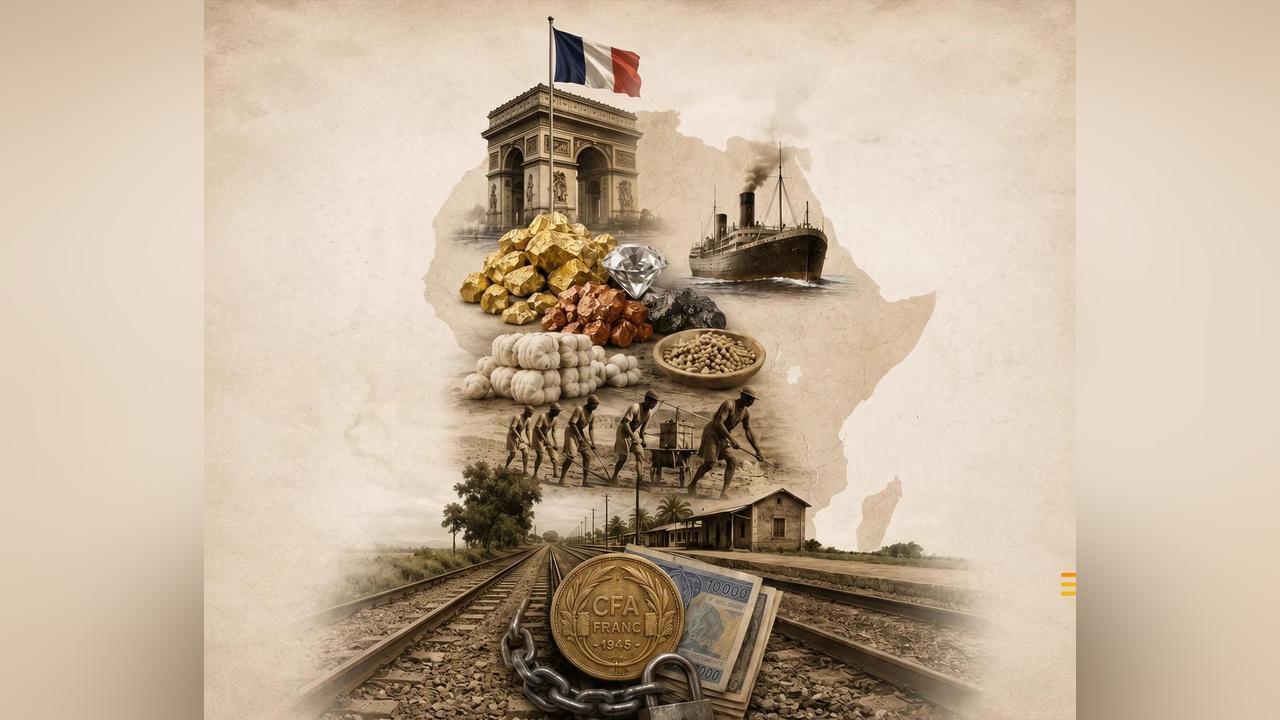
Africa-Press – Liberia. Since the 19th century and the beginning of the 20th century, European colonial powers have controlled the natural and human resources of the African continent to serve their industrial and commercial economies. They plundered natural resources and raw materials such as gold, diamonds, copper, iron, rubber, cotton, phosphate, and oil.
Colonial authorities forced the local populations to cultivate export-oriented crops instead of food crops, such as coffee, cocoa, cotton, and peanuts, leading to food insecurity and famines in some areas.
Colonialism also exploited the African people by imposing forced labor, harsh taxes, and low wages. Even the infrastructure established by colonialism, such as roads, railways, and ports, was designed to transport resources to colonial powers rather than to develop the internal African economy.
Even after the end of colonialism, it sought to maintain its interests against the interests of African nations and peoples. France, which François Mitterrand stated in 1957: “Without Africa, France will have no history in the 21st century,” will strive with all its might to maintain strong control over its former colonies. It will ensure priority over any raw or natural resource discovered in these former colonies and that its companies have precedence in public contracts, even if the former colonies receive better offers from other countries. It will also retain exclusive rights to provide military equipment and train military officers of independent countries, as Africans must send their officers for training in France, where they are often recruited and used when needed for coups or other purposes.
France also ensured the right to deploy troops in its former colonies and intervene militarily to defend its interests. It imposed a ban on independent countries from entering military alliances with any other country without France’s approval and required them to ally with France in times of war or global crises. France imposed its language as the official language and the language of education in independent countries and established organizations to promote Francophone culture.
France and the Colonial Tax
In 1957, during the height of the liberation war in Algeria, French President Charles de Gaulle proposed the “Colonial Charter,” which stipulated that French colonies in Africa could choose between joining a “French-African Group” to enjoy extensive autonomy while maintaining strong ties with France in defense, foreign policy, currency, and economy, or independence.
Most colonies initially chose to join the group, while Guinea opted for independence on October 2, 1958, after the Guineans, led by Ahmed Sékou Touré, rejected the proposal to remain within the French-African group, stating, “We prefer freedom in poverty to wealth in slavery.” This angered French political elites, who demanded that the French colonial administration in Guinea destroy everything they considered positive about French colonialism.
Thus, the French colonizers did not leave Guinea until they took everything they could carry and destroyed everything they could not: schools, public administration buildings, cars, books, medicines, tractors. They also killed horses and cows and poisoned or burned agricultural crops, leaving Guinea in a difficult economic situation. The aim of these criminal acts of destruction was to send a clear message to other colonized nations about the consequences of considering separation from France.
In the same year, fearing the consequences of choosing independence from France, Léopold Sédar Senghor stated: “The choice of the Senegalese people is independence, but they want it to happen only in friendship with France, not in conflict.”
The contagion of independence spread among African nations in the early 1960s, leading to the disintegration of the “French-African Group.” However, the elites of the independent African nations recalled the harsh lesson from Guinea, so they sought compromises with France. Sylvanus Olympio, the first president of Togo, was the first to propose that his country pay an annual colonial tax to France in exchange for what he claimed were benefits obtained during its colonization of Togo. Based on this proposal, France demanded a very large annual sum to repay what it called the “colonial debt” (about 40% of Togo’s budget in 1963).
Many countries colonized by France have paid and continue to pay this colonial tax, which some French people like to call the tax of civilization or modernization. In Morocco, former university professor and parliament member Khadija Mfid stirred controversy when she stated on a program on a Moroccan television channel that France benefits from the revenues of Morocco’s natural resources, especially phosphate, at a rate ranging from 60% to 80% based on the “Iks-Liban” agreements signed in 1956, under which Morocco gained independence. The duration of benefit according to the agreement extends for about 100 years, until 2050.
Ironically, Haiti, the poorest country in the Caribbean, was forced to pay France the equivalent of $21 billion today from 1804 to 1947 for the losses incurred by French slave traders after the abolition of slavery and the liberation of Haitian slaves.
The Colonial Financial System: The African Franc
France established the CFA franc in December 1945. Most countries in the franc zone are former colonies of the French Empire that gained their national independence mostly in the late 1950s and early 1960s.
While some colonies or former French protectorates chose their currencies, as was the case with Guinea Conakry after its independence in 1958, Morocco in 1959, Algeria in 1963, Madagascar in 1972, and Mauritania in 1973, 14 African countries (12 of which were formerly French colonies: Benin, Burkina Faso, Ivory Coast, Mali, Niger, Senegal, Togo, Cameroon, the Central African Republic, Chad, Congo-Brazzaville, and Gabon, in addition to Guinea-Bissau (a former Portuguese colony) and Equatorial Guinea (a former Spanish colony)) chose to use the CFA franc.
The currency law designates XAF for the currency used in Central Africa and XOF for the currency used in West Africa. This currency had a fixed value against the French franc and today has a fixed value against the euro.
Mali experimented with a national currency for 22 years but returned to the African franc (FCFA) in 1984 after experiencing an economic collapse.
France imposed on the countries using the CFA franc to place 85% of their reserves in the French central bank (each central bank of the countries using the CFA franc must keep at least 65% of its foreign currency reserves in an “operations account” managed by the French treasury, in addition to another 20% to cover financial obligations), allowing the countries under its financial system access to only 15% of their funds annually. If they needed more, African countries had to borrow at commercial rates on the 65% of their funds held in the French treasury.
France also imposes a ceiling on the amount of money that countries can borrow from reserves, limited to 20% of their public revenues from the previous year. If countries need to borrow more than 20% of their own funds, France has the right to veto.
In Togo, President Olympio attempted to overcome the difficult financial situation left by the colonial tax imposed by France on this newly independent country by withdrawing from the CFA franc system and establishing the Togolese currency. However, this idea did not sit well with French decision-makers, and on January 13, 1963, just three days after the new banknotes began printing, a French-backed coup occurred, and Olympio was executed by a former soldier of the French Foreign Legion, Corporal Étienne Gnassingbé.
After the introduction of the euro, despite the European Union’s rejection of the CFA franc system, France remained attached to it as it provides about $500 billion annually from Africa. Former French President Jacques Chirac stated about this system: “We must be honest and acknowledge that a large part of the money in our banks comes precisely from the exploitation of the African continent.”
The issue of the CFA franc raises discussions about economic sovereignty in the countries using it, especially after the shock of 1994 when Paris imposed a 50% devaluation of this currency. This had immediate consequences, as the purchasing power of citizens collapsed due to the sudden rise in prices, leading to a loss of confidence in the system.
Amadou Diop, a Senegalese economist, stated about the CFA franc: “It is like a golden necklace that suffocates us… They tell us it protects us, but in reality, it limits our sovereignty.” This opinion is shared by many in West Africa, who see this currency as an obstacle to economic development and political independence.
According to a survey conducted by the African Economic Observatory in 2023, 68% of citizens in the concerned countries believe that the CFA franc should be replaced with a true African currency. A new currency, the Eco, supported by the Economic Community of West African States (ECOWAS), was proposed to replace the CFA franc at the beginning of 2020, but the implementation of this currency has been postponed several times.
Today, France appears less powerful than it was fifty years ago. Concurrently with the decline of its military presence in the Sahel countries, France faces competition from European countries since the adoption of the euro and fierce competition from China, India, the United States, and Turkey. It has become difficult for France to control the economic directions of its former colonies, which has forced it since December 2019 to begin reconsidering its economic policies with its former colonies, especially after the sharp criticisms directed by the leaders of Burkina Faso, Mali, Niger, and Chad towards the French franc, which they described as a colonial currency and a tool of economic domination.