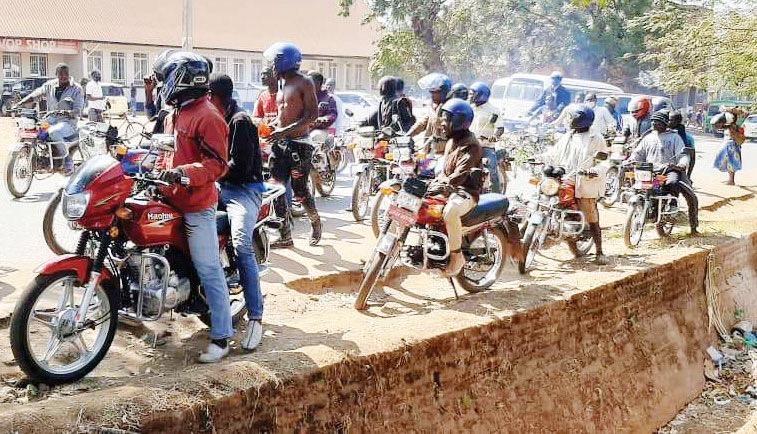
Africa-Press – Malawi. A new survey by the Institute of Public Opinion and Research (Ipor) shows that most Malawians still use motorcycle taxis, commonly known as kabaza, and are against banning them in towns and cities.
This is happening even though motorcycle accidents have greatly increased over the years. The Directorate of Road Traffic and Safety Services (DRTSS) reports a 1,700 percent increase in motorcycle accidents between 2014 and 2022. From 2020 to 2023, there were 4,566 motorcycle accidents, which led to 472 deaths.
Speaking in Lilongwe, Ipor Director of Research Boniface Dulani said the survey found that 72 percent of Malawians used kabaza in 2024, and more than half of them used it many times.
The survey interviewed 1,395 people in 27 districts. Of these, 86 percent were from rural areas, while only 14 percent were from urban areas. 43 percent came from the Southern Region, 44 percent from the Central Region, and 13 percent from the Northern Region.
Dulani explained that kabaza use is higher in cities (57 percent) than in rural areas (52 percent). The Northern Region has the highest usage (62 percent), followed by the Southern Region (55 percent) and the Central Region (49 percent).
He also said that educated people use kabaza more, with 85 percent of those with post-secondary education using it, compared to 49 percent with only primary education.
The study also found that 97 percent of Malawians believe kabaza is very important in their communities, but they want it to be properly regulated.
“Most Malawians do not support banning kabaza motorcycles from carrying passengers in towns and cities,” said Dulani.
According to the survey:
97 percent want riders and passengers to wear helmets
94 percent want riders to have licenses
77 percent want police to confiscate motorcycles when riders break the law
People value kabaza because it is cheap, fast, and helps them avoid traffic jams. In many rural areas, it is the only available form of transport.
Meanwhile, Moses Mwalabu, Chairperson of the Malawi Coalition for Kabaza Stakeholders Association (Macokasa), agreed that kabaza must be regulated. He said his association is already working with the police to encourage helmet use.
“Some passengers refuse to wear helmets, but as an association we do not support unsafe riding. We are doing awareness campaigns,” he said.
However, Mwalabu complained that licence fees are too high. He wants the operator licence fee reduced from K53,000 to K20,000. He also said registering a small motorcycle now costs about K116,000, which is too expensive. He noted that motorcycle and vehicle licence fees are currently the same, which he feels is unfair.
In another interview, Maureen Sabawo, President of the Malawi Orthopaedic Association, said kabaza accidents are putting too much pressure on hospitals.
“Our hospitals do not have enough beds, staff, and equipment to handle the large number of accident victims,” she said.
When contacted, DRTSS spokesperson Angellina Makwecha did not answer her phone. Ministry of Transport spokesperson Watson Maingo asked for more time to consult.
Health rights activist Maziko Matemba said government should ensure that part of the money collected from insurance goes to treating accident victims in hospitals.
Kabaza accidents remain a serious public health problem. Nearly half of adult injury patients in public hospitals are from road accidents, and over 60 percent of those involve kabaza.
In the first three months of this year alone, police recorded 227 kabaza accidents.
For More News And Analysis About Malawi Follow Africa-Press