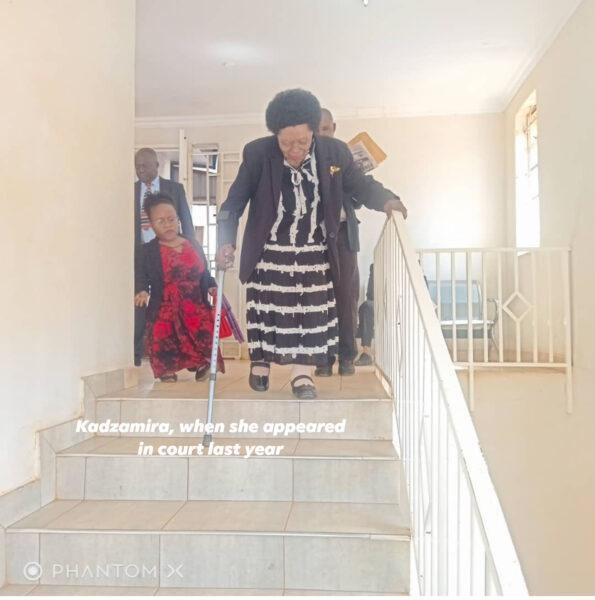
Africa-Press – Malawi. In a landmark judgment that has sent shockwaves through Malawi’s legal and agricultural communities, the High Court in Lilongwe has stripped Mama Cecilia Tamanda Kadzamira of Tichitenji Estate, a farm she has owned, developed, and peacefully occupied for over forty-seven years. The decision, delivered by Justice Simeon Mdeza on December 30, 2025, sides with descendants of the late Elias Zakeyo Kaphwiti Banda, who claimed a superior title based on a lease from the 1960s.
While the court’s ruling hinges on technicalities of registration priority and the nemo dat quod non habet principle, a deeper analysis reveals a story not of legal clarity, but of a profound injustice: a woman who, by all accounts of possession, investment, and state-recognised tenure, is losing her life’s work due to historical administrative ghosts and a rigid application of law that overlooks four decades of reality.
The Heart of the Matter: Forty-Seven Years of Peaceful Possession vs. a Paper Trail
For nearly half a century, Cecilia Kadzamira was the undisputed mistress of Tichitenji Estate. The court’s own record acknowledges this:
She was granted a 99-year lease by the Government of Malawi, effective April 1, 1978, following the lawful surrender of a previous lease by Dr. Hastings Kamuzu Banda.
She took immediate possession, developed the land, and exercised open, continuous, and unchallenged ownership from 1978 until 2021.
For over 40 years, no competing claim was raised against her. She paid rates, invested in the property, and operated under the full authority of a state-issued lease registered in the Deeds Registry.
Her story is one of diligent acquisition and sustained stewardship. The Ministry of Lands, joined in the case as a Third Party, steadfastly defended the legality of its actions: the surrender by Dr. Banda was valid, the re-grant to Kadzamira was procedural, and her certificate of lease was prima facie evidence of ownership. For the state itself, Kadzamira was the legitimate owner.
The Court’s Reasoning: A Triumph of Technicality Over Fact?
The court dismissed Kadzamira’s case on several technical grounds, each of which stands in stark contrast to the lived reality of her possession:
Priority of Registration: The court ruled that the 1968 lease to Elias Banda, registered in December 1968, took priority over Kadzamira’s lease, registered in November 1989. It applied Section 8 of the Deeds Registration Act mechanically, despite the fact that the earlier lease was widely believed—even by the Banda family—to have been extinguished or superseded for decades.
Late Registration: The court deemed Kadzamira’s lease “null and void ab initio” because it was executed in 1982 but only registered in 1989, missing the three-month statutory window. This rendered her 47 years of state-sanctioned possession legally invisible. The court dismissed the state’s presumption of regularity, punishing Kadzamira for an administrative delay that the government itself never challenged until now.
Nemo Dat Quod Non Habet (You Cannot Give What You Don’t Have): The court accepted the argument that because the 1968 lease was never formally cancelled, the government had no legal interest to regrant to Dr. Banda in 1972, and thus none to regrant to Kadzamira in 1978. This logic unravels a chain of state transactions spanning 18 years, invalidating the documented acts of a sitting President and the Ministry of Lands, and ignores the legal mechanism of surrender which the state testified was followed.
The Unanswered Questions and Glaring Inequities
This ruling raises disturbing questions about justice, equity, and the security of land tenure in Malawi:
Where was the State? For 47 years, the Government of Malawi recognised Kadzamira as the lawful lessee. It accepted her payments, dealt with her as owner, and defended the legality of her title in court. Now, the court’s finding implies the state has been collecting revenue and engaging with a “void” title for decades. Who bears responsibility for this colossal institutional failure?
The Price of Peaceful Possession: Kadzamira’s greatest strength—her long, peaceful, and open possession—was ultimately turned against her. The court acknowledged that limitation laws barred the Banda family from actively suing to recover the land (their right to sue expired in the mid-1980s). However, it allowed them to use that same “stale” claim as a shield to justify trespassing in 2021. This creates a perilous precedent: a registered owner can be ousted by a historical claimant who no longer has the right to sue, simply by walking onto the property.
Equity and “Sleeping on Rights”: The Banda family admitted they fled political persecution in the 1970s and only discovered the registered lease in 2014. While their historical grievance is noted, the law on acquiescence and delay exists precisely to prevent the unsettling of long-established possession. The court’s decision prioritises a dormant paper title from 1968 over the active, good-faith ownership of nearly five decades.
A Chilling Message to Landholders: The message is bleak: your state-issued title, your decades of investment, and your peaceful possession can be obliterated by a superior paper trail from a bygone era that the state itself forgot or failed to properly administer. This undermines the very foundation of a reliable land registry system.
Conclusion: A Bitter Legacy
Mama Cecilia Kadzamira did not steal this land. She acquired it through official channels, in a transaction defended by the state. She nurtured it for almost half a century without challenge. She is not a speculator or an absentee landlord, but a long-term developer whose life’s work is now legally severed from her.
The court has delivered a verdict steeped in legal technicalities from the Deeds Registration Act. But justice is more than the sum of statutory sections. It must consider reason, fairness, and the crushing human cost of upending a settled life built in good faith.
In ruling for the paper of 1968 over the person of 1978-2025, the court has not just transferred a property title. It has written a cautionary tale about the fragility of ownership in Malawi and delivered a devastating blow to a woman who, by every measure of tangible possession and state recognition, was the true custodian of Tichitenji Estate. The farm may have changed hands on paper, but its history, for the last 47 years, will forever bear her name.
For More News And Analysis About Malawi Follow Africa-Press