
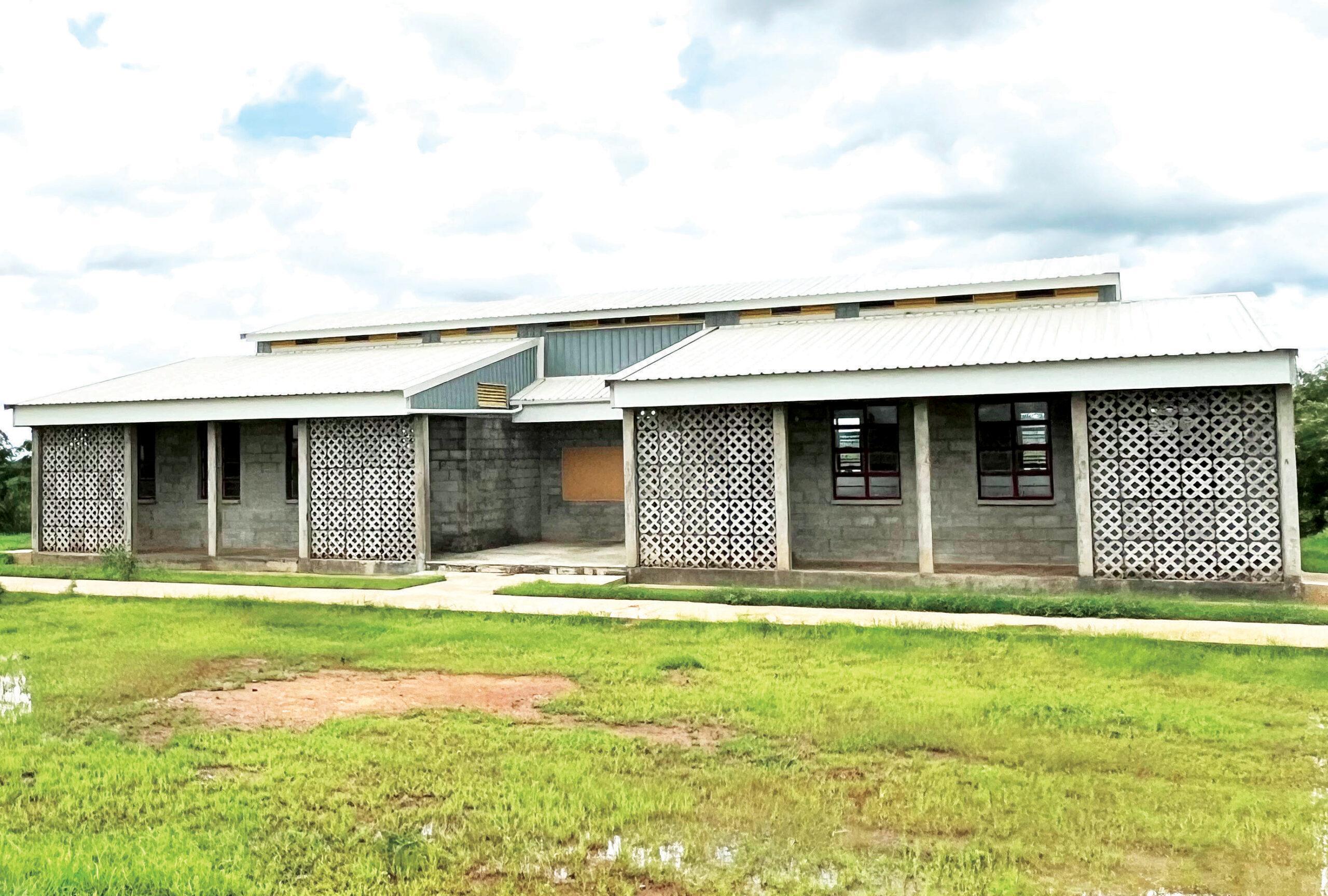
NOT YET UTILISED—School structuresMercy Matonga & Taonga Sabola:
Every school term, 20-year-old Mayankho Bottoman shoulders a small bag and walks away from her village in Khotekhote, Salima District, toward a life of uncertainty.
Her journey to Mvera Secondary School spans nearly 20 kilometres, an exhausting distance that has forced her to, far from the comfort and protection of home, live without a guardian.
For her, education comes wrapped in hunger, fear and missed lessons.
“We are not safe. Sometimes we run out of food and have to go back home to get ufa [maize flour]. That means missing classes. Living away from home is not easy,” Bottoman said.
– Advertisement –
Her hardship is made more painful by what stands idle just a few kilometres away: a newly built secondary school, locked behind silent gates, its classrooms unused, its corridors collecting dust.
In Khotekhote, public funds are frozen in a project that has never served a single learner.
Completed in 2023 under the Secondary Education Expansion for Development (Seed) Project, Khotekhote Secondary School was meant to shorten journeys like Mayankho’s and bring learning closer to home.
Instead, it has become a white elephant, shut down by a land dispute that has grown into a legal battle, exposing cracks in land governance, community consultation, and project oversight within Malawi’s education sector.
– Advertisement –
At the heart of the impasse is the land itself.
Christina (not her real name), who claims ownership of the land on which the school was constructed, sued the government for building the facility without her consent or compensation.
“The government built the school without consulting us. Now that the building is complete, we are only asking for compensation. In 2023, the court ordered the government to compensate us but nothing has happened,” she said.
NTHAWANJI—This land was not in useHer claim has halted what should have been a moment of pride for the community, transforming a symbol of progress into a monument of dispute.
Records indicate that the land was donated by Senior Village Headman Nthawanji of Nthawanji Village, under Sub-Traditional Authority Chotayika, Traditional Authority Khombedza.
Nthawanji said he donated the land in good faith, believing it was idle customary land under his authority.
“This land was not in use. According to customary law, idle land reverts to the chief. That is why I donated it,” Nthawanji said.
But the donation soon came under challenge. Some family members later contested the decision, claiming ownership.
They, therefore, secured a court injunction that stopped the authorities from opening the school. The dispute has placed the chief under intense scrutiny from members of his own community.
“People now question my integrity and blame me for the suffering caused by the closure of this school,” he said.
The Ministry of Education insists that due process was followed.
KAMPANI—The land was donated without expectation of compensationMinistry spokesperson Lily Kampani said the land was donated voluntarily through community processes, in line with Seed Project requirements.
“The understanding, at the time, was that the land was donated without expectation of compensation, which is standard practice under the project,” Kampani said.
However, she admitted that the dispute has exposed weaknesses in family-level consultation where customary land is involved, weaknesses that have now stalled a critical public investment.
Governance experts argue that the failure runs deeper.
Centre for Social Accountability and Transparency Executive Director Willy Kambwandira described the situation as a serious lapse in governance.
“Constructing a public school before conclusively compensating landowners is not just negligence; it is unlawful and undermines trust placed in public institutions. The resulting injunction and delayed opening of the school are entirely avoidable.
“The government must secure land transparently before construction begins, with [processes such as] proper valuation, timely compensation and clear legal transfer [duly followed],” Kambwandira said.
As institutions trade explanations, learners like Mayankho bear the heaviest cost.
The nearest secondary school is more than 15 kilometres away, forcing students into risky self-boarding arrangements that expose them to insecurity, hunger and interrupted learning.
Parents, too, are paying an emotional price.
Amos Ngwangwa said he was forced to split his family to secure his daughter’s education.
“I left my wife and children in Lilongwe because there is no nearby secondary school. I thought this school would change that, but nothing has happened,” he said.
Funded by the United States Agency for International Development (Usaid), the Seed Project was designed to expand access to secondary education in underserved areas.
Yet in Khotekhote, a fully funded and completed school remains unusable, raising troubling questions about value for money, accountability and risk management.
Benedicto KondoweCivil Society Education Coalition Executive Director Benedicto Kondowe said pressing ahead with construction works amid unresolved land disputes undermines both efficiency and the right to education.
“Clear documentation of land transfer, fair valuation and prompt payment are governance essentials. Ignoring these exposes projects to litigation and denies learners access to already funded facilities,” Kondowe said.
He added that education infrastructure projects demand strong coordination among the ministries responsible for education, lands as well as justice.
Efforts to obtain a comment from the Office of the Attorney General and lawyers representing the claimants were unsuccessful.
Member of Parliament for the area, Maxwell Mnjemu, said he has been assured that the school may open next term, though compensation delays remain unresolved.
“There are issues between the government and landowners. We are asking for speed so that the school can finally be opened and used,” Mnjemu said.
The Ministry of Education maintains that the school will only open once the court process is concluded.
“The ministry is committed to respecting the outcome of the court process and implementing guidance through appropriate legal channels,” Kampani said.
Beyond Khotekhote, the dispute mirrors a broader systemic challenge.
The prolonged closure of the school undermines Malawi’s commitment to the Sustainable Development Goals (SDGs), particularly SDG 4 on quality education, which calls for inclusive and equitable access to secondary education.
Despite the existence of a completed public facility, learners continue to trek long distances or live in unsafe self-boarding arrangements, conditions that contradict the promise of equitable access to education services.
The case also touches on SDG 16, which calls for strong, accountable institutions, and implicates SDG 1 (No Poverty) and SDG 10 (Reduced Inequalities), as poor rural families shoulder extra costs for food, transport and accommodation, burdens that heighten dropout risks, especially for the girl.
As Malawi invests heavily in education infrastructure to meet national and global targets, Khotekhote Secondary School stands as a stark warning.
Without transparent land governance, timely compensation and rigorous oversight, well-intended projects risk becoming locked monuments of lost opportunity while learners like Mayankho continue their long, uncertain journeys in search of an education that should have been closer to home.