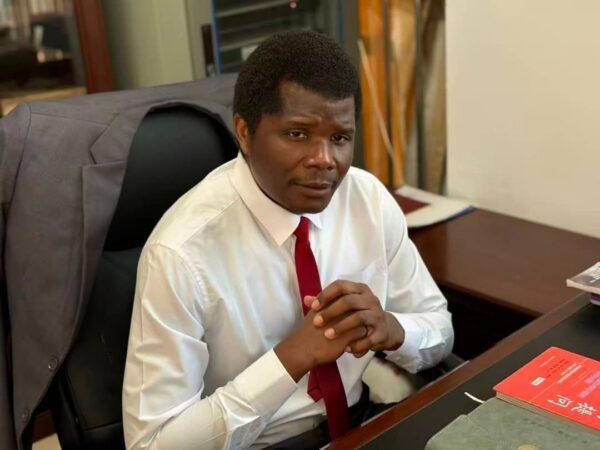
Africa-Press – Malawi. An aspiring presidential candidate for the 2030 general elections, Jani Grey Kasunda, has launched a scathing attack on President Peter Mutharika, accusing him of preaching a war on corruption while presiding over a government deeply entangled in it.
Kasunda was reacting to Mutharika’s 2026 State of the Nation Address (SONA), in which the President once again declared his administration’s commitment to fighting corruption and strengthening governance institutions.
But in a sharply worded statement, Kasunda dismissed the speech as hollow rhetoric, arguing that Mutharika’s own Cabinet composition fundamentally contradicts his public posture on corruption.
“Nearly half of the President’s Cabinet ministers have active cases pending before the courts,” Kasunda said. “You cannot claim to be serious about fighting corruption while entrusting the most sensitive public offices to individuals whose integrity is already in serious question.”
Kasunda acknowledged the constitutional principle of presumption of innocence but insisted that political leadership demands higher ethical standards than mere legal technicalities.
“The law presumes innocence until proven guilty; that is true,” he said. “But appointing individuals with clouded reputations to manage public resources, and then standing in Parliament to say ‘anyone’ will be arrested, is not leadership. It is a mockery of accountability.”
Mutharika’s SONA placed heavy emphasis on governance reforms, fiscal discipline, and renewed efforts to combat corruption, presenting his administration as committed to restoring public trust and institutional credibility. However, Kasunda argued that the President’s words collapse under the weight of his own appointments.
According to Kasunda, the contradiction is not theoretical but practical: ministers with unresolved corruption allegations continue to oversee procurement, infrastructure, finance, and regulatory agencies—precisely the sectors most vulnerable to abuse.
“You cannot fight corruption using people who are themselves under the shadow of corruption,” he said. “That is like appointing suspected arsonists to lead the fire brigade.”
Kasunda further argued that Mutharika’s rhetoric reflects a broader pattern in Malawian politics, where anti-corruption slogans are deployed for public relations while the real power structure remains untouched.
He said the President’s repeated declarations have failed to translate into decisive political action, such as dismissing compromised officials, enforcing lifestyle audits, or empowering anti-graft institutions to operate without political interference.
Instead, Kasunda claimed, the government has normalized a dangerous culture where serious allegations are treated as background noise rather than red flags.
“The problem is not that cases exist. The problem is that they are ignored when it is politically convenient,” he said. “That destroys public confidence and sends a message that corruption is tolerated at the highest levels.”
Kasunda, who leads the People’s Revolution, said his movement represents a clean break from what he described as “selective justice and cosmetic reforms.”
He said his party is ready to offer Malawians a leadership model based on ethical governance, institutional independence, and zero tolerance for corruption—starting with the principle that no one under serious investigation should hold executive authority.
“We are not here to recycle speeches. We are here to change how power is exercised,” Kasunda said. “Leadership must work for every Malawian, everywhere—not for a protected political elite.”
Kasunda’s intervention comes at a time of growing public cynicism over anti-corruption campaigns, as high-profile cases drag on in courts while accused officials continue to occupy influential positions.
For many observers, his criticism taps into a wider national frustration: that corruption is endlessly condemned in words, but carefully accommodated in practice.
And in that gap between rhetoric and reality, Kasunda argues, lies the true failure of Mutharika’s anti-corruption crusade.
For More News And Analysis About Malawi Follow Africa-Press