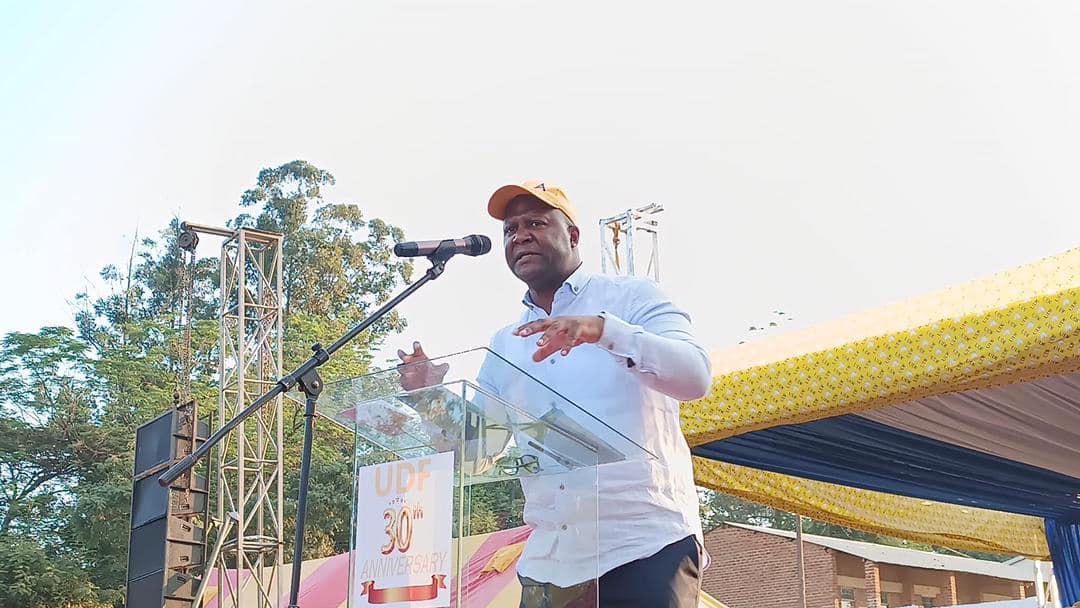
Africa-Press – Malawi. At a time when Malawi’s opposition appears fragmented, hesitant, and largely invisible in national debate, a single political voice is cutting through the noise with unusual clarity and force. That voice belongs to Atupele Muluzi, the leader of the United Democratic Front (UDF), whose latest statement reads less like routine political criticism and more like a serious policy manifesto for a country in distress.
While Parliament remains dominated by disjointed opposition performances and the main opposition party, the Malawi Congress Party (MCP), is increasingly consumed by internal leadership squabbles, Muluzi has stepped forward with a message that is both direct and uncomfortable. He is not merely attacking government failures; he is questioning the entire structure of the Malawian state and calling for what he describes as “national renewal” rooted in deep systemic reform.
His intervention comes against a grim national backdrop. Inflation has climbed above 30 percent, foreign exchange remains scarce, food insecurity continues to haunt millions of households, and corruption scandals appear with alarming regularity. Yet, according to Muluzi, these are not isolated crises or temporary setbacks. They are symptoms of a broken system that has never been fundamentally fixed.
In his words, Malawi does not suffer from a shortage of speeches, but from a shortage of structural reform. This distinction is critical. For decades, successive governments have responded to economic decline with short-term measures, subsidies, donor-driven programmes, and endless promises. What they have not done, Muluzi argues, is reform the machinery of the state itself. They have tried to manage decline instead of redesigning the system that produces it.
What makes Muluzi’s message stand out is not just its tone, but its content. While much of the opposition remains stuck in generic criticism, he is offering a clear diagnosis and a proposed cure. He speaks of digitising public procurement, introducing real-time expenditure tracking, enforcing performance contracts for senior officials, and accelerating corruption prosecutions. These are not slogans; they are specific institutional reforms aimed at restoring credibility and efficiency to government.
Beyond governance, Muluzi’s vision extends into economic reconstruction. He calls for a National Solar Irrigation Grid to stabilise agriculture, the creation of mega-farm commercial clusters, strategic development of minerals, and domestic value addition to end Malawi’s dependency on raw exports. He also places strong emphasis on the future, advocating for fibre connectivity in every district, remote work hubs for young people, and reform of technical education to match emerging industries such as mining, energy, and digital services.
This level of policy detail is rare in Malawi’s opposition politics, where debates often collapse into personality clashes and reactive statements. It raises a serious question: is Atupele Muluzi quietly becoming the only opposition leader speaking in complete sentences while others remain trapped in political survival mode?
The contrast with the broader opposition landscape is striking. Inside Parliament, opposition voices appear divided and unfocused. The MCP, which once positioned itself as the moral alternative in Malawian politics, is now largely absorbed by internal leadership tensions and succession anxieties. Instead of articulating a coherent national alternative, it is increasingly preoccupied with internal power struggles that do little to address the everyday realities facing citizens.
In this vacuum, Muluzi’s message stands almost alone. He is not calling for louder criticism of government, but for a state that actually works, an economy that produces, and institutions that can be trusted. His framing shifts the debate from emotional protest to structural transformation, from blame to design, and from political noise to economic architecture.
There is also a deeper political implication. By focusing on system reform rather than regime change, Muluzi is positioning himself not merely as an opposition figure, but as a potential architect of a new governance model. He is speaking the language of state capacity, institutional design, and productive economics, themes that resonate strongly with frustrated citizens who no longer believe in cosmetic politics.
Whether this strategy will translate into electoral strength remains uncertain. The UDF itself is no longer the dominant force it once was, and Malawian politics is notoriously volatile. However, in the current moment, Muluzi appears to be occupying a unique space: the only major opposition leader articulating a coherent national project while others remain stuck in fragmented reactions and internal conflicts.
In a political environment where silence, confusion, and factionalism dominate the opposition, Atupele Muluzi’s voice is not just audible; it is structurally different. He is not merely opposing government. He is challenging the design of the Malawian state itself.
And that raises an uncomfortable but increasingly unavoidable question for Malawi’s political class: when the opposition is lost in the wilderness, is Atupele Muluzi becoming the only one with a map?
For More News And Analysis About Malawi Follow Africa-Press