By Amb. Anthony Mukwita
Africa-Press – Malawi. Africa’s Call to Rise: PRO Lumumba’s Lusaka Manifesto
Amb. Anthony Mukwita wrote:
18 Feb 26.
—–
“The Greek philosopher Heraclitus once said, “Character is destiny.” If Zambia’s leaders choose gossip over intellect, poverty will persist. If they heed thinkers like Lumumba, destiny can change.”
—–
At the Kenneth Kaunda International Wing of the Mulungushi International Conference Centre, an ultra-modern gift from the People’s Republic of China through the warm ties between President Edgar Lungu and President Xi Jinping, Professor Patrick Loch Otieno Lumumba delivered a lecture that will reverberate across Africa’s intellectual corridors for years to come.
The Kenyan lawyer, activist, and former director of the Kenya School of Law and the Kenya Anti-Corruption Commission spoke with the urgency of a prophet and the precision of a jurist.
Lumumba’s Profile: The Conscience of Africa
Lumumba is no ordinary speaker. He is a man who has built his reputation on confronting corruption, mentoring lawyers, and speaking truth to power.
His tenure at the Kenya Anti-Corruption Commission (2010–2011) was marked by fearless confrontation of entrenched interests.
Today, he is celebrated as Africa’s most eloquent pan-Africanist. High five to Lumumba!
Africa’s Poverty: A Leadership Choice
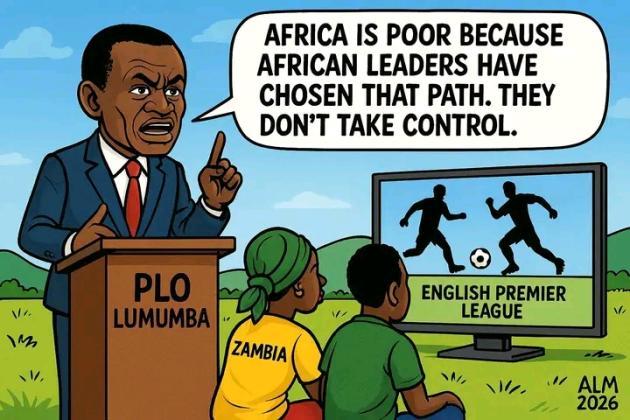
Lumumba’s central thesis was stark: “Africa is poor because African leaders have chosen that path. They don’t take control.”
He pointed in my view, to the recent mining indaba in Cape Town, where African presidents, including Zambia’s Hakainde Hichilema, attended discussions on rare earth minerals—the future of global industry. Yet Africa, the custodian of these minerals, remains a passenger.
In December 2022, Zambia and the Democratic Republic of Congo signed a deal with the United States to develop an electric vehicle battery value chain.
Parliament in Lusaka was not consulted, even though the global rare earth market is projected to reach over $7 trillion by 2030. Lumumba’s lament was clear: Africa risks auctioning its future while others reap the rewards.
Misplaced Pride and Mental Colonization
Lumumba did not spare cultural critique. He lamented that Zambians and other Africans worship the English Premier League while ignoring local clubs like Mufulira Wanderers or Nkana.
This, he argued, is symptomatic of mental colonization. “We lack pride,” he said, urging Africans to reclaim cultural confidence and celebrate their own.
Borders and Unity: Lessons from the EU
Lumumba contrasted Africa’s fragmented borders with the European Union’s seamless integration.
The EU, with a GDP of around $19 trillion, thrives on the free movement of goods, services, and people. Africa, with a GDP of only $2.8 trillion despite a population of 1.4 billion, remains shackled by visas and borders. “We must be serious—too many visas, too many borders,” Lumumba declared.
He commended President Hichilema and Ghana’s John Dramani Mahama for visa-free initiatives but insisted that without economic agreements, such gestures remain hollow. Africa’s rise demands tangible integration, not symbolic acts.
Language and Identity
Lumumba reminded his audience that language itself is colonization. He urged Africans to promote Swahili as a continental lingua franca, just as China has elevated Mandarin. “English for the English, Mandarin for the Chinese, Swahili for Africans,” he said.
Land: The Pivot of History
In recent interviews, Lumumba has emphasized land as the fulcrum of Africa’s struggle. On Wode Maya’s platform, he declared that land is dignity.
He warned, recently, against Western neo-colonial encroachment.
At the Nyeri Youth Summit, he lamented Africa’s dependence on imported food despite vast arable land. His message is consistent: land is history, identity, and future. Africa must guard it against foreign encroachment.
The Absence of Leaders
Daily Revelation Newspaper
One disappointment loomed large: no recognizable political leaders attended Lumumba’s lecture; maybe they were ‘ at work.’
While dozens of university students gathered, the political class stayed away.
They flock to gossipy rallies but shun intellectual discourse.
This absence underscored Zambia’s malaise—an addiction to rumour over reason and issue-based discourse.
High Five to Lumumba
High five to Lumumba for daring to speak the truth. High five to Lumumba for insisting on unity. High five to Lumumba for defending Africa’s land.
Daily Nation Zambia
High five to Lumumba for challenging mental colonization. High five to Lumumba for reminding us that Africa’s rise begins now, not tomorrow.
Smart Eagles
Comparative Thinkers
Lumumba’s vision recalls Kwame Nkrumah, who declared that Africa must unite or perish. In Europe, Jean Monnet, the architect of the EU, believed integration was the path to prosperity.
Both men understood that fragmented states are weak, but united continents are formidable.
Zambia’s Lesson
As Zambia approaches six months to the polls on 13 August, Lumumba’s words should guide reflection.
The Greek philosopher Heraclitus once said, “Character is destiny.” If Zambia’s leaders choose gossip over intellect, poverty will persist. If they heed thinkers like Lumumba, destiny can change.
Kelvin Kaunda: The Unsung Patron
Kelvin Kaunda deserves heartfelt thanks for making Lumumba’s lecture possible. As founder of Eden University, he has created a platform for intellectual engagement.
Special thanks to Kelvin Kaunda! Special thanks to Kelvin Kaunda! His vision has given Zambia and SADC a university with thousands of students, shaping future leaders.
Equally, Ms. Chana Kaunda must be commended. Her dedication to Eden University’s brand as its public face is tireless, yet unsung. She embodies the quiet strength that sustains institutions.
Costa Mwansa: The Moderator Extraordinaire
No account of the Lusaka lecture would be complete without commending Costa Mwansa, CVO of Diamond TV, for his excellent moderation.
Mwansa’s deft handling of the event ensured that Lumumba’s fiery words were framed with clarity and respect.
His moderation was not passive; it was active stewardship of dialogue.
In a continent where media often panders to gossip, Mwansa elevated discourse to the level of intellectual engagement. He will grow bigger in the field.
A Call to Leaders
African leaders must stop worshiping the West while ignoring local talent—from Lusaka to Nairobi, Johannesburg to Blantyre.
They must heed voices like Lumumba’s, and yes, voices like mine, and those of former Ambassadors, former service chiefs etc., who bring education and experience.
Treating intellectuals as enemies impoverishes nations, the current Zambia government is guilty of this phenomenon.
Former top government officials are regarded as ‘nuclear active,’ not treasure troves or repositories of wisdom.
Conclusion: Africa’s Destiny
Lumumba’s Lusaka lecture was more than an event; it was a manifesto.
Africa’s economic emancipation lies only in unity. The future of generations begins now, not tomorrow. If leaders continue to ignore this call, history will judge them harshly.
But if they embrace it, Africa can rise as a game-changer in the global order.
High five to Lumumba, the conscience of our continent.
–Amb. Anthony Mukwita is a published Author and International Relations Analyst.
Books: China in Africa the Zambia Story: Against All Odds: Edgar Lungu’s Rough Journey to State House.
Source: The Zambian Observer
For More News And Analysis About Malawi Follow Africa-Press