Africa-Press – Malawi. The Lilongwe Water Board (LWB) has reaffirmed its strong commitment to environmental conservation, emphasizing that protecting forests and water catchments is critical to securing the long-term water supply for the city of Lilongwe.
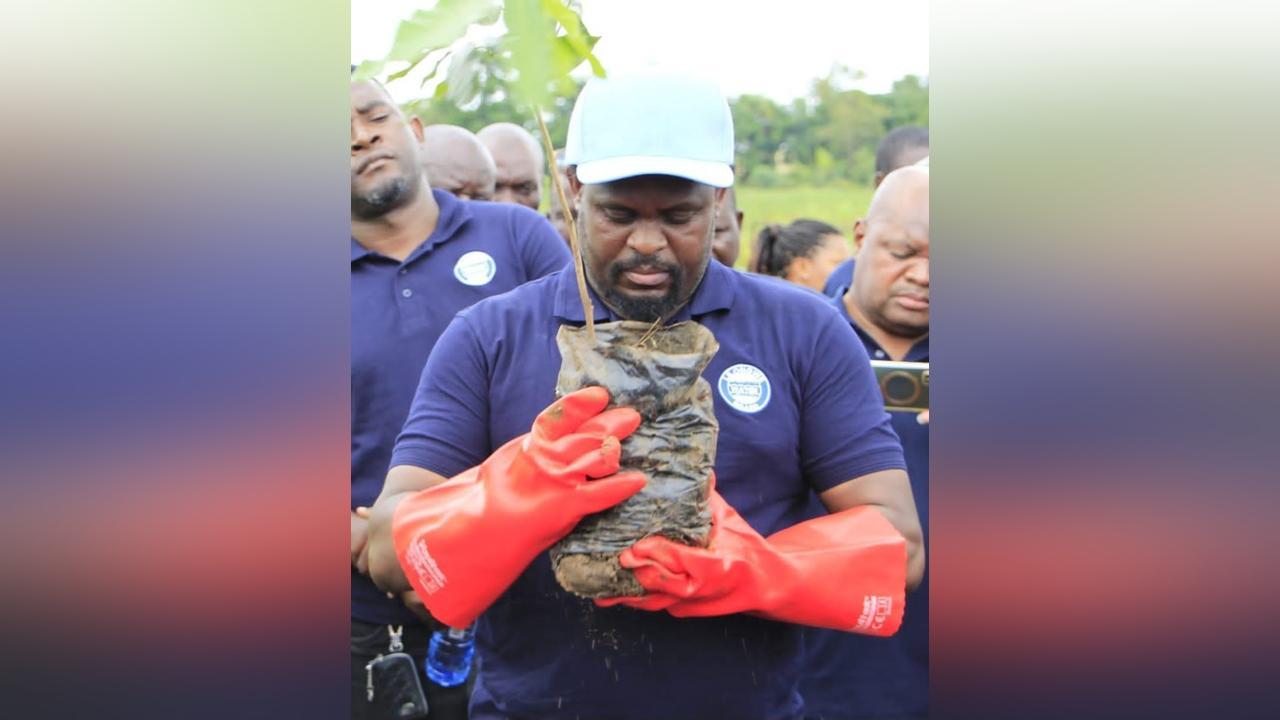
Speaking during a tree-planting exercise at Sinyala in the Malingunde area under Senior Chief Masumbankhunda, LWB Board Chairperson David Mbewe said the initiative demonstrates the Board’s determination to safeguard the Dzalanyama Forest Reserve catchment, the main source of water for Lilongwe City.
“This is not just a ceremonial activity; it represents our shared responsibility to protect the environment and ensure sustainable access to clean water for our communities,” said Mbewe.
He stressed that environmental degradation in catchment areas directly threatens water security for Lilongwe’s growing population, making tree planting and forest restoration a crucial intervention.
Mbewe revealed that last year’s tree-planting programme recorded a 71 percent survival rate, a significant achievement that has encouraged the Board to scale up conservation efforts this year. He expressed confidence that this year’s programme will produce even better results through close collaboration with the Department of Forestry, traditional leaders and surrounding communities.
The exercise was conducted under the theme “Trees for Water Conservation, Water for Life,” highlighting the link between forest protection and sustainable water supply.
Since the start of the 2025/2026 tree-planting season, LWB has successfully raised and planted 350,000 tree seedlings across various sites in the Dzalanyama catchment area. During the official launch of the campaign, an additional 4,000 trees—including 1,000 fruit trees—were planted to mark the event.
Member of Parliament for Lilongwe South, Peter Dimba, commended LWB for maintaining a consistent environmental restoration programme, noting that protecting forests is essential for sustaining water resources.
Senior Chief Masumbankhunda also pledged to strengthen community by-laws aimed at protecting the newly planted trees, stressing that environmental conservation today guarantees water security for future generations.
Beyond tree planting, Mbewe highlighted several broader initiatives being implemented by LWB to protect the environment and water infrastructure. These include promoting alternative energy sources such as briquette production to reduce reliance on firewood and charcoal, strengthening measures to curb encroachment in protected areas, and intensifying campaigns against vandalism of critical water infrastructure.
He also pointed to the completion of the Malingunde Water Supply Scheme, a major project now delivering safe and clean water to households in the area. The project includes the construction of 19 communal water kiosks serving communities in Malingunde, Nsija and Sinyala within the Dzalanyama area.
The tree-planting event attracted wide institutional support, with representatives from the Ministry of Agriculture, Irrigation and Water Development, Department of Forestry, Central Region Water Board, Southern Region Water Board, Water Services Association of Malawi, Malawi University of Natural Resources and Applied Sciences, Malawi Housing Corporation, the Malawi Defence Force and the Malawi Police Service.
Community members from both Senior Chief Masumbankhunda’s and Senior Chief Masula’s areas also took part in the exercise, reinforcing the message that protecting forests and water sources requires collective action from both institutions and local communities.
For More News And Analysis About Malawi Follow Africa-Press