
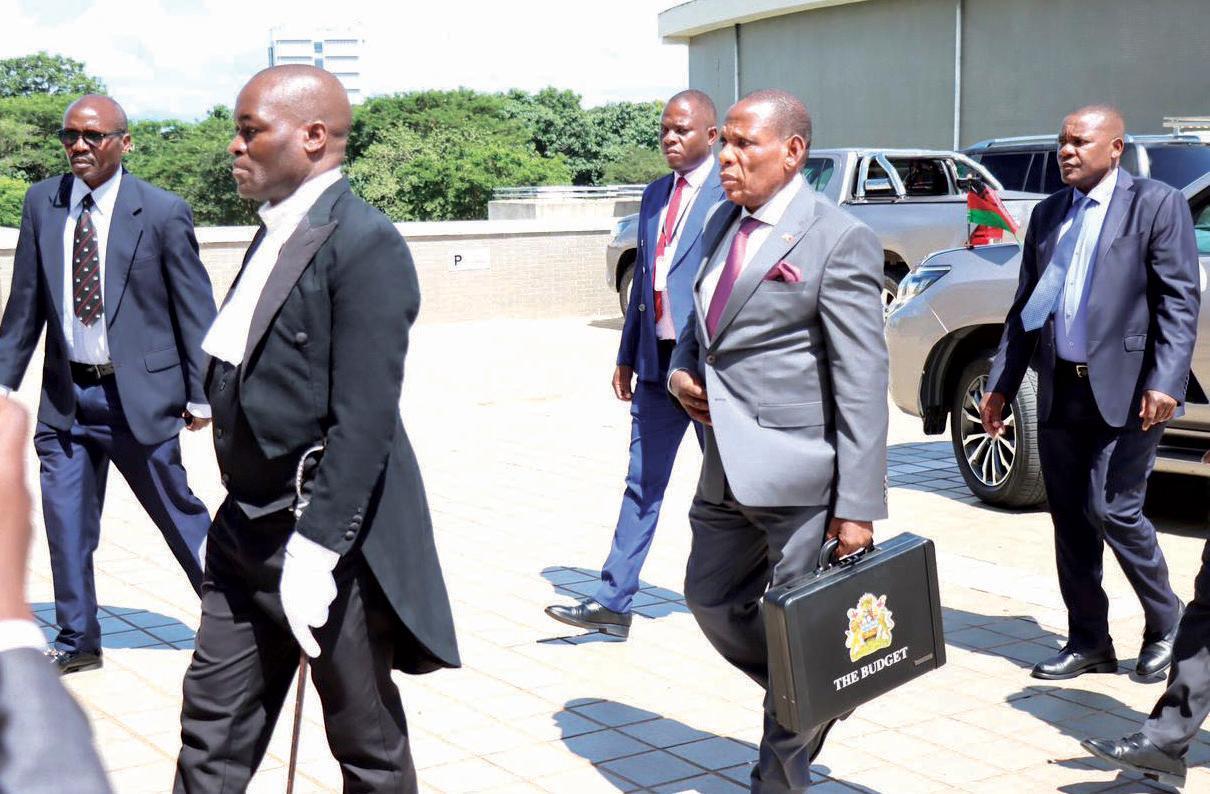
PURSE KEEPER—Mwanamvekha arrives at Parliament to present the budgetBy Kingsley Jassi:
A few minutes after 2 pm Friday, inside the chamber of Parliament in Lilongwe, Minister of Finance, Economic Planning and Development, Joseph Mwanamvekha, rose to deliver what was essentially less a speech than a national appeal.
Before him lay a stark proposition: that 21 million Malawians, many of them impoverished and weary from successive economic shocks, entrust him with K10.978 trillion of public resources to steer the country through the fiscal year stretching from April 1, 2026 to March 30, 2027.
Across the nation, a hush must have settled in – at least among those who care about what a budget statement means to their lives.
For such kind, in homes, trading centres and offices, they must have kept their eyes fixed on television screens and their ears tuned to radios.
– Advertisement –
In his presentation, Mwanamvekha spoke with deliberate measure, almost methodically, presenting a budget crafted in the ghostly shadows of what he acknowledged to be tough economic times.
On analysis, at its core, the fiscal plan rests on cautious optimism.
Mwanamvekha said he expects the plan to deliver a 4.1 percent GDP growth rate, a modest but symbolically important signal of forward motion in an economy that has struggled to find firm footing for years.
It is the arithmetic, however, that tells a more sobering story.
– Advertisement –
– Advertisement –
With a 44.8 percent increase in revenue and grants, total financial resources are estimated at K8.12 trillion. Yet expenditure pressures push the deficit to K2.9 trillion, which is equivalent to 9 percent of the GDP.
This is an improvement from the 11.9 percent deficit recorded in the 2025-26 budget, which suggests an attempt, however incremental, to rein in on domestic borrowing.
Inflation is projected to close the year at 15 percent. The minister expects the policy rate to decline to 18 percent, easing the cost of borrowing and, in theory, stimulating productive activity.
It is a delicate balancing act built on the following thinking: contain inflation without choking growth, tighten fiscal discipline without stifling recovery.
He announced that domestic revenue is projected at K6.454 trillion, which is 20.5 percent of GDP. This represents an increase of 44.1 percent from the 2025-26 Mid- Year revised figure of K4.478 trillion.
Expenditure patterns reveal the government’s priorities and constraints at the same time.
Of the total outlay, K7.581 trillion is allocated to recurrent expenses and K3.397 trillion to development expenditure, representing 69.1 percent and 30.9 percent respectively. This is what it means in lay terms: nearly K7 out of every K10 will go toward keeping the machinery of the state running, leaving less than a third for transformative investment.
Among the notable projects are several roads, houses for security officers, and the long awaited Mombera University.
The reformed Constituency Development Fund (CDF) will be implemented at K5 billion per constituency, which is a nod to decentralization and grassroots impact, though its effectiveness will ultimately hinge on governance, a factor that has proven to be Malawi’s Achilles heel for as long as democracy has existed in this country.
Then, the structural pressures are evident in the line items.
Goods and services will consume K1.5 trillion.
Subvented organisations will receive K867 billion.
Salaries and wages account for K1.9 trillion.
And most hauntingly, interest payments are estimated at K2.793 trillion, which is roughly 23 percent of the budget. That’s the story of heavy burden of debt servicing. It means nearly a quarter of public resources will go not to new schools, roads, or hospitals, but to settling past obligations.
In what is a strategic pivot, K1.334 trillion, or 12.2 percent of the total budget, has been set aside for priority sectors grouped under Agriculture, Tourism, Mining and Manufacturing (ATMM), a strategic direction of the previous regime.
Here, with funds earmarked for industrial parks, tourism initiatives, irrigation schemes and mining projects, this allocation signals an ambition toward industrialization.
CAMARADERIE—Mwanamvekha and Leader of Opposition Simplex Chithyola share a light momentIt’s a clear expression of state-led industrialization attempts, a desire to shift Malawi from consumption to production, from importing to exporting.
Yet, sectoral allocations reveal traditional priorities holding firm.
Education leads with K1.23 trillion, health gets K1 trillion. Agriculture receives K931 billion, transport and infrastructure K664.4 billion, energy and mining K352 billion, and tourism and manufacturing K51.2 billion.
The hierarchy reflects both developmental necessity and political reality: human capital and food security remain foundational concerns.
On the revenue side, the government has introduced targeted tax measures. These include import duty on luxury goods and products that are locally produced, higher carbon tax on foreign registered vehicles, and import duty on some hybrid vehicles.
At the same time, Mwanamvekha has eased capital gains tax by introducing a 2 percent withholding tax on gross profit.
A 15 percent withholding tax on rental fees for residential houses aims to ease administrative complexities, while gains from bets will attract a 10 percent withholding tax.
The budget is framed under the theme: “Driving economic recovery and sustainable growth through impactful reforms and fiscal consolidation.”
Such a mouthful theme as if to reflect the ambitious formulation, a suggestion of both urgency and restraint, a point where reform is paired with consolidation, growth tempered by discipline.
Whether the numbers will bend to the rhetoric, that is the question.
But what is clear is that the government is attempting to navigate a narrow, somewhat slippery path: restore macroeconomic stability, stimulate growth, and manage mounting fiscal pressures – all while asking a fragile nation for patience and trust.
Such a tough call.