
By Isaac Salima & Mercy Matonga:
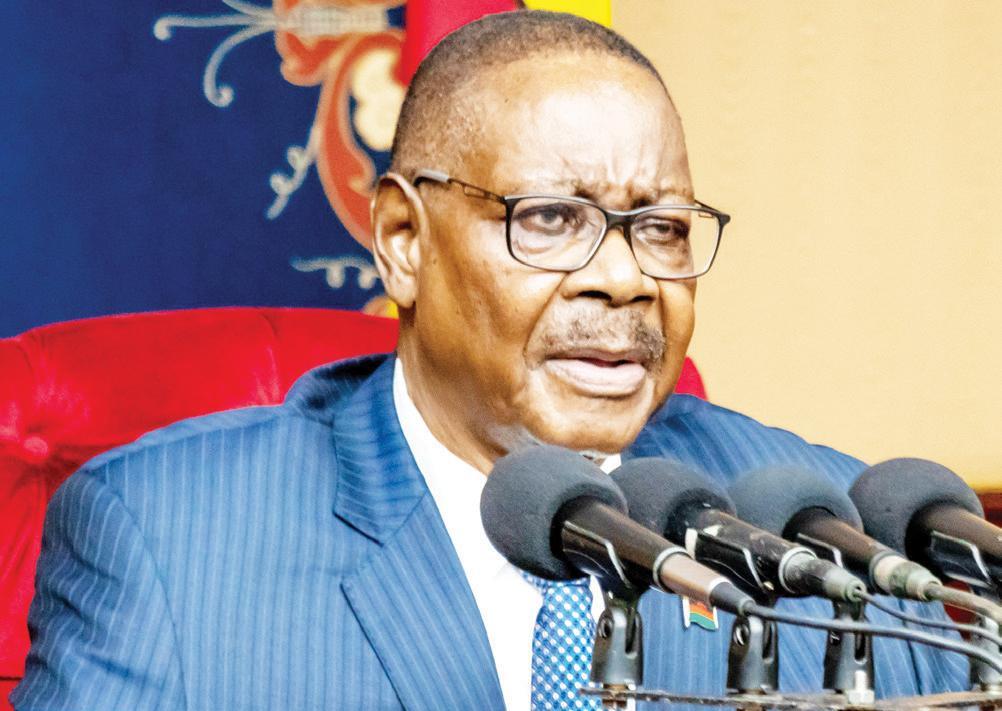
President Peter Mutharika has this week been appointed honorary patron for Peace Parks Foundation as well as Scotland-Malawi Partnership.
Peace Parks Foundation is an organisation that re-establishes, renews and conserves large ecosystems in Africa while the Scotland- Malawi Partnership fosters cooperation between the two countries.
The foundation’s vice chairperson Joaquim Chissano, who is also former president of Mozambique, conveyed the message about the appointment, which will see the Malawi leader becoming the foundation’s patron.
And, in a statement, Chief Secretary to the Government Justin Saidi confirmed the development.
– Advertisement –
“The foundation’s vice chairperson stated that the appointment is in recognition of Mutharika’s distinguished leadership and unwavering commitment to sustainable development, regional cooperation and ecological resilience,” Saidi says in a statement.
Peace Parks Foundation was founded in 1997 by the late Anton Rupert, former South African president Nelson Mandela and Prince Bernhard of the Netherlands and champions the creation of trans-frontier conservation to promote regional integration and biodiversity across Africa.
Meanwhile, Mutharika has also been appointed co-honorary patron of the Scotland-Malawi Partnership, marking the second time he has held this prestigious role within the international network.
“His Excellency Professor Arthur Peter Mutharika has reaffirmed his commitment to further strengthen the fraternal bonds of friendship that exist between the people of Malawi and Scotland,” Saidi’s statement reads.
– Advertisement –
– Advertisement –
The Scotland- Malawi Partnership is an international development network that was created to coordinate, support and represent the numerous links between the people of Scotland and Malawi.
In another development, Malawi and Scotland have signed a K2.3 billion health partnership aimed at improving health service delivery in the country.
Speaking during the signing ceremony Thursday, Principal Secretary for Health, Dr Dan Namarika, said the initiative spoke directly to the realities facing Malawi’s health system.
“A central challenge is our health workforce.
Shortages across cadres, high workloads, skills gaps in specialised areas and the need for continuous professional development all place pressure on service delivery,” Namarika said.
The health pact will, among other things, support the Cancer Centre at Kamuzu Central Hospital, Queen Elizabeth Central Hospital, the Malawi Epidemiology and Intervention Research Unit, and mental health services under the Department of Psychiatry at Kamuzu University of Health Sciences.
Speaking during her presentation, International Development and Global Health Development Lead Phoebe Spurr said the guiding principles ensured that global health work was not transactional but transformational.
“The dual burden of persistent infectious diseases and NCDs [non-communicable diseases], widening inequalities, unsustainable system pressures and a worsening climate emergency all reflect that we live in a world where the health of people, communities and the planet are inseparable,” Spurr said.
The programme will run for 18 months.