
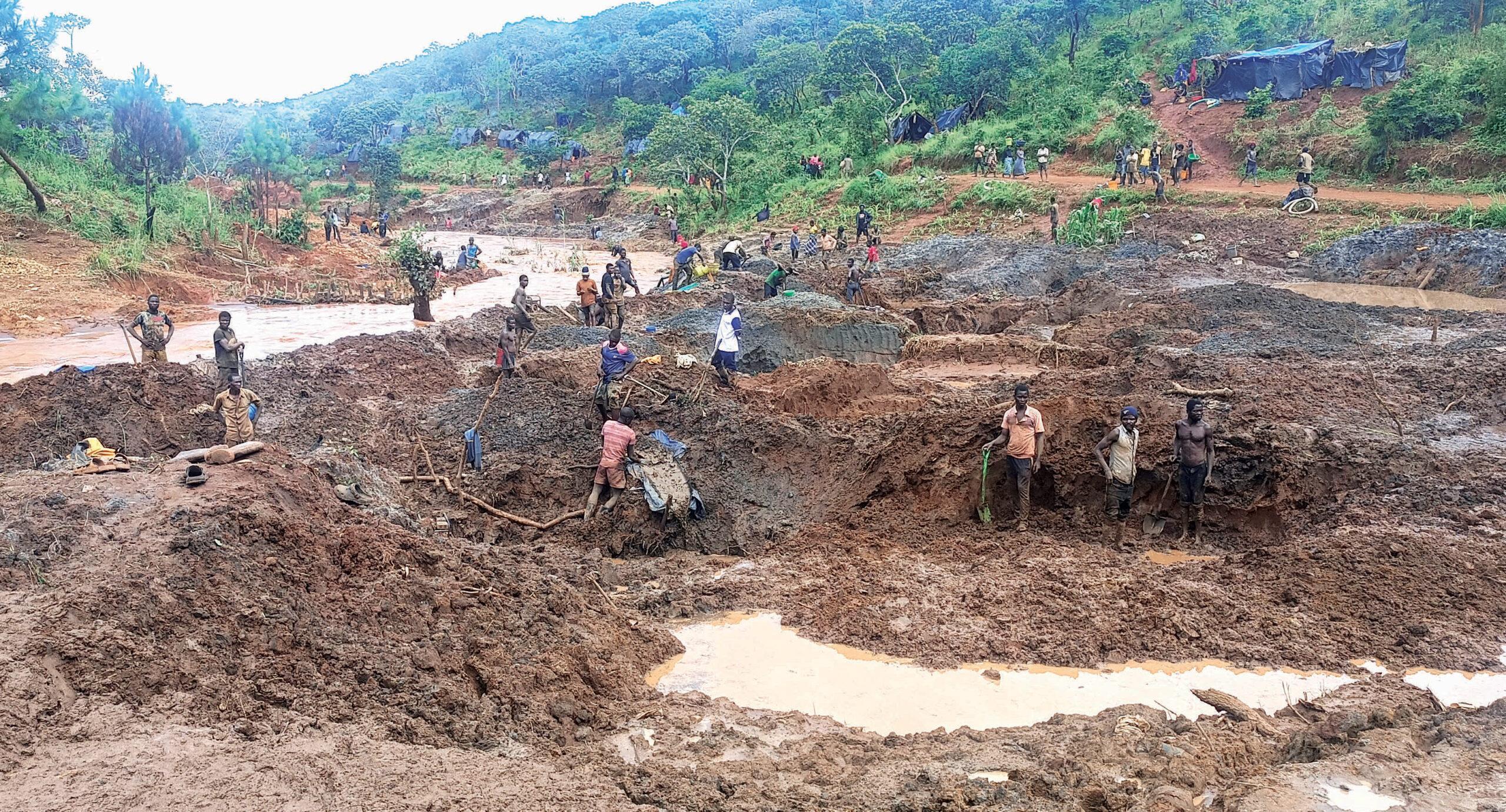
CLAY WATERS—Lupachi River which the mining site is locatedBy Joel Phiri:
At Kamchocho Village in Traditional Authority Mabilabo in Mzimba District, the once fertile landscape along the Lupachi River has been transformed into a chaotic gold rush site.
Deep pits scar the earth, trees lie felled in all directions, and makeshift shelters stretch as far as the eye can see – about 2-and-half-kilometre stretch of land is under siege from illegal gold diggers.
Standing with his arms akimbo, Mzimba’s Principal Environmental Officer, James Pelani, surveys the damage with visible concern.
“Gold brings wealth, but its side effects include environmental degradation, as we see here,” Pelani says, shaking his head while watching scores of both energetic men an d women digging for gold deposits in the muddy waters.
– Advertisement –
More than 4,000 people are estimated to have descended on Kanchocho village that sits along Lupachi River since gold was discovered in January this year.
By mid-February when we visited the site, the area resembled a refugee settlement.
Temporary grass-thatched structures and plastic-covered shacks serve as homes, toilets, restaurants, and beer halls. The quiet riverside community has turned into a bustling, unregulated mining settlement almost overnight.
The lure is powerful. A single gram of gold is fetching up to K500,000, a fortune in a district where many struggle to make ends meet.
– Advertisement –
– Advertisement –
“It’s a lucrative business,” says Thomson Banda, who has emerged as one of the vocal miners at the site and spokesperson for the gold diggers.
SEEING IS BELIEVING—Police and other authorities watch the mining activity“We are poor Malawians trying to earn a living through this business. We have people here from all over Malawi here.”
Indeed, miners have flocked to Kamchocho from various districts, driven by unemployment and poverty. Young men dig tirelessly with picks and shovels, while others sieve soil in the river in search of glittering specks. Some entrepreneurs have hired teams of labourers, paying them about K20,000 per day per person to dig on their behalf.
Life at the gold site, however, is far from easy. The cost of living has skyrocketed.
“Life is expensive here because everyone is making money,” says one miner. “If you buy nsima at K5,000 at Jenda Trading Centre or at Mzimba Boma, here it is K10,000 per dish,” says Nixon Black from Blantyre but has come here to dig gold.
Traders from Jenda Trading Centre and surrounding areas have seized the opportunity, setting up grocery stands, restaurants, and bars. Business is booming. Every day, sacks of maize flour, soft drinks, beer, and other essentials are ferried into the settlement to meet soaring demand.
Yet beneath the buzz of commerce lies a troubling reality: the mining activities are illegal.
Joseph Chirwa, Regional Mining Engineer for the north in the Department of Mines, is unequivocal.
“Nobody has been licensed to mine gold here,” he says. “All the people digging at this site are illegal miners,” says Chirwa.
“We need to formalize this. Let these people obtain licences. There are licenses for Small Scale Miners,” says Chirwa.
Without licences, there is no regulation, no environmental safeguards, and no structured oversight.
Miners dig randomly, leaving behind dangerous open pits. Along the Lupachi River, soil is being heavily disturbed as prospectors search for deposits, increasing the risk of siltation and water pollution.
Pelani says the environmental consequences could be long-lasting.
“Land is being degraded. Trees are being cut down indiscriminately. Gold mining along the river is leading to serious environmental damage. This worries us as a council,” he explains.
The destruction is visible. What was once arable land suitable for agriculture is now dotted with craters and mounds of displaced soil. Farmers who relied on the land for maize and other crops face uncertainty about whether it can ever be restored.
SITE SEEING—Mitai arriving at the mining sitePolice have also taken note of the unfolding situation. Commissioner of Police for the Northern Region, Glinton Mitai, acknowledges the scale of the problem.
“Land degradation here is acute,” says Mitai. “That is why we came here to establish the truth and assess the situation.”
Authorities now face a delicate balancing act. On one hand, thousands of people are earning an income in a struggling economy. On the other, the environmental cost is mounting, and the operations are illegal.
There are also concerns about safety and social order. With thousands of people living in cramped, makeshift shelters without proper sanitation, the risk of disease outbreaks looms large. The absence of regulation has created fertile ground for exploitation, disputes over mining spots, and potential criminal activity.
Reports indicate that buyers from various parts of the country—and even beyond Malawi’s borders— some from Ruanda, Zambia, Tanzania and Mozambique are said to be frequenting the site to purchase gold. Some Malawians have carved out a niche as middlemen, buying gold from miners and reselling it at a profit. The flow of cash is constant, but so is the erosion of the land.
For now, the gold rush continues unabated. The sound of shovels striking the earth echoes from dawn to dusk. Each miner hopes to strike it rich, even as the landscape bears the brunt of their ambition.
As Pelani takes one last look at the scarred terrain, his concern is evident. The promise of quick wealth has drawn thousands to Kamchocho, but the environmental price may outlast the glitter of gold.
Whether authorities will regularize the operations, shut them down, or find a middle ground remains to be seen.
What is clear is that along the banks of the Lupachi River, the scramble for gold has already rewritten the story of Kamchocho Village— turning farmland into a frontier of fortune and environmental uncertainty.— Mana