
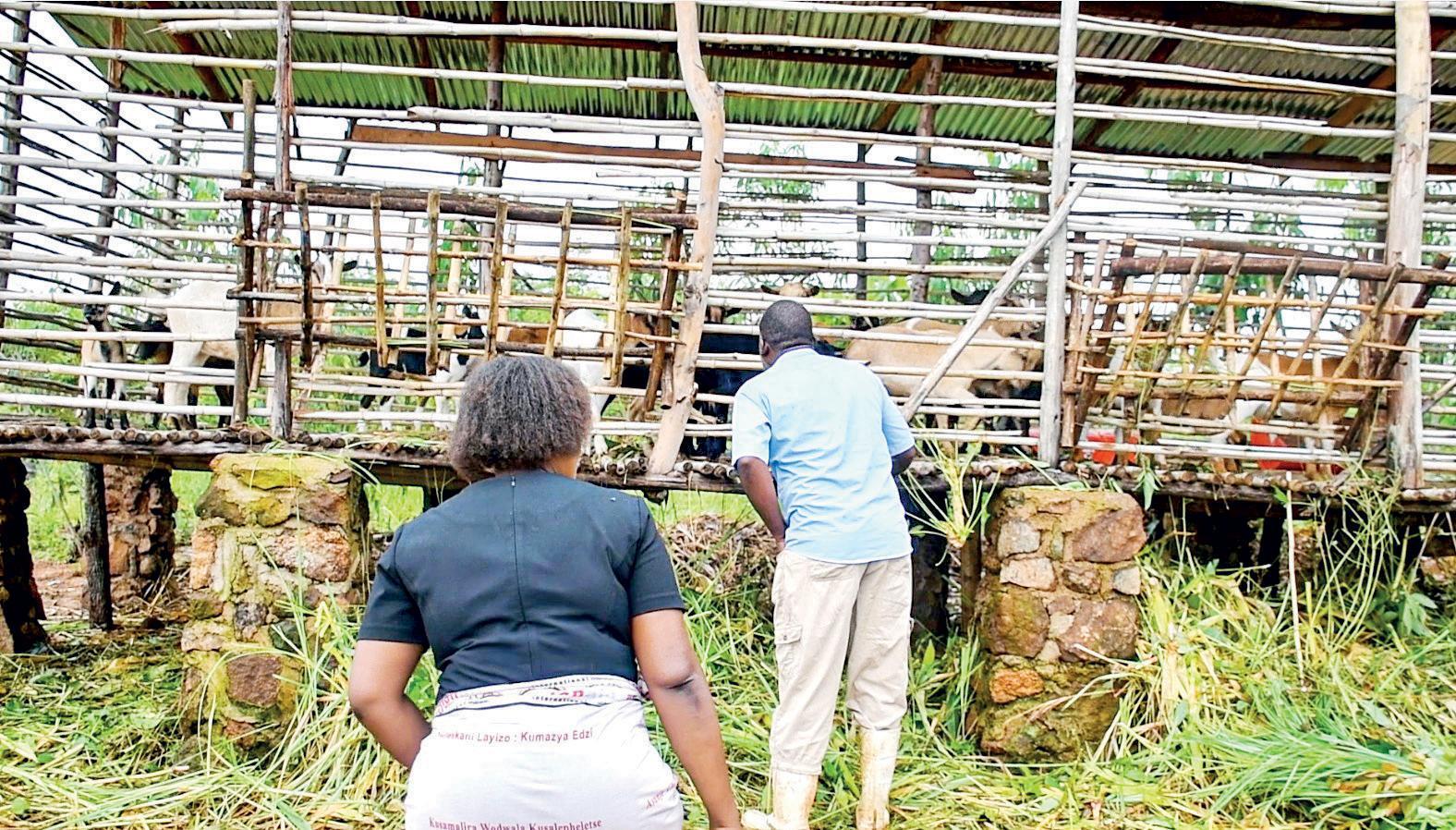
WORK IN PROGRESS—Builders work on cattle infrastructure
A cluster of cattle once stood in open enclosures in Mpama Village, Traditional Authority Malemia, Zomba, exposed to disease, slow weight gain and the uncertainty of weather and survival.
That early experience exposed a hard truth for Zomba Stall Feeding Cooperative. Without control and structure, livestock farming was losing value before it could turn a profit.
That reality pushed the group to rethink how they rear cattle and adopt a tightly managed stall-fed beef cattle fattening system now being developed with support from the Agriculture Commercialisation Project Phase II (Agcom 2).
The cooperative brings together 32 members, 17 of whom are women and 15 men.
It kicked off in 2019 as a village savings and loans group before shifting into a livestock enterprise with a clear goal of rearing and fattening beef cattle for the meat market.
– Advertisement –
Vice Chairperson Chimwemwe Sagona says the turning point came after repeated losses under the old system.
“We were losing animals and losing weight. There was no control, no proper growth. Now everything is managed and we can actually expect to see the cattle putting on weight the way we want,” Sagona says.
That shift is being backed by a K224 million Agcom II grant, with K104.4 million already disbursed in the first tranche.
The funding supports construction of a cattle kraal, feed storage facilities, piped water and the purchase of beef cattle.
– Advertisement –
– Advertisement –
Sagona says the project has changed how members think about livestock farming.
“Before that, we were just keeping cattle. Now we are running a business. Every animal we expect to buy and rear has a purpose and a timeline,” she says.
The new system is highly controlled. The kraal will hold 14 beef cattle at a time with strict monitoring of feeding, health and growth until the animals reach target weight before being replaced.
The once informal activity has become a structured business built around production cycles, contracts and guaranteed buyers.
SAGONA—There was no control
The cooperative has already signed off-take agreements that secure a ready market.
“We have buyers in place, so our challenge is not selling but producing enough and producing it well. That gives us confidence to invest properly and focus on quality,” Sagona says.
Income generation has become the central motivation for members, with livestock now directly linked to household needs such as school fees, clothing, food and daily expenses.
“This project is not just about cattle. When we sell, we can see the difference at home immediately. That is what keeps us going,” Sagona says.
Beyond immediate income, the cooperative is also opening up employment opportunities within the community.
Sagona explains that the project is already creating work for local residents.
“We will be hiring people for feeding, security and general maintenance. It is not only members who benefit. The community around us is also involved,” she says.
Environmental conservation has also become a deliberate part of the project, as underlined by Agcom, which insists that any form of farming should not harm the environment.
Sagona says the cooperative is investing in tree planting to protect the site and surrounding land.
“We have planted more than 560 trees because we are on a hilly area and we want to protect the soil and the structures from strong winds and erosion.
“It is also about making sure we leave the place better than we found it and everyone is determined to play their part,” she says.
Manure from the cattle is another key benefit being integrated into the system. According to Sagona, nothing will be wasted under the new model.
“The manure will be very useful. We will be using it in our fields and also sharing with other farmers who need it. It will reduce costs and improve soil fertility at the same time,” she says.
Plans are also in place to establish a cold storage facility within five years to support slaughtering and direct meat supply in Zomba, strengthening control over the value chain.
Public works officials from the district council are also ensuring construction meets required standards while agriculture officers are providing training in cattle production and business management to strengthen the enterprise.
BAMUSI—Not everyone shared the vision
Member Abeck Bamusi says the group’s survival came down to discipline and shared vision.
More than 40 people initially joined the group when it was formed in 2019, but only those with a shared vision remained.
“Not everyone shared the same vision. Those who stayed are the ones who agreed that this must be treated as a business, not just farming. That made all the difference,” Bamusi says.
He adds that structure and transparency now guide their daily operations.
“We now plan and we work with targets. If you do not treat it as a business, you fall behind quickly. As we expect to receive the remaining tranche, we are already seeing value in the venture,” Bamusi says.
Agcom 2 reinforces this shift in mindset by treating farming as a structured business rather than subsistence production.
Even before scaling up, the group secured buyers, making market access part of the production plan from the beginning.
Agcom 2 is largely financed by the World Bank’s International Development Association.
It is estimated at about $326 million, with wider financing frameworks rising above $390 million when additional partner support is included.
The bank contributes the largest share at around $265 million, with additional funding from partners including the European Union, Ireland, Norway and the Government of Flanders.
The initiative is designed to accelerate the shift from subsistence farming to commercial agriculture by linking farmers to structured markets and strengthening value chain partnerships.
On the western slopes of Zomba Mountain, that shift is already visible in how the cooperative talks about its work.
“We are building discipline and a shared understanding that this is a business. When the livestock finally comes in, we want to be ready to manage every animal with purpose,” Bamusi says.