What You Need to Know
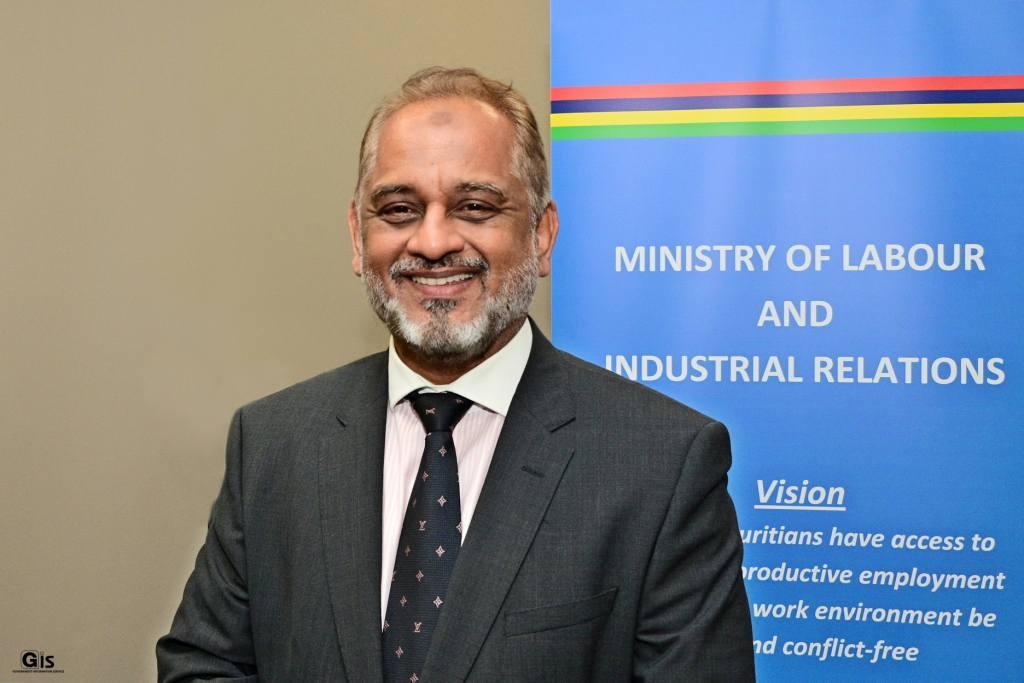
In an interview, Minister of Labour and Employment Reza Uteem addressed pressing issues such as wage compensation, union dissatisfaction, and the potential for a credit downgrade by Moody’s. He highlighted the government’s commitment to social justice while ensuring fiscal sustainability, particularly in light of the Pay Research Bureau report and upcoming labor law reforms set for 2026.
Africa-Press – Mauritius. In the wake of the Tripartite Committee’s recommendations on wage compensation and the release of the Pay Research Bureau (PRB) report, Le Mauricien met with Reza Uteem, Minister of Labour and Employment. He addressed union discontent, Moody’s potential sovereign credit downgrade, foreign labor policies, and upcoming labor law reforms. Throughout the interview, Minister Uteem emphasized a delicate balancing act—ensuring social justice while maintaining fiscal sustainability, all while preparing for major national initiatives in 2026.
You’re ending the year amid intense activity—wage compensation and the PRB report—yet unions remain dissatisfied. How do you respond?
When I assumed office at the end of last year, my ministry immediately introduced two key legislative bills: one on salary relativity to resolve a court dispute, and another on the 14th-month payment. So yes—we started the year at full speed, and we’re ending it the same way, with wage compensation and the PRB report.
But beyond the numbers, it’s crucial to understand that these decisions were made within a constrained economic context, inherited from a fragile fiscal situation, yet with a strong commitment to social cohesion. Our guiding principle has always been clear: protect the most vulnerable without jeopardizing macroeconomic stability.
On wage compensation, we held extensive tripartite meetings with unions and employer representatives. My ministry then submitted a report, after which the Prime Minister—as Minister of Finance—took over. He consulted social partners again before presenting a proposal to Cabinet.
Following input from the Ministry of Finance, the Financial Secretary, and the Prime Minister’s economic advisors, the government decided to grant wage compensation to all employees—public and private—earning up to Rs 50,000. We also extended this measure to pensioners, widows, orphans, and citizens over 60 receiving Income Support, recognizing their heightened vulnerability.
Regarding the PRB report, some civil servants are unhappy. Why?
The PRB is a fully independent body that issues recommendations every five years after consulting unions and civil servants. It’s normal that some groups are satisfied while others aren’t.
Dissatisfied parties can submit representations. Often, the PRB then issues an “Errors and Omissions” supplementary report to fine-tune its recommendations.
Given the economic and fiscal context—and after consultations with the Ministry of Finance—the Cabinet decided to implement 50% of the recommended increases from January 1, 2026, and 100% from January 1, 2027. This is a responsible compromise, balancing social fairness with financial sustainability.
Unions contest the official inflation rate of 3.7%. Is it truly reflective of reality?
The Statistics Bureau presented a detailed methodology explaining how inflation is calculated. They also shared Household Budget data: the average monthly expenditure for a household of two working adults and two children rose from Rs 43,400 to Rs 45,000—an increase of Rs 650–700, which aligns closely with the compensation granted.
Inflation is a weighted average of household consumption—not the price change of every individual item. It’s true that some imported goods have risen sharply, but we’ve taken concrete measures to contain overall inflation: stabilizing the rupee, reducing fuel prices, injecting over Rs 1 billion in food subsidies, and removing VAT on essential goods. These actions have helped keep inflation at 3.7%.
Without credible alternative data, we must rely on official statistics. The lower inflation we see is the direct result of these interventions.
How will you manage future union unrest?
Since taking office, I’ve maintained an open-door policy—always available to both unions and employers. Social dialogue remains central to avoiding unilateral decisions and balancing workers’ expectations with business realities.
I understand the disappointment, but this was a collective Cabinet decision, and I fully stand by it.
SMEs fear they can’t absorb higher wage costs. Will the government support them?
Employers raised legitimate concerns during tripartite talks. Some sectors—like construction or textiles—operate on fixed-price contracts and can’t pass on costs. Others worry about profitability or even survival.
The Ministry of Finance took these factors into account. It would be counterproductive to raise wages only to see workers bear the cost through higher prices or new taxes. This is a shared responsibility—between government, employers, and social partners.
Will SMEs receive specific support?
Absolutely. SMEs are the backbone of the Mauritian economy. A dedicated ministry supports them, and several schemes already exist. We’re also designing new support mechanisms to help them manage increased payroll costs.
Is Moody’s threat to downgrade Mauritius’s credit rating real?
Yes, it’s very real. The Prime Minister and DPM have met Moody’s representatives, who confirmed the downgrade risk remains high.
Another downgrade would severely limit access to international financing, increase borrowing costs, and discourage investment—not just sending a negative signal but actively hindering development.
Under the previous government, Mauritius was downgraded three times. The Ministry of Finance warned that implementing the full PRB increase in 2026 would trigger a downgrade. That’s why we opted for a phased approach: 50% in 2026, 100% in 2027.
Is the PRB a “social time bomb,” as some claim?
The PRB is independent and operates without political interference—despite rumors to the contrary. The Cabinet did not alter or censor its recommendations. We only staggered implementation for fiscal prudence.
Dissatisfied civil servants can choose not to sign the Option Form or submit formal representations.
What about the 14th-month bonus?
I would have liked the state to afford a 14th-month payment, but public finances don’t allow it. I understand workers’ expectations, especially with rising living costs.
However, some private-sector companies—particularly in banking and tourism—have posted record profits. I hope they will offer additional bonuses.
Are you calling on businesses to act responsibly?
Absolutely. I’ve always believed that workers are an asset, not a cost. Fairly compensated employees are more motivated, more productive, and directly contribute to business and national success.
Foreign workers now exceed 50,000. Why this surge?
There’s no fixed cap. The increase follows a revision of eligibility criteria based on an interministerial committee’s recommendations. We abolished the quota system, which unfairly burdened SMEs. Now, employers can hire foreign workers only if they prove local recruitment is impossible.
This reform has also reduced illegal foreign employment.
How is foreign recruitment regulated?
With support from the International Organization for Migration (IOM), we’ve strengthened legal safeguards. Employers now bear all recruitment costs—foreign workers no longer pay to come to Mauritius.
We’re also finalizing bilateral agreements with Madagascar, Bangladesh, Kenya, Ghana, and Pakistan.
Is forced labor still a concern in Mauritius?
Only one company was sanctioned by U.S. authorities based on complaints predating my tenure. Since then, no new forced labor complaints have been filed.
We’ve launched a multilingual migrant worker rights booklet and created a dedicated protection unit. We will be zero-tolerant of violations.
Is there a threshold for foreign workers to avoid social imbalance?
Even with over 50,000 foreign workers, they represent less than 10% of the active population. They enjoy the same rights as Mauritian workers. I’ve instructed law enforcement to crack down on employers hiring without permits.
The issue isn’t the number—it’s oversight, living conditions, and legal compliance. A key focus is housing: we’re replacing employer-linked dormitories with centralized, regulated housing meeting strict standards. For domestic workers, new rules will guarantee decent lodging and cooking facilities.
Mauritius is a nation of immigrants. With an aging population and shrinking workforce, we need foreign talent—not just in manual jobs but in AI, fintech, blue economy, renewable energy, and marine biology.
Foreign labor is essential, provided it’s planned and regulated—a core principle of our Vision 2050 immigration strategy.
You recently held the “Assises du Travail.” What’s next?
Yes—this was a first. Aligned with our commitments to the International Labour Organization (ILO), these forums aim to strengthen social dialogue and ensure reforms are inclusive and durable.
Is a new labor law in the works?
Indeed. Several electoral promises will be implemented in 2026:
40-hour workweek
Parental leave
Improved working conditions
Revised Workfare Programme
Better industrial dispute resolution
2026 will be a pivotal year for labor reform.
What are your 2026 priorities?
After focusing on foreign labor in 2025, 2026 will center on local employment:
Better job matching
Reducing skills mismatches
Improving access for the unemployed
We’re developing an AI-powered platform to directly connect workers and employers.
As MMM President, how is cohabitation within the governing alliance?
In a four-party alliance, disagreements are normal. What matters is rising above differences for the common good. All partners share the same goal: improving citizens’ lives and ensuring sustainable growth.
Final thoughts as we close 2025?
2025 was complex—many ministers serving for the first time, constrained by limited funding and the heavy economic legacy of ten years under the MSM.
But 2026 will be the year of relaunch:
New investments
Progress in energy—especially LNG
Construction start of the Rivière-des-Anguilles dam
Advancements in the port sector
A fresh start for Air Mauritius and Airport Holdings
I’m confident that 2026 will be the year of major national projects—building a more resilient economy and a fairer, more inclusive labor market.
Mauritius has faced economic challenges in recent years, particularly in balancing wage demands with fiscal responsibility. The Tripartite Committee’s recommendations and the Pay Research Bureau’s reports have sparked significant discussions about wage compensation and labor reforms. As the country approaches 2026, the government aims to implement changes that promote social equity while maintaining economic stability.
The labor market in Mauritius has evolved, with increasing reliance on foreign workers to address skills shortages and an aging population. Recent reforms have aimed to regulate foreign labor and ensure fair treatment for all workers. As the government prepares for major new