What You Need to Know
A new Agricultural Nature-Based Solution Project was launched in Cap Malheureux to enhance food security and promote sustainable practices among children in Residential Care Institutions. The initiative, led by the Ministry of Gender Equality and Family Welfare and the FAO, aims to provide practical agricultural knowledge and improve resilience against food insecurity.
Africa-Press – Mauritius. An Agricultural Nature-Based Solution Project was officially launched this morning at the Cap L’Espoir Residential Care Institution in Cap Malheureux.
This initiative is led by the Ministry of Gender Equality and Family Welfare, in partnership with the Food and Agriculture Organization (FAO) of the United Nations (UN) and the Ministry of Agro-Industry, Food Security, Blue Economy and Fisheries.
The launching ceremony was graced by the Minister of Agro-Industry, Food Security, Blue Economy and Fisheries, Dr Arvin Boolell, and the Minister of Gender Equality and Family Welfare, Mrs Marie Arianne Navarre-Marie. Also present were Members of Parliament, Mr Rameshwar Etwareea and Mr Nitish Sharma Beejan; the UN Resident Coordinator for Mauritius and Seychelles, Ms Lisa Simrique Singh; the WHO Resident Representative to Mauritius, Dr Abdou Salam Gueye; along with senior government officials and representatives of partner institutions.
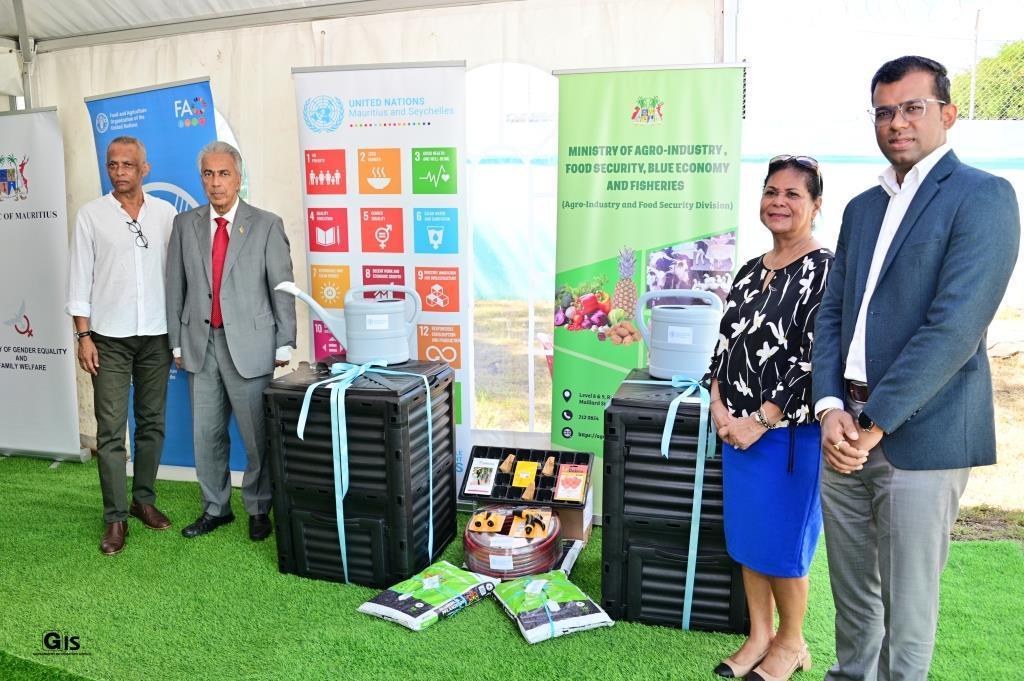
The programme also included the distribution of agricultural equipment to support the implementation of the project, alongside a symbolic tree-planting activity.
In her address, Minister Navarre-Marie emphasised that the project is designed to promote the holistic development, autonomy and well-being of children residing in Residential Care Institutions. She highlighted that beyond protection and shelter, the initiative seeks to provide a stable and nurturing environment conducive to personal growth, skills development and future social integration.
The Minister further underlined that the project also introduces sustainable practices such as aquaponics, organic farming, and rainwater harvesting. These initiatives, she said, equip children with practical agricultural knowledge and essential life skills. She added that such exposure fosters responsibility, confidence, discipline, and self-reliance, while also contributing to food security and healthier living.
Minister Boolell, for his part, highlighted that agriculture today must be approached through the lens of innovation, resilience and sustainability, stressing the importance of transitioning towards precision and climate-smart farming. He noted that initiatives of this nature demonstrate how modern agricultural practices can be effectively introduced at community level, particularly among young people.
He likewise emphasised that strengthening local production and reducing import dependency remain key pillars of Mauritius’ food security strategy. He moreover encouraged greater youth participation in agriculture, presenting it as a viable and forward-looking career path.
Ms Singh noted that small-scale, climate-smart initiatives such as this can make a meaningful contribution to reducing import dependency and strengthening food resilience at community level. She pointed out that globally, a substantial share of fresh produce is still lost in supply chains, underscoring the importance of developing localised systems within institutions.
During a tour of the garden at Cap L’Espoir Residential Care Institution, the dignitaries observed a variety of existing crops, including chilli, eggplant, Kermit eggplant, and bell pepper.
They were also briefed on the additional agricultural equipment provided under the project, which includes compost bins, garden hoses, fertilisers, and other essential tools intended to strengthen and further expand ongoing agricultural activities.
About the project
Mauritius is currently facing challenges linked to food import dependency, climate variability, and the need to modernise agricultural practices. Within this context, Residential Care Institutions, which rely significantly on external supplies, are particularly exposed to food insecurity.
The pilot project therefore seeks to provide a practical and replicable model to strengthen local food production and improve resilience within such institutions in the country.
Mauritius faces significant challenges related to food import dependency and climate variability, which threaten food security across the nation. Residential Care Institutions, which often depend on external supplies, are particularly vulnerable to these issues. This project aims to address these challenges by promoting local food production and sustainable agricultural practices, thereby enhancing resilience in these institutions and the wider community. By introducing innovative farming techniques, the initiative seeks to empower children with essential skills and knowledge for a sustainable future.