
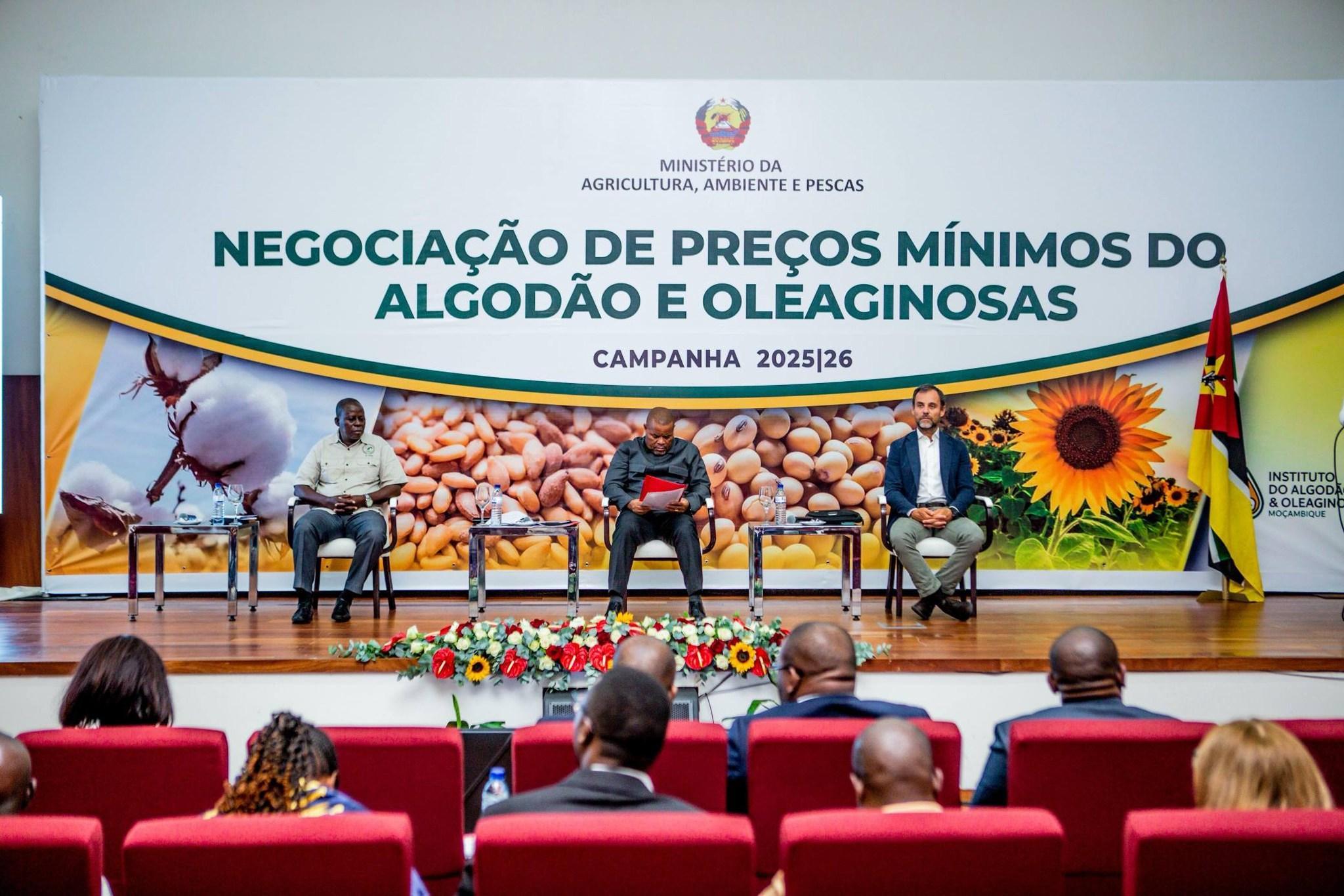
The price of cotton per kilogramme will rise by 22.7% in Mozambique during the 2025/2026 agricultural season, to 27 meticais (€0.36), the government announced on Friday, as it seeks to recover producers who abandoned the sector due to previous prices.
“The equation gave 26.5 [meticais per kilogramme] (…) but we saw it was possible to reach at least 27 meticais. We would like it to be much higher than that, but we will round it up to 27 meticais per kilo and the state, together with the industry, will find a mechanism to compensate producers for this additional half metical,” said Agriculture, Environment and Fisheries Minister Roberto Albino.
The minister was speaking in Maputo after a meeting to negotiate minimum prices for cotton and oilseeds for the 2025/2026 campaign, during which he said the government and private sector would cover the difference without resorting to the stabilisation fund, while calling for improvements in production through better seeds and appropriate technology.
“Producers are very sensitive to prices, so a reduction like last year’s was enough for us to immediately lose 30% to 40% of producers in the sector. Therefore, the government and the private sector decided to join efforts to begin recovering those who became discouraged so that they return,” the minister said.
According to the government, the new table sets the price at a 22.7% increase compared with the previous agricultural season, when first-grade cotton was priced at 22 meticais (€0.30) per kilogramme.
At the same meeting, minimum prices were also approved for sesame, which will now cost 70 meticais (€0.94) per kilo, 30 meticais (€0.40) per kilo for soybeans, 32 meticais (€0.43) per kilo for sunflower and six meticais (€0.08) per kilo for the cotton ginning rate. The proposals will be submitted to the Council of Ministers.
“The prices agreed here should serve as a mobilising and incentive instrument for production, aimed at increasing productivity, improving the income of producer families and strengthening the competitiveness and efficiency of the national agricultural sector,” the minister said.
Negotiations on minimum cotton prices now also include oilseeds, with the minister stating that these sectors involve more than 800,000 family producers across the country, including around 100,000 in cotton and 700,000 in oilseeds.
During the previous campaign, Mozambique produced 25,000 tonnes of seed cotton, with the participation of three concessionary companies, and more than 350,000 tonnes of various oilseeds across more than 140 districts, according to information presented by the government.
The president of the Mozambique Cotton and Oilseeds Association (AAM), Francisco Ferreira dos Santos, said a consensus had been reached on “balanced prices”.
“I think we have a basis to work from and I would like to appeal to all farmers to increasingly embrace this strategy of cultivating several crops (…) let us try to help one another by maintaining crop production, including cotton,” he told journalists.
Cotton exports, one of Mozambique’s main cash crops, falled to US$2.3 million (€2 million) in the first quarter of 2025, according to official data compiled last September. According to a statistical report by the Bank of Mozambique, with data from January to March 2025, this volume compares with the US$3.7 million (€3.1 million) exported during the same period in 2024, representing a year-on-year decline of 48%.
Mozambique accounts for less than 0.5% of global cotton production, in a market led by countries such as the United States, China and India.
The cotton production area in Mozambique increased from 95,097 hectares in 2023 to 96,523 hectares last year.