What You Need to Know
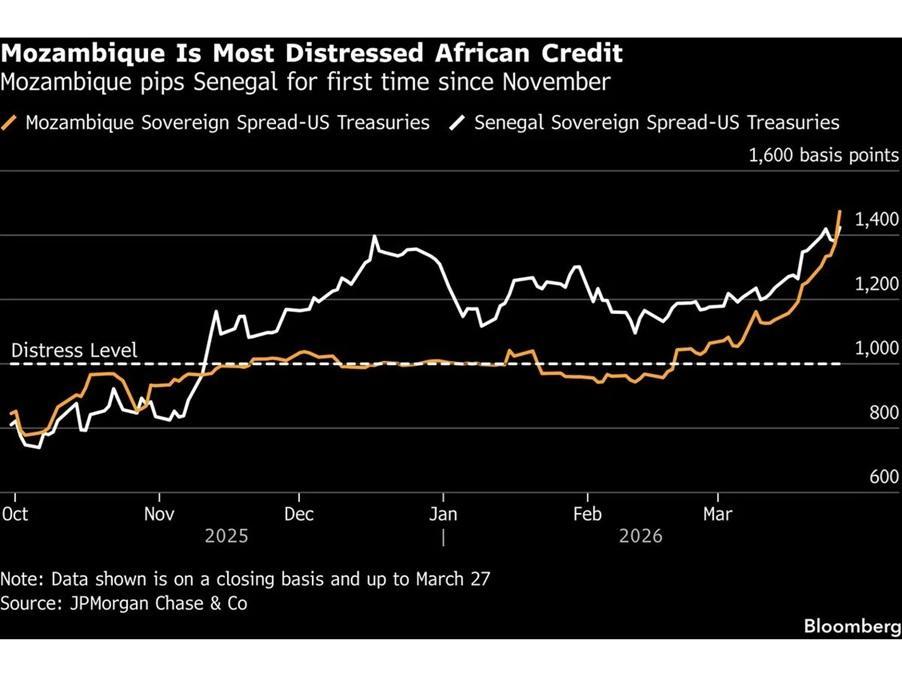
Mozambique has overtaken Senegal as Africa’s riskiest sovereign debt, with its yield spread reaching 1,473 basis points. The country’s financial struggles are exacerbated by the war in Iran, which has increased energy import costs. Mozambique’s bonds have seen significant losses, and its economic outlook remains bleak due to ongoing challenges with liquefied natural gas projects and foreign debt.
Africa-Press – Mozambique. Mozambique bonds have overtaken Senegal as Africa’s most distressed sovereign debt, as the war in Iran puts fresh strain on the country’s fragile finances.
The country’s sovereign yield spread, the extra premium that investors demand to hold its hard currency debt over Treasuries, rose to 1,473 basis points on Friday, according to data from a JPMorgan Chase & Co index. That’s above Senegal’s 1,423 points spread, the first time this has happened since November. Spreads wider than 1,000 basis points denotes distress.
Mozambique was in distressed territory even before the war started a month ago, due to debt-funded overspending and delays to its crucial liquefied natural gas (LNG) projects. But the prospect of higher energy and fertilizer import bills deepened the selloff, blowing out its yield spread by more than 400 basis points this month.
On Monday, its $900 million bond due 2031 extended losses into a 13th consecutive session to trade at 74.29 cents on the dollar, bringing its month-to-date slide to over 11 cents. The yield at 16.29%, effectively keeps it shut out from international debt markets.
The challenge for investors in Mozambique is that they “are buying a potential future LNG output which is far and is postponed every year,” said Romain Bordenave, portfolio manager at Edmond de Rothschild Suisse SA. Despite the sharp fall in the dollar bonds’ price, he will wait for a better entry point before buying, he said.
The conflict has forced investors to steadily reprice emerging markets risk, especially for energy-importers. But Mozambique’s performance has been the worst in emerging bond markets after war-torn Ukraine. It’s sharply underperformed the rest of Africa too, with the continent’s average spread over Treasuries 37 basis points wider in March to 387 basis points.
Senegal, which has been struggling to secure an International Monetary Fund program, saw spreads widen about 248 basis points.
Mozambique’s foreign exchange shortages could worsen due to the conflict and the closure of a key aluminium smelter, S&P Ratings said in a report Friday. Also, the government’s ongoing local debt exchanges are “tantamount to default,” it added.
While S&P expects Mozambique to continue making payments on its eurobond, it said this would hinge on progress on its gas projects.
Mozambique has faced significant economic challenges in recent years, primarily due to heavy debt burdens and delays in key infrastructure projects, particularly in the liquefied natural gas sector. The country’s financial instability has been compounded by external factors such as global market fluctuations and geopolitical tensions, which have strained its already fragile economy. As a result, Mozambique’s sovereign debt has become increasingly distressed, drawing investor concern and leading to wider yield spreads compared to other African nations.