Africa-Press – Mozambique. The regions affected by the “El Niño” weather phenomenon, in the southern Mozambican province of Gaza, have experienced unprecedented levels of rainfall during the current rainy season.
“El Niño” is a weather phenomenon, arising from anomalous warming of parts of the Pacific Ocean that often disrupts rainfall patterns, leading to periods of drought in southern Africa.
Data from Mozambique’s National Institute of Meteorology (INAM) shows that districts in northern Gaza, historically affected by the El Niño phenomenon and usually arid or semi-arid, received in just one week the equivalent of an entire rainy season’s rainfall.
The current rainy season, running from October to April, reversed a prolonged cycle of severe drought that had lasted for almost a decade.
According to climatologist Isaías Raiva, the districts of Massangena, Mabalane, Chicualacuala, Massingir, and Mapai recorded between 400 and 500 millimetres of rain in just seven days. These volumes correspond to the accumulated average of the entire rainy season in these parts of Gaza, during normal years.
“We are talking about very large, extreme rainfall, never before recorded at this level in the semi-arid areas of Gaza,” he said.
The scenario contrasts sharply with the reality since 2016, a period marked by a sharp drop in rainfall in the north of the province. Data from INAM, based on analyses of historical series, indicate a trend of progressive reduction in rainfall, aggravated by recurring El Niño episodes, responsible for prolonged droughts.
In recent years, accumulated rainfall has been below average, with long periods without any recorded rainfall during the rainy season. The result has been crop loss, animal deaths, and increased social vulnerability.
Now, the exceptional rainfall may come as a relief. Soil recovery, replenishment of water reserves, and pasture regeneration could boost agricultural production and livestock farming, the basis of the local economy.
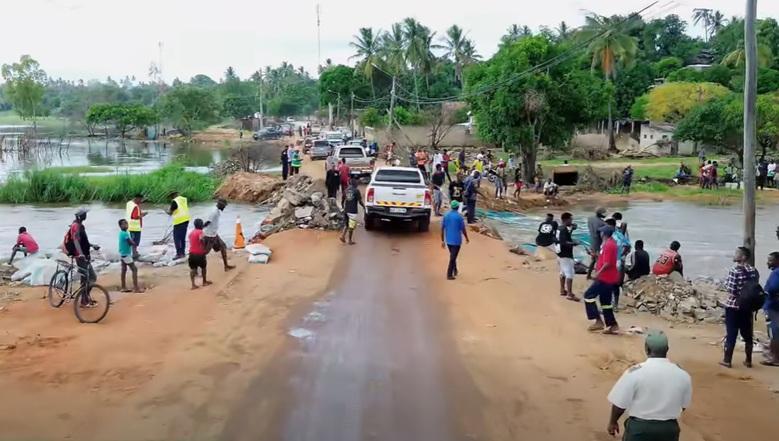
Even so, the phenomenon raises concerns. The intensity of the rainfall is already causing floods, soil erosion, and damage to infrastructure, especially in areas poorly prepared for extreme events.
Given this new climate pattern, Raiva calls for mitigation and adaptation actions. “We have to prepare communities to live with these changes, because the climate will not return to normal immediately”, he said.
The 2025 State Climate Report highlights changes, not only in rainfall, but also in other indicators, such as sea surface temperature and sea level.
Severe flooding hit Gaza in January, and again in March, and forced the temporary closure of about 240 companies.
According to the country’s Confederation of Business Associations (CTA), cited by the independent paper “O País”, the situation impacted over 3,000 workers.
“This number could still increase, as assessment of the damage is continuing in the affected districts. Of the total number of workers impacted, about 24 per cent have permanent contracts, while the remainder are seasonal”, says the CTA.
However, the full extent of the losses is still difficult to calculate, as many agricultural areas remain under water.
According to data updated on March 31 by the relief agency, the National Institute for Disaster Risk Management and Reduction (INGD), the current rainy season has already caused 309 deaths and affected approximately 1.06 million people across the country, since October.