What You Need to Know
In Mozambique, the street charcoal trade remains a vital source of income for families like Rute Manhica’s, who have relied on it for decades. Despite the rise of gas as an alternative energy source, many continue to sell charcoal to support their households, facing challenges of low sales and rising costs.
Africa-Press – Mozambique. In the bustle of Benfica, Maputo, since 1991 Rute Manhiça has been turning sacks of charcoal into bread, schooling and a future for her four children, an effort that has allowed her to see some of them graduate, although the business is now under threat from gas.
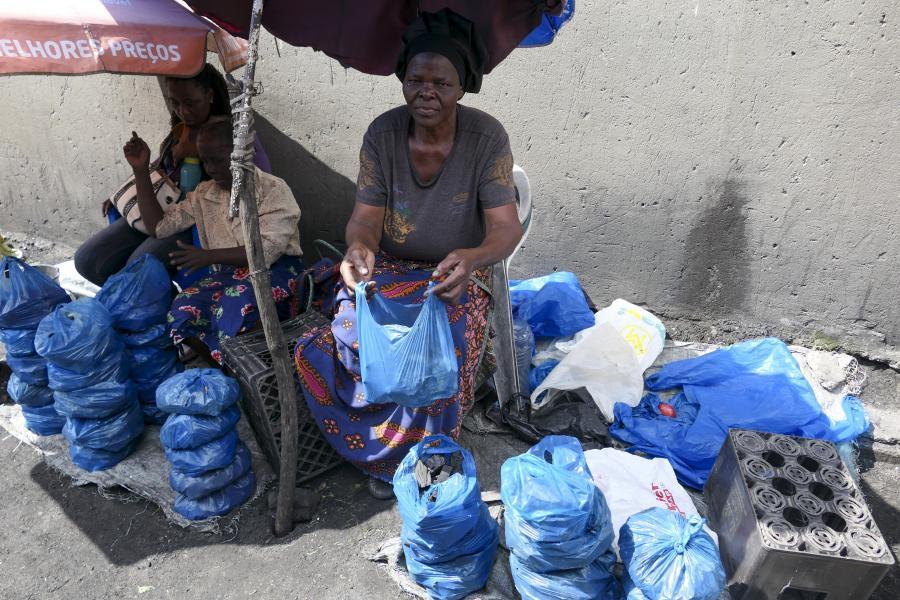
Amid the black dust covering the ground of the narrow street where four stalls sell charcoal in plastic sacks, in front of a busy road and surrounded by shacks and small businesses, Rute, 60, tells Lusa she began selling there after being invited by friends already working in the trade.
Selling charcoal on the street, which remains a domestic energy source for the majority of the population, is just one of many activities feeding Mozambique’s informal economy, which, according to official estimates, employs more than 13 million people, from trade to agriculture, and accounts for more than a quarter of Mozambique’s Gross Domestic Product (GDP).
These figures mean little to Rute, who saw the street business 35 years ago as a way of feeding her family, symbolising Mozambican resilience in the face of hardship.
“I was invited by my friends to sell here, so that I could support my children. My husband worked, but he earned little,” she says, recalling the difficulties she faced in starting the trade due to a lack of money.
Every day, Rute opens her stall at 07:30 and only packs away the sacks of charcoal at 19:00, when the day already weighs heavily on her hands and body, in a routine repeated daily since 1991, always marked by early starts, long hours in the street’s bustle, and the quiet endurance of someone who has turned the passing of time into a daily commitment to family survival.
After her husband’s death, Rute became responsible for supporting the family, and the small business became the sole foundation for her children’s survival, ensuring daily food and, over time, enabling investment in education and improved living conditions.
“When my husband passed away in 2001, I was able to send my children to school. They studied, some even earned doctorates,” she says.
Despite low earnings and the many times she has considered giving up, she recalls the past with a nostalgic expression, when the product was linked to her greatest achievements.
“What I did here with charcoal that was most important was building part of my house, because it used to be a thatched house, but now it is a block house, although it is not big, and I also built a bathroom,” she says proudly.
Speaking of these achievements, Rute acknowledges that the present no longer matches the past, at a time when daily effort does not always translate into sales or income.
“Now people don’t buy anymore. People have become modern; they have gas, they have electric stoves. Even here where I am, I haven’t even sold 300 meticais [about four euros] since I arrived this morning,” she laments, recalling that in the past she could make up to 2,000 meticais (26.8 euros) a day, while today she is grateful when she returns home with around 500 meticais (six euros).
She admits she feels she has no alternative to the charcoal business, a job in which she no longer sees a future and which she would leave if another opportunity arose, at a time when she says she sees no way out or prospects for change.
“Nowadays it is very difficult; I can only afford to eat. Sometimes I go home to sleep without eating because people are not buying,” she says bitterly.
Next to Rute’s stall, Lina Manhiça, 64, follows a similar routine that began a year after her neighbour, in 1992, making a living from selling charcoal in a job that started as a means of survival and has continued over the years, accompanying the changes in the Benfica neighbourhood.
“What brought me here to sell charcoal was the war situation. I left Marracuene and came to stay here,” she explains, adding that adapting to the business was made easier by the presence of other women already selling charcoal in the area.
Also a widow and mother of four, Lina found in charcoal the only support for raising and sustaining a household, in a path marked by continuous work and quiet resilience.
“When we sell and make a profit, we teach our children so they can study,” she tells Lusa, stressing that charcoal income is still essential for food and for building the home where they live: “The house where I live, I built it myself with this charcoal.”
With tired eyes and hands marked by years of labour, Lina complains about the difficulties of the business and the impact of rising charcoal prices: “Sometimes charcoal becomes expensive.”
But she quickly stresses the persistence of someone who remains in the same place despite rising costs: “We do not give up, we are here. And now charcoal is also expensive, 2,200 meticais [29.49 euros] to get charcoal, but we are here so we can earn money for bathing and food.”
“Now we cannot earn money, but before we did have money, we could build houses,” she says, explaining that sales no longer allow savings, as each sack takes days to sell and what little comes in is consumed by daily family food expenses.
The charcoal trade in Mozambique has been a significant part of the informal economy, providing livelihoods for millions since the end of the civil war in the 1990s. As urbanization and modernization increase, the reliance on charcoal as a primary energy source has been challenged by the growing availability of gas and electric stoves, impacting traditional sellers’ incomes and sustainability.
Women like Rute and Lina have turned to charcoal sales as a means of survival, often becoming the primary breadwinners for their families. Their stories reflect the resilience of Mozambicans in adapting to economic changes while striving to provide for their children through education and improved liv