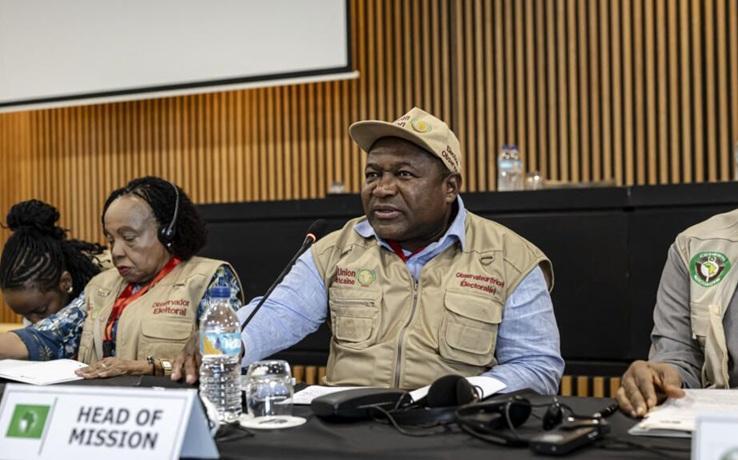
Africa-Press – Mozambique. Former President of Mozambique Filipe Nyusi, head of the African Union (AU) observation mission for the elections in Guinea-Bissau, stated today that there are election results and a “winner” of the vote, which ended amid a coup d’état, and that these results “must be published.”
“In Guinea-Bissau, the elections went well and there is a winner. Or, to be more modest, there are results. And these results must be published,” said Nyusi, former Mozambican President (2015–2025), who led the AU observation mission on the ground, quoted by Rádio Moçambique.
Nyusi criticised the failure to publish the election results in Guinea-Bissau, saying: “It cannot be avoided. Why is it being avoided? Why was it accepted to hold elections there? Because at the moment the ballot boxes were closed and sealed, after the voting ended, there was no such problem. So, there are results that must be published.”
Fernando Dias, a presidential candidate claiming victory in Guinea-Bissau’s elections, called on the National Electoral Commission (CNE) on Wednesday to convene a plenary session to announce the election results “as soon as possible.”
In a statement seen by Lusa on social media, Fernando Dias da Costa’s campaign responded to the CNE’s announcement on Tuesday that it was unwilling to continue the electoral process or publish the results of the legislative and presidential elections held on 23 November, citing alleged vandalism at its offices.
The CNE, through its deputy executive secretary, Judge Idriça Djaló, stated at a press conference that it “is completely unable to continue and conclude the electoral process” due to the alleged vandalism, damage to equipment, and confiscation of regional tally sheets.
According to Djaló, the alleged acts were carried out by “armed and hooded men” on 26 November, the day before provisional results were due to be announced.
Fernando Dias da Costa’s campaign, currently exiled at the Nigerian embassy in Bissau, condemned the “illegal stance” of the CNE’s executive secretariat, accusing it of “usurping the powers” of the plenary session, which it argued should have been convened to discuss the process.
Therefore, the candidate demands the convening of the CNE plenary session and the publication of results “as soon as possible to respect the popular will expressed at the polls.”
Guinea-Bissau has been suspended from ECOWAS and the African Union following the coup d’état on 26 November, when a High Military Command took power, removed President Umaro Sissoco Embaló—who fled the country—and suspended the electoral process.
The general elections, both presidential and legislative, had taken place without incident on 23 November. The following day, opposition candidate Fernando Dias, supported by the historic PAIGC party (excluded from the elections), claimed victory in the first round over President Embaló.
On the eve of the official results announcement, a shooting in Bissau preceded the military takeover, with the High Military Command appointing General Horta Inta-A as transitional president.
The general announced that the transition period would last a maximum of one year and named Ilídio Vieira Té, a former minister under Embaló, as prime minister and finance minister.
On Saturday, a new transitional government was sworn in, including members of the deposed administration and five military officers among the 23 ministers and five secretaries of state.
During the coup, PAIGC leader Simões Pereira was detained, and the military takeover is being denounced by the opposition as a manoeuvre to prevent the publication of election results.