Africa-Press – Namibia. The need for stronger economic cooperation was among the key challenges highlighted during the 11th session of the Namibia–Russia Intergovernmental Commission on Trade and Economic Cooperation in Windhoek yesterday.
This push comes in the face of global uncertainty and growing threats to international peace.
Addressing the opening, Namibia’s chief diplomat and international relations and trade minister, Selma Ashipala-Musavyi, said the current geopolitical environment has created uncertainty across the world, making cooperation between countries more important than ever.
“The world is characterised by uncertainty more than ever before. International peace and security are under immense threat,” she said.
Ashipala-Musavyi said diplomatic engagement and partnerships between countries are crucial to maintaining stability and promoting development.
“In Namibia, we believe it is our collective responsibility as friends and as part of the global community to bring about a safer world for both the present and future generations,” she said.
The minister noted that the meeting between Namibia and Russia forms part of efforts to strengthen cooperation and address shared challenges through economic partnerships.
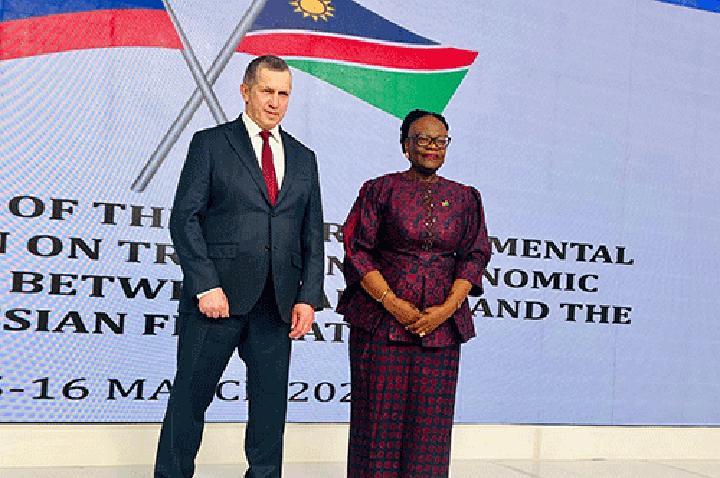
The session was co-chaired by Ashipala-Musavyi and Russian Deputy Prime Minister Yury Trutnev, who is also the presidential envoy to the Far Eastern Federal District.
“We hold today the 11th session of the Intergovernmental Commission to, among others, review progress made after the 10th session, but it is also an opportunity to come up with new areas of potential cooperation,” she said.
Ashipala-Musavyi continued that the recently held Namibia–Russia business forum held last week created new momentum for trade and investment between the two countries. “I believe the business forum, which brought together a broad spectrum of our business people, has added new impetus to our mutual desire to take our bilateral cooperation on trade and investment to the next level,” she said.
The minister also encouraged greater engagement between businesses from both countries and invited Russian investors to explore opportunities in Namibia’s priority development sectors.
She said these sectors include agriculture, youth empowerment, education and training, creative industries, health, land, housing and sanitation. “These priority areas are very important to the upliftment of the living standards of our people,” she said. One of the proposals discussed during the business forum was the establishment of a fertiliser manufacturing plant in Namibia to support agricultural development.
“The fertiliser plant will not only reduce costs, but it will also boost agricultural production and increase output for those farming at the subsistence level,” she said.
She added that increased agricultural production could help Namibia reduce its dependence on imported food and position the country to export both food and fertiliser to other African countries under the African Continental Free Trade Area.
The minister also highlighted progress in several agreements between the two countries, including a draft agreement on cooperation and mutual administrative assistance in customs matters and ongoing collaboration in geology and mining. “There are many more legal instruments pending, and I urge all stakeholders, especially our senior officials, to expedite the finalisation of all outstanding cooperation frameworks,” she said.
From Russia
Meanwhile, Trutnev described Namibia as an important partner for Russia on the African continent and emphasised the long-standing political ties between the two countries.
“Today Namibia is a reliable partner of Russia on the African continent. Our common view on most international issues allows us to effectively coordinate foreign policy steps on the world stage,” he said.
He also pointed to the historic cooperation between the two nations, noting that many Namibians received their education in Russia.
Trutnev said trade between the two countries has been growing but still remains below its full potential.
He said bilateral trade grew by 2% in 2024 to reach 11.7 billion rubles and increased by a further 56% in 2025 to reach 18.4 billion rubles.
“Obviously, these figures do not correspond to the full potential of our cooperation,” he said. He said expanding cooperation in key sectors such as mining, nuclear energy and fisheries could significantly strengthen economic ties.
Trutnev also said Russia is ready to work with Namibia on projects related to uranium development as well as nuclear technology and medicine.
“We are planning not only to mine uranium but also to prepare joint projects in the field of nuclear energy and medicine,” he said.
He added that Russian companies have experience building nuclear power plants in several parts of the world and are prepared to share their technology and expertise.
For More News And Analysis About Namibia Follow Africa-Press