Africa-Press – Namibia. In the quiet village of Gibeon, some 100km south of Hardap’s regional capital, Mariental, survival for most elderly residents rests squarely on the monthly old-age pension grant.
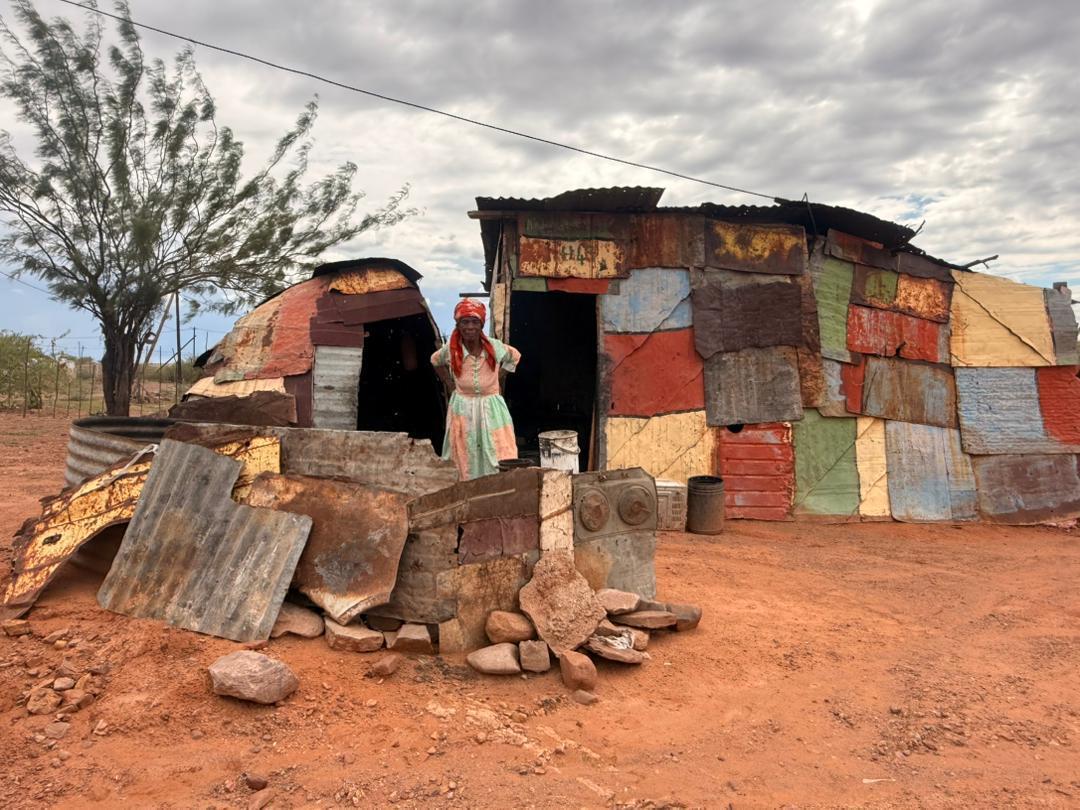
Driving through the settlement, one of the first things that stands out is a small, colourful house assembled from rusted pieces of corrugated iron, some of them seemingly cut from old metal drums. The patchwork structure, standing on the dry reddish soil typical of southern Namibia, reflects both creativity and hardship. The house consists of uneven metal sheets fastened together to form two small rooms, with a separate round shack nearby also built from salvaged materials.
In front of the dwelling lies a fireplace, while a lone tree provides limited shade from the harsh unforgiving sun.
Standing at the entrance is Welhimina Boois, a pensioner who has lived here for years. She explains that the government pension grant is her main source of income and what keeps her household going.
“I receive my pension on time. That is what I use to take care of myself and my brother’s son who stays with me,” she says.
The elderly woman adds that the man is the only person who assists her with daily chores around the house. “Sometimes days go by and we have nothing to eat,” Boois says.
Despite her own struggles, she offered this reporter a cup of tea as a gesture of hospitality. However, she apologised that she had no sugar to add, a small detail that illustrates the daily challenges faced by many elderly residents living in rural communities. The country’s old-age pension grant currently stands at N$1 600 per month for citizens aged 60 years and older.
National statistics show that more than 250 000 elderly Namibians depend on the social old-age pension as their primary source of income. For many households, particularly in rural villages such as Gibeon, the grant often supports not only the pensioner but also extended family members, including grandchildren and unemployed relatives. Boois says the recent rainfall in the south has brought mixed feelings.
“The rain is good for the farmers. But for me it is difficult because when it rains, the house leaks and everything inside gets wet.”
The patched metal roof of her home struggles to keep out the rain, leaving bedding and belongings exposed to water during heavy downpours.
Even with these challenges, Boois remains grateful. “But I am happy to be alive,” she says quietly.
Last year, finance minister Ericah Shafudah has proposed the allocation of N$7.2 billion towards the social grants’ management programme.
The programme aims to improve the payout systems for social grants during the 2025/26 financial year. “Investment here supports automation, efficiency and the delivery of social protection to the most vulnerable, reinforcing the government’s commitment to equity and inclusive growth,” she said at the time.
The social grants to be disbursed during the year were broken down as – old age grants (N$3.7 billion), funeral benefits (N$47.8 million), conditional basic income grant (N$65.8 million), vulnerable grants (N$877 million), foster care grants (N$36.9 million), maintenance grants (N$417 million), disability grants for adults, 16 and above (N$955 million), and disability grants for minors, under 16 (N$152 million).
Before his death in 2024, president Hage Geingob had promised to increase the old age pension to N$3 000 by the time he leaves office.
However, successive finance ministers and presidents have taken a cautious approach in fulfilling this dream.
This year, the old age pension was increased by N$100 to N$1 700 during the current financial year. [email protected]
For More News And Analysis About Namibia Follow Africa-Press